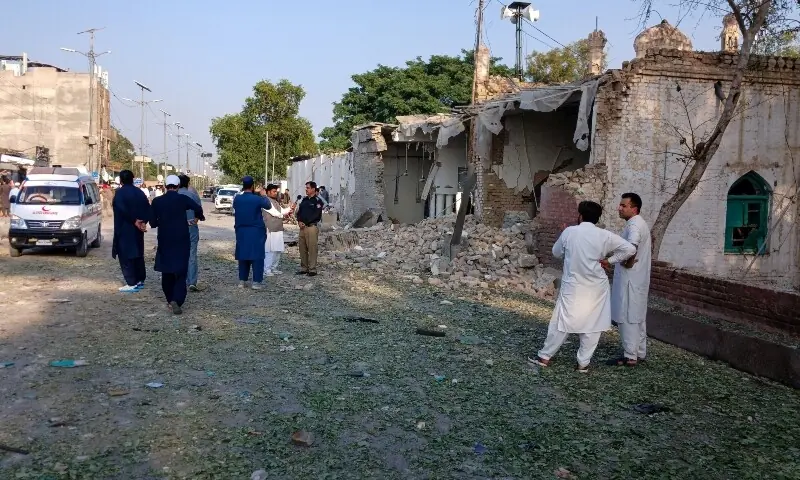
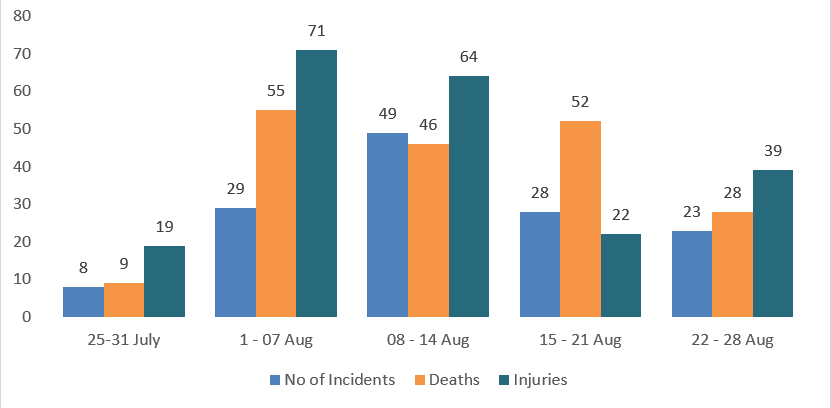
During the week of 22–28 August 2025, militant activity declined with 23 attacks compared to 28 the previous week, leaving 28 dead—including 12 security personnel and 13 civilians—and 39 injured. Erstwhile FATA remained the most affected region with nine attacks, followed by five each in KP and Balochistan, three in Sindh, and one in Gilgit-Baltistan. The attacks included nine targeted strikes, eight tactical assaults, three IED blasts, two grenade attacks, and one quadcopter strike. Although security agencies anticipated possible high-profile attacks in Balochistan around Nawab Akbar Bugti’s death anniversary, enhanced measures prevented such incidents. Security forces also carried out seven operations, killing eight militants and arresting eight others, including six alleged RAW facilitators.
Authorities in Bajaur have begun facilitating the phased return of displaced residents to villages cleared in Lowi Mamund tehsil, with six declared free of militants so far. The gradual, village-by-village clearance strategy may allow militants to slip away and return later, making sustained security measures and community involvement essential to deny them future footholds.
Major General Noor Wali Khan has been appointed Additional Secretary in the Interior and Narcotics Control Division, replacing senior PSP officer Sohail Habib Tajik. The unusual appointment of a military officer reflects Interior Minister Naqvi’s plan to strengthen coordination between civil armed forces and the military in counterterrorism operations. While it highlights concerns over the military’s growing role in civilian affairs, it could also improve intelligence-sharing and operational effectiveness amid intensified campaigns in KP and Balochistan.
PTI lawmakers have resigned from key parliamentary committees and announced a boycott of upcoming by-elections on Imran Khan’s instructions, signaling a decisive turn toward confrontation. The move follows sweeping convictions of PTI leaders linked to the May 9 riots, which the party denounces as victimization. While some leaders favor reconciliation, Khan insists on protests, legal battles, and boycotts to frame his struggle internationally as state repression. This strategy could mobilize his support base and attract global attention but also risks deepening party rifts and raising political costs.
Pakistan and Bangladesh signaled a reset in ties during Ishaq Dar’s landmark visit to Dhaka, the first in over a decade. Six agreements were signed covering trade, media, culture, and diplomacy, alongside initiatives such as the Pakistan–Bangladesh Knowledge Corridor. Discussions on trade access, shipping routes, and possible air links added momentum, with Pakistan also engaging opposition leaders to project balance. While sensitivities rooted in 1971 remain, shifting regional dynamics and India’s tensions provide space for pragmatic cooperation, though the trajectory depends heavily on Bangladesh’s upcoming elections. India–Pakistan relations have grown more tense amid disputes over water, military posturing, and diplomacy. Pakistan accused India of breaching the Indus Waters Treaty by bypassing the bilateral commission to send flood warnings, calling it a “new normal.” Islamabad also alleged India was “weaponising water” by abrupt dam releases that worsened flooding inPunjab. Meanwhile, Indian Defence Minister Rajnath Singh stressed that future wars would be prolonged and technology-driven, raising new concerns in Pakistan. Adding to uncertainty, U.S. President Donald Trump nominated Sergio Gor as ambassador to India and special envoy for South and Central Asia, unsettling New Delhi, which rejects being grouped with Pakistan in Washington’s policy.
Violence surged in Iran’s Sistan-Baluchestan, where Jaish al-Adl killed five police officers in an ambush on August 22. Iranian forces responded with sweeping operations, killing nearly 20 militants in multiple districts. Against this backdrop, Pakistan’s Army Chief Asim Munir and Iran’s military chief Abdolrahim Mousavi held a call on August 27, pledging to strengthen border security and transform it into a zone of “friendship and development.” Both sides appear willing to cooperate against militants, but the real test lies in whether pledges translate into joint actions against Baloch separatists straddling the border.
Pakistan–Afghanistan relations have entered a new phase of strain, with Islamabad frustrated at the Taliban’s refusal to act against TTP and Baloch militants while pressing ahead with Afghan deportations under the Illegal Foreigners Repatriation Plan. Drone strikes in Nangarhar and Khost on TTP hideouts caused civilian casualties, drawing Kabul’s condemnation. The killing of 50 Afghan TTP fighters in Balochistan reinforced Pakistan’s claims of Taliban sheltering militants, while the UN warned of ISKP’s rising regional threat. Although Taliban Defence Minister Mullah Yaqoob called for reconciliation, mistrust dominates as Pakistan intensifies military action and refugee crackdowns, Kabul resists CT demands, and China cautiously seeks to mediate—leaving ties fragile and uneasy.
To get access to the complete report please become a subscriber. For the details of subscription please Click Here