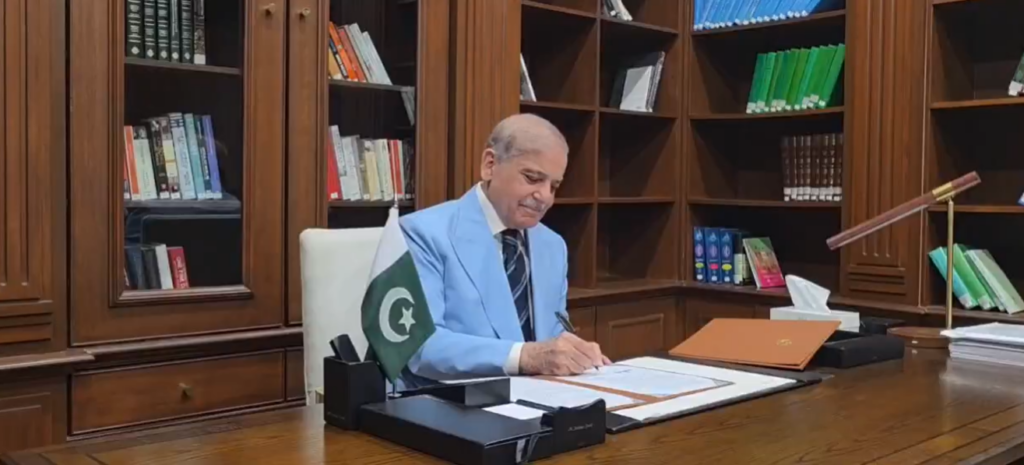
In the early hours of a June morning in 2026, the world exhaled. After more than 100 days of conflict that threatened to engulf the Middle East and choke global energy supplies, the United States and Iran reached a framework agreement — the 14-point Islamabad Memorandum of Understanding. Electronic signatures from President Donald Trump and his Iranian counterpart formalized the end of active hostilities, the lifting of the naval blockade, and the full reopening of the Strait of Hormuz. Prime Minister Shahbaz Sharif has also signed the document as official mediator.
What made this possible was not the usual roster of great-power brokers. It was Pakistan — a nation long stereotyped in global headlines for its internal security challenges — that stepped forward when prospects looked bleakest and delivered the most consequential peace framework in recent memory.
The road was never straightforward. When the conflict erupted, Iran responded with barrages of missiles and drones that struck Gulf infrastructure, provoking fury among Pakistan’s closest Arab partners. Riyadh, Abu Dhabi, and others watched with alarm as their energy facilities and sovereignty came under direct threat. Islamabad faced an excruciating dilemma: condemn the strikes on its Arab brothers — which it did, forthrightly — while simultaneously refusing to abandon its neighbor Iran to unilateral escalation. Most capitals would have chosen sides or stayed silent. Pakistan chose the harder path of persistent engagement with everyone.
That choice carried real risk. Pakistan’s strategic partnership with Saudi Arabia, sealed by a landmark mutual defense agreement, its deep economic ties across the Gulf, and its “all-weather” relationship with China all stood to suffer if the mediation was perceived as naïve or one-sided. Yet Islamabad calculated correctly that its unique geography, history, and relationships gave it an irreplaceable role. No other country combined a long border with Iran, Major Non-NATO Ally status and personal rapport with Washington, and the trust of Beijing and Riyadh simultaneously.
The reciprocity was poetic. Exactly one year earlier, President Trump had helped pull India and Pakistan back from the brink of a dangerous South Asian confrontation that carried nuclear overtones. In 2026, Pakistan returned the favor on a vastly larger canvas. A closure of the Strait of Hormuz — through which roughly one-fifth of global oil transits — would have triggered worldwide recession, food and energy crises from Europe to East Asia, and unpredictable escalation involving multiple nuclear-armed states. By helping keep that chokepoint open and converting a fragile April ceasefire into a durable framework, Pakistan arguably prevented a far more devastating global conflict.
The architecture of success rested on three pillars of Pakistani leadership. Prime Minister Shahbaz Sharif provided the political vision and public legitimacy, repeatedly offering Islamabad as neutral ground and absorbing domestic political heat for engaging Tehran. Field Marshal Syed Asim Munir, through relentless back-channel diplomacy and personal credibility with both President Trump and Iranian commanders, kept negotiations alive during multiple near-collapses. Deputy Prime Minister and Foreign Minister Ishaq Dar coordinated the day-to-day shuttle diplomacy, managed messaging with Gulf capitals, and ensured the process never lost momentum even when Washington and Tehran traded public barbs. Together they turned Pakistan’s perceived liabilities — its security environment, its complex alliances — into diplomatic currency.
This was a masterclass in balancing. Pakistan maintained its principled positions: it condemned attacks on Iranian territory and leadership, just as it condemned Iranian strikes on Gulf civilian and energy infrastructure. It hosted the highest-level direct US-Iran engagement in decades in Islamabad. It worked quietly with Qatar, Türkiye, Egypt, and China while reassuring Saudi Arabia that its core interests would not be sacrificed. Few capitals possess either the access or the discipline to walk such a tightrope without falling.
The dividends are already visible and will compound rapidly. With the Hormuz crisis resolved and sanctions dynamics shifting, the long-stalled Iran-Pakistan gas pipeline — Iran’s section already complete — can finally advance. Construction on the Pakistani side is expected to resume in earnest, delivering much-needed energy security, easing pressure on domestic gas shortages, and unlocking billions in bilateral trade potential. Broader economic confidence is returning: investors who fled the threat of regional war are reassessing Pakistan’s stability premium. Diplomatic capital earned in Washington, Beijing, Riyadh, and Tehran can now be deployed to accelerate other connectivity projects and attract fresh financing.
Yet the true test lies ahead. The 60-day window to negotiate a final, comprehensive agreement will test implementation discipline on nuclear confidence-building, sanctions relief sequencing, and regional de-escalation. Pakistan’s interest lies in seeing this framework succeed, because sustained peace in its western neighborhood directly serves its own security and economic revival.
The larger lesson is strategic. In an era of great-power competition and proxy conflicts, middle powers with credible access across rival camps can still shape outcomes. Pakistan demonstrated that a country facing serious internal challenges can nevertheless project disciplined diplomacy when its leadership aligns political will, military professionalism, and institutional memory. The same qualities that enabled this breakthrough — restraint, persistence, and the refusal to be boxed into zero-sum choices — can now be applied to Afghanistan stabilization, regional energy corridors, and a more confident Pakistani role in global forums.
History will record the Islamabad Memorandum not merely as an end to one war, but as proof that principled, high-risk diplomacy by unexpected actors can still bend the arc of crisis toward peace. Pakistan took that risk when few others would. The world, and Pakistan itself, are already better for it.
The writer serves as Managing Director at Pakistan Institute for Conflict and Security Studies (PICSS) an Islamabad-based think tank