By Ahmed Rauf
Sometimes, a single incident can alter the trajectory of an already fragile situation. The September 18 Kohat attack appears to have done precisely that. Coming at a moment when several diplomatic channels were active between Pakistan and Afghanistan, the attack not only intensified the security confrontation between the two countries but also exposed divisions within the militant landscape operating around the Pakistan-Afghanistan conflict.
The timing is significant. In the weeks preceding the attack, diplomatic engagement had remained active despite persistent tensions. From August 30 to September 5, Chinese Special Envoy for Afghan Affairs Yue Xiaoyong visited Pakistan and Saudi Arabia for consultations, including discussions with Pakistani officials. On September 1, Afghan Ambassador Sardar Ahmad Shakib addressed the National Defence University in Islamabad, emphasizing the deep interdependence of Pakistan and Afghanistan and arguing that their security and economic interests were closely interconnected. Most significantly, on September 16–17, Türkiye’s intelligence chief Ibrahim Kalın travelled to Kabul and Kandahar before visiting Islamabad, where he met senior Pakistani officials. Turkish and other regional reporting described the visits as part of efforts to maintain dialogue and address tensions between Islamabad and Kabul.
It was against this backdrop that the Kohat attack occurred.
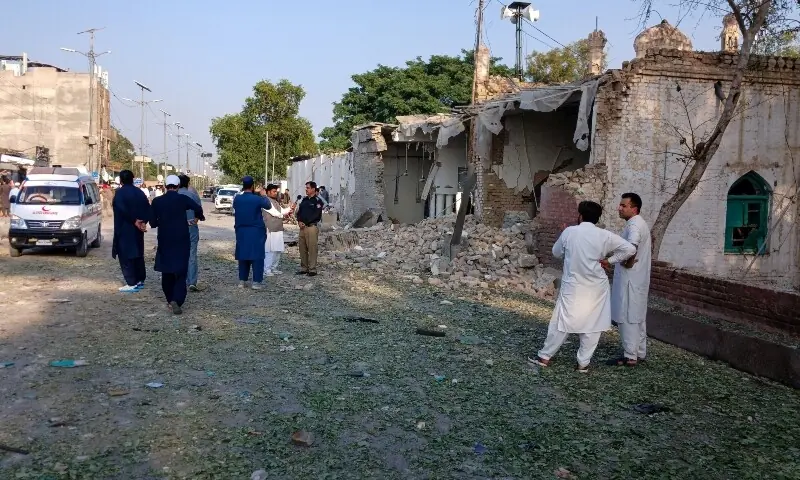
On September 18, a suicide bombing and armed assault targeted the old Police Lines complex in Kohat, Khyber Pakhtunkhwa, during Friday prayers. The attack involved an explosives-laden vehicle followed by an armed assault on the compound. The death toll subsequently rose to at least 31, with more than 100 people reported injured, including police personnel.
The significance of the attack, however, lies not only in its scale but also in what followed.
The assault was subsequently attributed to the Hafiz Gul Bahadur faction within the Ittehad-ul-Mujahideen Pakistan (IMP) network. What immediately drew attention was the pattern of communication surrounding the claim. The claim appeared through IMP’s Pashto-language media channel, while its principal Urdu- and English-language platforms did not publicly associate themselves with the operation. Such a divergence does not, by itself, prove an organizational split, but it raises an important question: was the Kohat attack carried out with the consent of the wider IMP alliance, or did one of its constituent factions act independently?
Subsequent reporting and militant messaging suggest that the operation was not universally accepted within the alliance. Harkat Inqilab-e-Islami Pakistan (HIIP) and Lashkar-e-Islam were reportedly not aligned with the operation, while Al-Qaeda in the Indian Subcontinent (AQIS) publicly condemned the targeting of a mosque and other public places. AQIS described such attacks as wrong and expressed regret over the casualties, particularly those resulting from the assault on the mosque.
This is important because the disagreement appears to concern more than the immediate choice of target. It points towards a broader tension between the operational priorities of individual militant factions and the strategic or ideological calculations of actors within the wider militant ecosystem. If the Hafiz Gul Bahadur faction was able to conduct a major operation without broader consensus, the episode raises questions about how cohesive IMP actually is and how much control its different constituents exercise over one another.
The pattern becomes even more significant when the response of other militant organisations is considered.
Several groups operating in Pakistan went out of their way to deny involvement in the Kohat attack. Tehreek-e-Taliban Pakistan publicly denied responsibility, while other militant actors also distanced themselves from the incident. The Afghan Taliban’s spokesperson, Zabihullah Mujahid, subsequently condemned the attack. The repeated denials matter because militant organisations do not ordinarily distance themselves from violence without reason. The central question, therefore, is not simply who carried out the attack, but why so many other actors were unwilling to be associated with it.
One explanation lies in the political environment surrounding Afghanistan. Several militant organisations maintain relationships, ideological affinities or operational links with actors based in Afghanistan, while the Afghan Taliban government itself remains under pressure over Pakistan’s allegations that militant groups use Afghan territory to conduct attacks inside Pakistan. Kabul has consistently rejected the accusation that it allows its territory to be used against Pakistan. At the same time, Afghanistan remains economically and geographically dependent on access through its neighbours, including Pakistan. The Afghan Taliban therefore has an interest in avoiding a further deterioration of relations with Islamabad, particularly at a time when diplomatic channels were beginning to reopen. Shakib’s remarks at the National Defence University reflected precisely this emphasis on interconnected security and economic interests.
This provides one possible explanation for the unusually visible distancing from the Kohat attack. Factions that maintain closer political or strategic relationships with the Afghan Taliban may have had an incentive to avoid being associated with an operation that could further complicate Kabul’s already strained relationship with Islamabad. This should not be treated as definitive proof of their motives, but the timing of the denials makes the possibility difficult to ignore.
There is also a second layer to the denials. The nature of the attack itself may have created an ideological problem for some militant organisations. The assault took place during Friday prayers and caused substantial civilian casualties. AQIS’s subsequent displeasure indicates that at least some actors within the broader militant environment regarded the targeting of worshippers and public places as strategically. The disagreement, therefore, may reflect both political calculations and differences over acceptable targets and methods.
The Kohat attack consequently exposed a paradox within the militant landscape. A faction capable of conducting a major and highly destructive operation may possess considerable operational autonomy, while other factions retain enough ideological or political influence to publicly reject the method or timing of such an operation. The result is not necessarily a clean organisational split, but rather a more fragmented militant environment in which different groups may pursue different strategic calculations.
The consequences were not confined to the militant sphere.
Three days after the Kohat attack, Pakistan carried out airstrikes in Afghanistan’s Kunar and Paktika provinces. Pakistan said the strikes killed 28 militants, while Afghan authorities and the United Nations reported three civilian deaths. The strikes ended roughly three months of relative calm and immediately brought the broader Pakistan-Afghanistan confrontation back into focus.
The sequence is significant. An attack inside Pakistan was followed by Pakistani military action inside Afghanistan, demonstrating how quickly militant violence can become intertwined with the interstate relationship. For Pakistan, the strikes represented a response to what it considers militant sanctuaries across the border. For Kabul, they represented a violation of Afghan sovereignty. The competing narratives therefore reinforce the very security dilemma that diplomatic efforts had been attempting to contain.
The escalation continued. On September 23, Pakistani security sources reported that eight drones launched from the Afghan side entered Pakistani airspace and were intercepted, with four reportedly downed near Torkham and four in the mountainous areas near Kohat. Afghanistan disputed Pakistan’s account of the incident. On September 24, Pakistan announced precision aerial and drone strikes against ten locations inside Afghanistan that it said were being used to launch or store drones. Strikes in Gurbuz District of Afghanistan’s Khost Province targeted camps and positions used by the Gul Bahadur Group. The targets included the group’s Gulano Camp, along with locations in the Ismail Khel and Mandozai areas. Pakistani authorities said the targets were military objectives directly linked to the attempted attacks.
The speed of this escalation demonstrates how the consequences of the Kohat attack have moved beyond the original incident. What began as a militant operation has become part of a rapidly expanding cycle involving militant factions, the Afghan Taliban, Pakistani security forces and cross-border military action.
The Kohat attack may therefore prove to be more than an isolated militant incident. It has exposed questions about the cohesion of IMP, highlighted differences among militant organisations over targets and tactics, and disrupted an already fragile effort to manage Pakistan-Afghanistan tensions through diplomacy. Most importantly, the subsequent sequence of retaliation reflects the very type of wider political and military consequences that AQIS warned against when it expressed displeasure over the attacks on mosques and public places.
The immediate trajectory remains uncertain. But if cross-border retaliation continues, the conflict could increasingly move beyond the previous pattern of militant attacks and limited military responses towards a more sustained cycle of asymmetric pressure and interstate confrontation. The Kohat attack has therefore demonstrated not only the destructive capacity of militant factions, but also how a single operation can disrupt diplomatic openings, expose fractures within militant alliances and trigger consequences far beyond the location where it began.
The writer is Ahmed Rauf, a graduate of Defence and Strategic Studies from Quaid-i-Azam University, Islamabad, and is currently an intern at the Pakistan Institute for Conflict and Security Studies (PICSS)