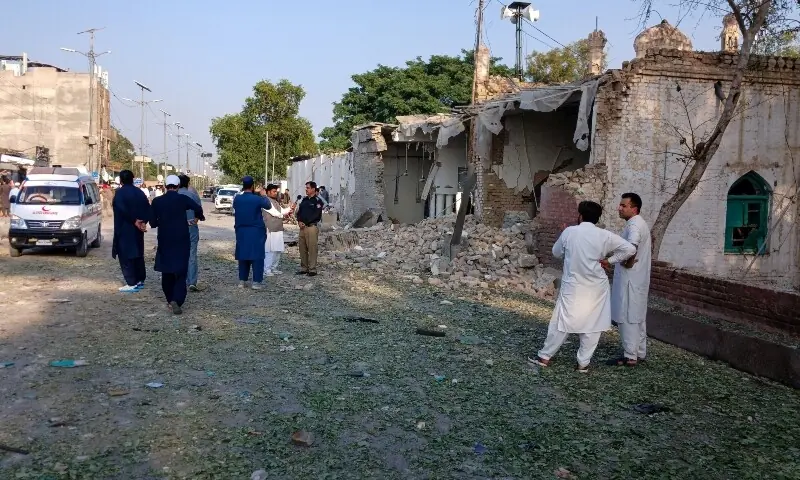
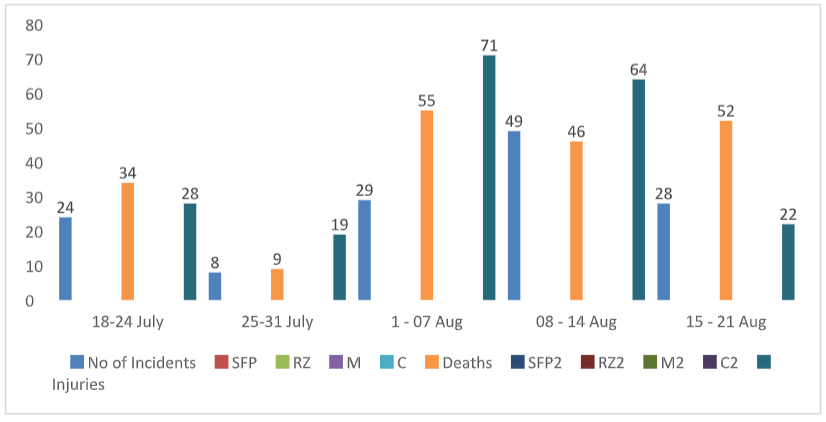
During 15–21 August 2025, militant activity declined nationwide, with 28 attacks
recorded versus 49 the previous week. Despite fewer incidents, fatalities rose to 52, including
30 militants, 15 civilians, and seven security personnel, while injuries fell to 22. KP saw 12
attacks, followed by nine in erstwhile FATA, five in Balochistan, and one each in Punjab and
Sindh. Incidents included targeted killings, tactical assaults, IEDs, grenade attacks, kidnappings,
and a quadcopter attack. Security forces conducted 10 intelligence-driven operations,
neutralizing 21 suspected militants and detaining seven others.
In Balochistan, Section 144 was extended from 16–31 August, restricting pillion riding,
masks while riding, and gatherings over five people. Citizens criticized the impact on daily life.
Security forces foiled a major BLA plot on 14 August, allegedly involving the Majeed Brigade and
facilitated by Dr. Usman Qazi, a government-employed professor linked to past attacks.
Investigations now cover 2,000–2,500 government employees through a special
counterterrorism cell. Meanwhile, the High Court ordered restoration of mobile internet
services, overturning a 15-day suspension, though partial compliance is likely around Nawab
Akbar Bugti’s death anniversary on 26 August.
Between 16–21 August, a curfew was imposed in 24 Mamond tehsil areas, Bajaur,
following targeted operations. Residents faced strict movement restrictions. Local leaders,
including JUI-F, demanded halting the operation and safe return of displaced families. In Lower
Dir, elders pledged cooperation with police but warned against militant activity. A multiparty
conference of 20 parties (excluding PTI) called for democracy, constitutional supremacy,
abolition of illegal armed groups, and flood relief. Despite criticism, the federal government
maintains military action is necessary to counter militants in KP. Floods and rains have
temporarily limited operations, though targeted strikes reportedly continued, with full
operations expected once conditions improve.
Since 21 July, Gilgit-Baltistan traders have protested the suspension of Khunjerab Pass
trade under the Pak-China Tajeer Etihad Action Committee. Demands include clearance of 280
stranded consignments, tax exemptions, trade incentives under the 1985 border agreement,
and a one-time amnesty for delayed shipments. Clashes in Sost Valley escalated tensions,
prompting a shutter-down strike by Sost Bazaar Association. The government’s reluctance to
engage risks prolonged unrest along this CPEC route.
Pakistan’s economy faces reform pressures, financial stabilization, and a state-led digital
push. The IMF urges SBP independence, including removing government oversight from its
board, ahead of the September review mission. Fitch Ratings forecasts banking sector
improvement, citing easing inflation, lower policy rates, and rising private-sector lending, with
GDP expected to reach 3.5% by FY27. The Pakistan Digital Authority was established under the
Digital Nation Bill to oversee nationwide digital transformation, signaling recognition of
governance and technology as pillars of resilience.
On 20 August, the Senate passed the Anti-Terrorism Amendment Bill, allowing
preventive detention of suspects for up to three months, with judicial oversight and a three-
year sunset clause. Provisions include joint investigation teams comprising police, intelligence,
and armed forces. Once signed by the President, the law will strengthen legal authority for
counterterrorism operations and coordinated intelligence gathering, reflecting the
government’s focus on security in KP and Balochistan.
Pakistan’s political landscape shows a mix of confrontation and cautious engagement.
COAS Asim Munir reaffirmed the military’s defensive role, though reports of informal
overtures—denied by ISPR—suggest potential reconciliation with PTI. Imran Khan’s party
balances defiance, nominating Mahmood Khan Achakzai as National Assembly Leader of the
Opposition, with conciliation via Azam Khan Swati’s Senate nomination. The government is
open to procedural talks but not May 9 accountability, while Deputy PM Ishaq Dar dismissed
constitutional amendment rumors. Supreme Court bail grants in eight May 9 cases add cautious
optimism, suggesting a careful negotiation process.
The federal government reversed its decision to relocate Madni Masjid near Rawal Dam
Chowk, agreeing to rebuild it at the original site after pressure from JUI-F and allied clerics. A
four-day agreement pledges reconstruction within four months under CDA supervision, while
denying plans to demolish other mosques. The reversal, while highlighting susceptibility to
religious pressure, aimed to prevent escalation that could be exploited by TTP and other
extremist groups amid ongoing KP operations.
The HRCP report highlights rising violence against minorities, including targeted killings,
demolitions, forced conversions, and underage marriages. Two blasphemy suspects were killed
while seeking police protection. Hate speech has intensified, and bar associations increasingly
align with extremist groups. While progress was noted with the Child Marriage Restraint Act
2025 and provincial centres against violent extremism, HRCP calls for urgent reforms, including
an independent minorities commission, improved police training, seminary oversight, and
federal inquiry into blasphemy-related entrapments.
India’s successful test of the nuclear-capable Agni-5 missile, with MIRV and future
bunker-busting capabilities, signals strategic assertiveness after the May 2025 skirmish and
Pakistan’s Army Rocket Force Command. Pakistan countered India’s claims of aerial victories
and emphasized national restraint. Concurrently, India banned bilateral sporting ties with
Pakistan but allowed multilateral participation, maintaining symbolic distance while leaving
limited controlled interaction.
During Chinese FM Wang Yi’s visit on 21 August for the Pakistan-China Strategic
Dialogue, both countries reaffirmed their “iron-clad and all-weather partnership.” Meetings
with Pakistan’s civil and military leadership focused on CPEC Phase-II, trade, ICT, agriculture,
regional security, counterterrorism, and protection of Chinese nationals. The engagements
signal continued strategic alignment, robust security collaboration, and China’s support for
Pakistan’s sovereignty, stability, and development.
Afghanistan pursued diplomatic and economic engagements, appointing Don Brown as
U.S. Chargé d’Affaires ad interim and signing electricity agreements with Uzbekistan to import
800–1,000 MW. Wang Yi visited Kabul to discuss security, regional stability, economic
cooperation, and BRI integration. The sixth Pakistan-China-Afghanistan trilateral meeting
emphasized counterterrorism and economic cooperation, though tensions remain over TTP and
BLA presence. Islamabad demands verifiable action, while Kabul accuses Pakistan of supporting
opposition activities. On the Taliban’s fourth takeover anniversary, Supreme Leader Mullah
Hibatullah Akhundzada ordered ministers to drop “acting” titles, solidifying the government’s
permanence and signaling unalterable control.
To get access to the complete report please become a subscriber. For the details of subscription please Click Here