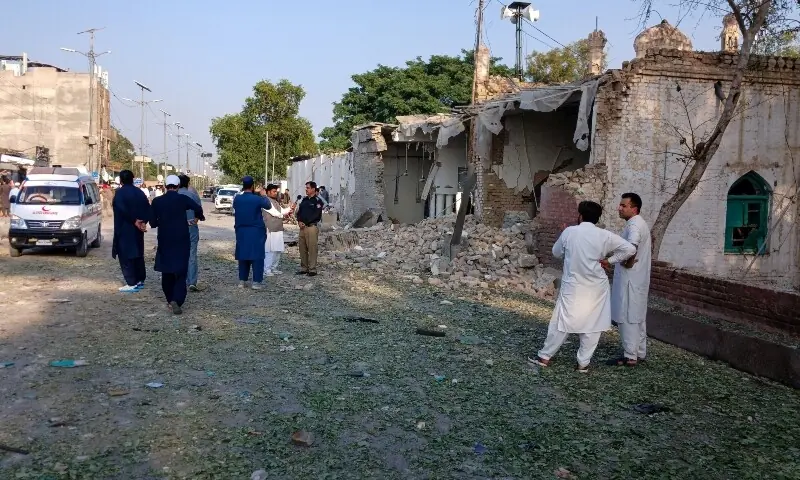
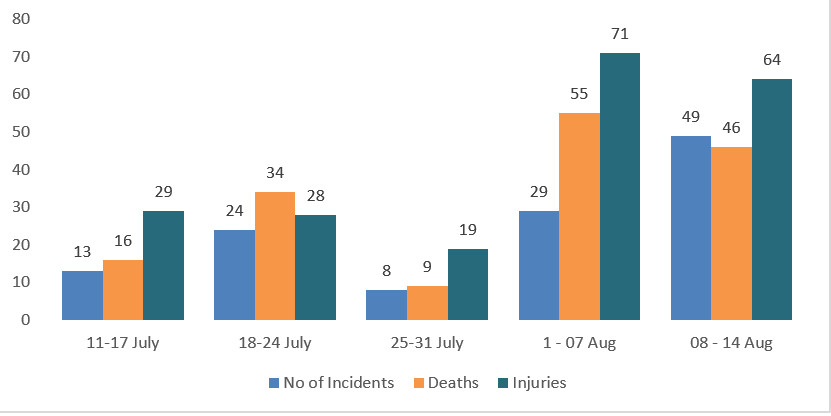
During the week under review, militant violence in Pakistan rose sharply, with 49 recorded attacks compared to 29 the previous week, leaving 46 dead—24 security personnel and 19 civilians—and 64 injured, including 44 security officials. Most incidents occurred in Khyber Pakhtunkhwa (20), erstwhile FATA (15), Balochistan (13), and Sindh (1). Tactics ranged from assaults (20) and targeted killings (12) to IED blasts (8) and grenade attacks (4). Security forces conducted 13 operations, killing 55 suspected militants and arresting seven. Preventive measures, such as mobile internet shutdowns and night travel bans, helped secure Independence Day events in Balochistan, though KP remained volatile.
On the eve of Independence Day, TTP launched 13 coordinated gun and grenade attacks across seven KP districts—Upper and Lower Dir, Shangla, Peshawar, Bajaur, Bannu, and South Waziristan—killing six policemen and injuring nine. Targeting police facilities, the strikes mirrored Baloch militant tactics to project instability, deliberately timed to overshadow celebrations. The wide geographic spread underscored TTP’s operational reach and sought to divert attention from Bajaur operations and anticipated action in North Waziristan.
The National Assembly passed amendments to the ATA 1997, restoring provisions allowing law enforcement and armed forces to detain “suspicious” individuals for up to three months on “sufficient grounds” to prevent terrorism. The law, valid for three years, allows Joint Interrogation Teams and requires detainees to be produced before a magistrate within 24 hours. The bill passed 125–59 after replacing “reasonable suspicion” with “sufficient grounds.” Critics warn it risks political misuse and violates fundamental rights, having been rushed through despite opposition protests.
On August 11, security forces resumed Operation Sarbakaf in Bajaur’s Lowi Mamund after peace talks between TTP and local jirga collapsed, prompting a three-day curfew in 27 villages. Backed by gunships and artillery, the offensive so far displaced over 20,000 families. Separate tribal jirgas pledged not to shelter militants, and reports of foreign fighters were met with government refusal to grant safe passage. While normalcy partly returned by August 13, civilian casualties sparked protests and demands to lift curfews. The government seeks a decisive outcome to set a precedent for similar operations, though terrain and local dynamics may slow progress.
The CDA’s late-night demolition of Madni Mosque near Rawal Dam in Islamabad on August 9, reportedly part of a relocation agreement, triggered protests from clerics claiming only the seminary—not the mosque—was to be moved. JUI-F and allied groups accused the government of targeting mosques while ignoring other encroachments. Lal Masjid cleric Maulana Abdul Aziz’s call for jihad and civil disobedience raised fears of unrest akin to the 2007 Lal Masjid standoff. The government insists the mosque was illegal, cleared in management’s presence, and replaced with a new facility. Observers warn the dispute could trigger further tensions. Moody’s upgraded Pakistan’s credit rating from Caa2 to Caa1 with a “stable” outlook, citing fiscal consolidation, better tax collection, subsidy cuts, lower interest rates, and narrowing deficits under an IMF-backed program. While Fitch and S&P issued similar upgrades, Pakistanremains below investment grade with $50 billion in repayments due by FY2026. The SBP echoed cautious optimism but warned that high debt, inflation, and structural inefficiencies threaten gains without sustained reforms.
An anti-terrorism court sentenced PTI leaders Dr Yasmin Rashid, Omar Sarfraz Cheema, Mian Mehmoodur Rasheed, and Ejaz Chaudhry to 10 years in prison in May 9 violence cases, while acquitting Shah Mehmood Qureshi. PTI called the verdicts politically motivated. Reports suggest backchannel talks between PTI and the government, with most PTI lawmakers supporting dialogue despite Imran Khan’s reluctance. Party divisions persist between hardliners abroad and moderates seeking political space, with Qureshi’s possible release seen as pivotal.
PM Shehbaz Sharif announced the Army Rocket Force Command on August 13 to enhance long-range conventional strike capabilities, possibly learning from from the May war with India, India’s missile defence advances, and plans for development of an Agni-V bunker-buster variant.
The US designated the BLA and its suicide wing, the Majeed Brigade, as Foreign Terrorist Organisations—a step Pakistan hailed as a diplomatic win and plans to advance at the UN. This coincided with COAS Asim Munir’s second US visit in six weeks, high-level meetings, and an August 12 Counterterrorism Dialogue, where both sides pledged to combat BLA, ISIS-K, and TTP, strengthen cooperation, and explore economic ties. US praise for Pakistan’s CT role and economic cooperation offers hint at deepening engagement.
The PCA’s ruling on the Indus Waters Treaty reinforced Pakistan’s right to unrestricted use of western rivers and limited India’s hydroelectric scope. India rejected the decision as illegitimate, while Pakistani leaders vowed strong retaliation against any attempt to restrict flows. India-Pakistan war once again attracted the headlines after India’s Air Chief claimed to have downed Pakistani jets in May, a claim Pakistan dismissed as fabricated. These developments come amid warming Pakistan–US ties in addition mounting political pressure from opposition on ruling BJP and the PM Modi.
Pakistan–Azerbaijan relations have grown stronger, particularly after the Azerbaijan–Armenia conflict, with enhanced defence and economic cooperation. During his visit to Pakistan, Azerbaijan’s First Deputy Defence Minister Karim Valiyev met COAS Field Marshal Asim Munir to discuss security and defence collaboration, where Munir welcomed Azerbaijan’s peace deal with Armenia and Valiyev awarded him the Patriotic War Medal for advancing military ties. Separately, President Asif Ali Zardari met the Azerbaijani ambassador to promote trade, connectivity, and direct air links, while expressing gratitude for Azerbaijan’s support on the Kashmir issue.
To get access to the complete report please become a subscriber. For the details of subscription please Click Here