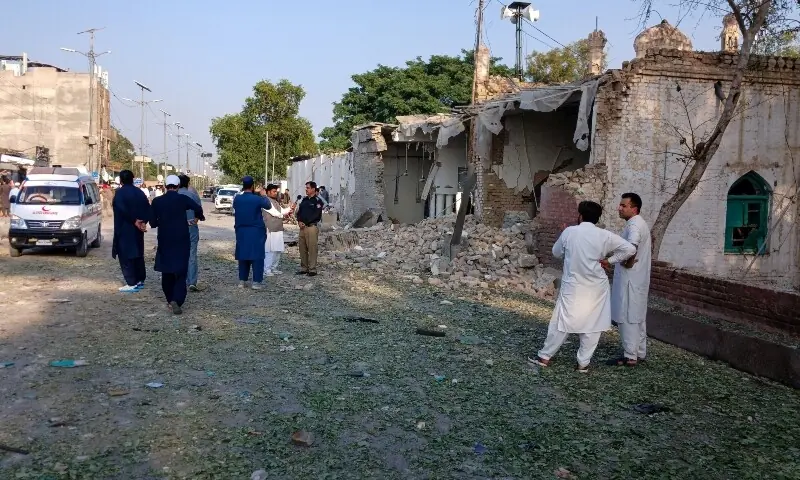
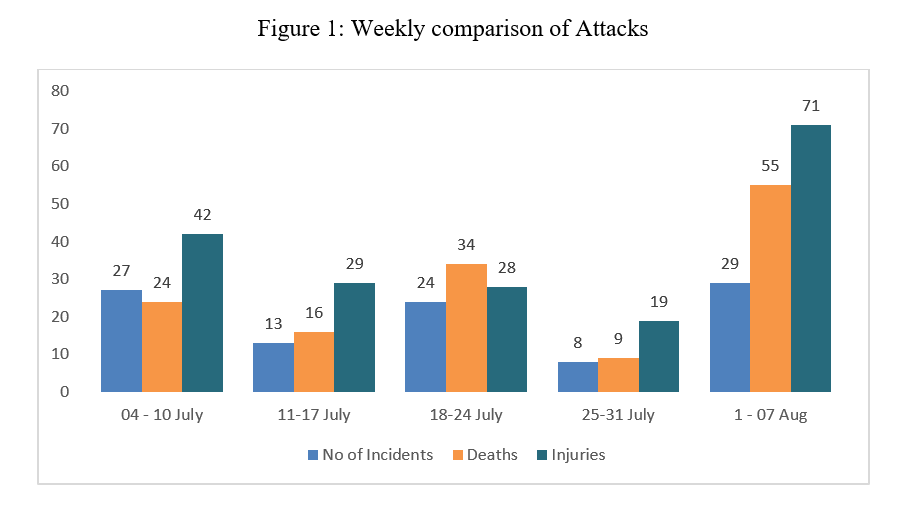
During the week under review, Pakistan saw a sharp spike in militant violence, with 29 attacks resulting in 55 deaths (including 20 security personnel and 16 civilians) and 71 injuries. Most attacks occurred in Khyber Pakhtunkhwa, followed by Balochistan, Punjab, and Sindh. Methods included IEDs, targeted killings, tactical assaults, drone and mortar strikes, and a kidnapping. Security forces responded with three intelligence-based operations, killing six and arresting four suspects. The Balochistan government has suspended mobile data services across the province until August 31 due to security concerns, fearing that militants could misuse these networks for coordination. This move, following a recent ban on Pakistani pilgrims traveling by road to Iran and Iraq, reflects broader security measures amid a deteriorating law and order situation. The timing suggests authorities anticipate intensified militant activity around Independence Day, a period historically marked by Baloch insurgent attacks on security forces and civilians celebrating national events.
The government also launched a cyber crackdown against militant groups like the TTP, BLA, BLF, and ISKP, targeting their presence on Telegram, WhatsApp, and X. Following appeals to global platforms, ministers reported 481 terror-linked accounts were identified and blocked, severely disrupting militant propaganda and communications. Despite this, TTP and Baloch insurgent activity persisted during the week.
Situation in tribal belt remained volatile with various jirgas and negotiations were held. Some conditional agreements were reached, though the TTP continued to resist key demands such as vacating civilian areas. While KP Chief Minister Gandapur advocated direct dialogue, militants’ rigidity and entrenchment raised the risk of future military escalation. The federal government maintained a dual approach of selective operations and grassroots engagement.
Parliament passed the Pakistan Land Port Authority Bill 2025 to streamline trade and security at land borders. Once enacted, Pakistan will join India and Bangladesh in establishing a dedicated body to coordinate cross-border trade, reduce smuggling, and enhance infrastructure. The bill passed after PPP-backed amendments, and the new 16-member council will oversee implementation.
On August 2, the Pakistan Army inducted Chinese Z-10ME attack helicopters, enhancing battlefield capability with advanced radar and precision-strike features. Overseen by COAS Field Marshal Asim Munir, the induction underscores Pakistan’s deepening military ties with China despite recent U.S. engagement. Both COAS Munir and CJCSC General Mirza reaffirmed military solidarity with China during PLA anniversary events, echoed by Ambassador Jiang Zaidong’s praise for Pakistan’s regional role.
On August 5, Pakistan launched a voluntary repatriation plan for over 1.3 million undocumented Afghans under the IFRP, citing security and economic concerns. KP led implementation with transit points and jirgas. While Pakistan claimed the effort aimed at legal regulation, the UNHCR warned it could breach refugee norms. The Taliban FM’s planned visit was postponed due to a denied UNSC travel exemption, though Islamabad attributed it to technical reasons.Also on August 5, Pakistan observed Youm-i-Istehsal to mark six years since India revoked Jammu and Kashmir’s special status. The day featured nationwide events, parliamentary resolutions, and international outreach affirming support for Kashmir’s right to self-determination. Political and military leaders condemned India’s actions and warned of strong retaliation to future aggression. The situation intensified with Israeli PM Netanyahu’s admission that Israel supported India in Operation Sindoor, using drones and missiles against Pakistan—deepening Pakistan’s concerns over Indo-Israeli strategic alignment.
Iranian President Masoud Pezeshkian’s visit to Pakistan from August 5–7 signaled a push to boost bilateral ties following the Iran-Israel conflict. Talks focused on counterterrorism and increasing trade to $10 billion, despite sanctions and border issues. Twelve MoUs were signed in various sectors, and plans to revive long-stalled projects like the Joint Economic Commission and rail links were discussed. Parallel U.S. engagement—including a call between FM Dar and Secretary Rubio, and a likely visit by COAS Munir—highlighted Pakistan’s diplomatic balancing act. Though the stalled Iran-Pakistan gas pipeline wasn’t publicly addressed, quiet negotiations likely occurred to resolve arbitration concerns.
On August 4, Ukrainian President Zelensky alleged that foreign mercenaries—including Pakistanis—were fighting for Russia near Kharkiv. Pakistan’s Foreign Office dismissed the claim as baseless and requested clarification. While official involvement seems unlikely, concerns persist about non-state actors like the banned Zainabiyoun Brigade, previously active in Syria, potentially being drawn into the Ukraine conflict. This raises alarms over the exploitation of vulnerable youth for proxy wars and calls for greater responsibility from Pakistani Shia leaders to prevent such mobilization.
To get access to the complete report please become a subscriber. For the details of subscription please Click Here