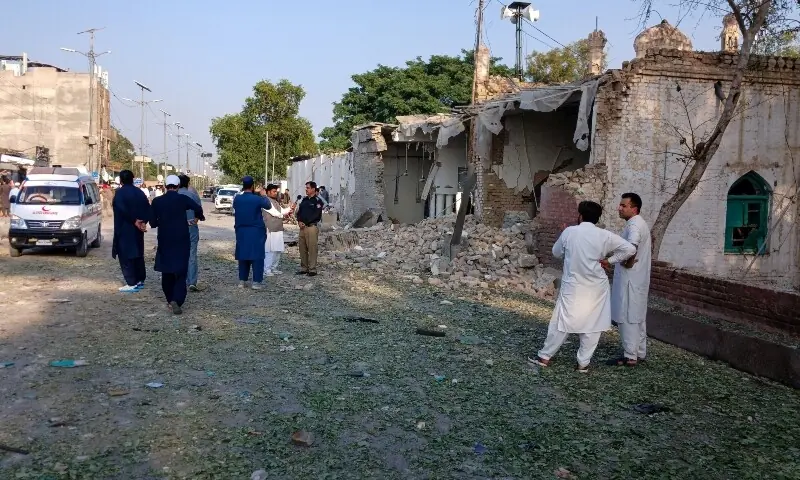
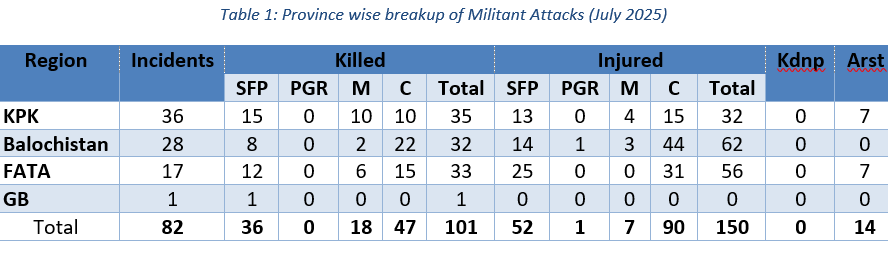
In July 2025, Pakistan witnessed a slight increase in militant violence, with 82 reported attacks resulting in 101 fatalities and 150 injuries. The majority of this violence remained concentrated in Khyber Pakhtunkhwa (mainland and tribal districts) and Balochistan, together accounting for 99% of all incidents. While KP’s mainland and Balochistan saw notable increases in attacks and casualties—33% and 40% respectively—the erstwhile FATA region experienced a 35% decline in violence. Despite this relative dip, the human toll of both militancy and counterterrorism operations remained high. A total of 35 operations were conducted nationwide, killing 106 militants and arresting 69, but also causing civilian casualties—particularly in FATA, where seven civilians were killed. The uptick in both militant and counter-militant activity underscores growing instability in Pakistan’s conflict-prone regions.
Adding to regional security challenges, developments in Bangladesh revealed the presence of Tehrik-e-Taliban Pakistan (TTP) sympathizers. Arrests of militants with links to TTP and other regional groups signal a dangerous expansion of transnational jihadist networks. Investigations into ties between Bangladeshi militants and the Kuki-Chin National Front (KNF) point to possible coordination across South Asia, raising alarm over the TTP’s growing ideological and logistical reach.
Domestically, political unrest intensified. Imran Khan, still imprisoned, called for nationwide protests on August 5. His party, PTI, faced mounting internal discord. PTI’s legal troubles worsened as multiple senior leaders received convictions for May violence, further eroding the party’s organizational and parliamentary strength. Rumors of impending constitutional amendments regarding resource allocation and administrative restructuring fueled public anxieties. PTI aligned itself with the newly formed Tehreek Tahaffuz Aain-e-Pakistan (TTAP) opposition alliance, which has called for judicial accountability, civilian supremacy, and a new charter of democracy. However, without grassroots mobilization, the alliance’s political influence remains limited.
In KP’s tribal belt, tensions surged due to increasing militancy, targeted operations, and community resistance to renewed military intervention. Protests in North Waziristan, Bajaur, and Tirah Valley were sparked by civilian casualties and fears of displacement. Local jirgas and civil society demanded political solutions, with KP’s chief minister initially voicing opposition to military action but later softening his stance. The federal-provincial friction over counterterrorism strategy, calls to revisit the FATA-KP merger, and perceived federal encroachment on provincial resources further strained center-periphery relations.
Nationally, the federal government restructured the Frontier Constabulary into a more powerful Federal Constabulary, granting it authority for deployment across provinces. Enacted through a presidential ordinance, the move bypassed parliamentary oversight and drew criticism for undermining provincial autonomy and violating the 18th Amendment. Simultaneously, the ban on overland Chehlum travel to Iran and Iraq due to security concerns triggered protests in Balochistan, with Shia communities decrying the restriction as unconstitutional.In a contentious move, an Islamabad court ordered the blocking of 27 YouTube channels for disseminating alleged anti-state content. While the government cited national security and disinformation control under PECA 2016, rights groups and civil society condemned the decision as censorship and an attack on press freedom. Sane voices called for strengthening and enforcing liberal/ defamation as well as disinformation laws to deal with disinformation and fake news.
Pakistan’s economic indicators showed tentative improvement in July. Foreign reserves rose above $14 billion, aided by Chinese loan rollovers and multilateral inflows. Improved credit ratings, rupee stability, and a buoyant stock market signaled positive momentum, although structural challenges—poverty, climate risk, and fiscal strain—persist. The enactment of the Virtual Assets Ordinance also marked a step toward regulating digital finance and attracting foreign investment in crypto-assets.
On the foreign policy front, Pakistan maintained a highly active diplomatic posture. Relations with the U.S. improved via high-level military engagement and trade cooperation, while tensions lingered over American designations of groups viewed by Pakistan as Indian-aligned. Concurrently, Pakistan deepened its strategic partnership with China through cooperation on CPEC, satellite launches, and bilateral engagements at military and political levels.
India-Pakistan ties remained fraught, with mutual accusations of cross-border terrorism and diplomatic posturing at international forums. Pakistan continued to advocate for dialogue, while India hardened its stance, including efforts to implicate Pakistan in FATF-related matters. Meanwhile, bilateral ties with Afghanistan showed cautious improvement, with trade agreements and security coordination taking shape. The Taliban’s signals of action against TTP elements were met with guarded optimism in Islamabad.
Pakistan also expanded regional diplomacy through engagement with Russia, Iran, and Central Asian states on the sidelines of the SCO’s foreign ministers meeting in China. Renewed ties with Bangladesh, particularly after a political shift in Dhaka, included visa-free agreements and counterterrorism cooperation. Broader military diplomacy with nations like Turkey, Libya, and Egypt further reflected Islamabad’s ambition to play a larger regional security role.
In short, Pakistan is making attempts to manage internal instability, revive economy, and balance international relations amid shifting regional dynamics. While there were notable advances in economic recovery and foreign diplomacy, domestic political fragmentation and intensifying militancy continue to pose serious challenges to long-term stability.
To get access to the complete report please become a subscriber. For the details of subscription please Click Here