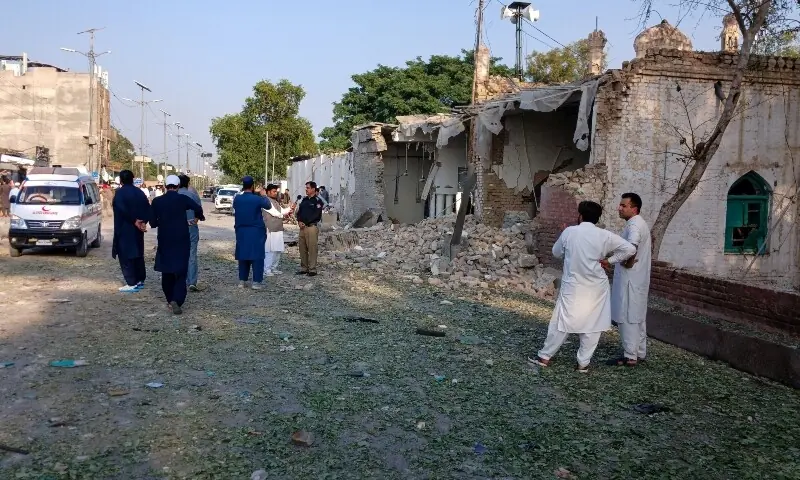
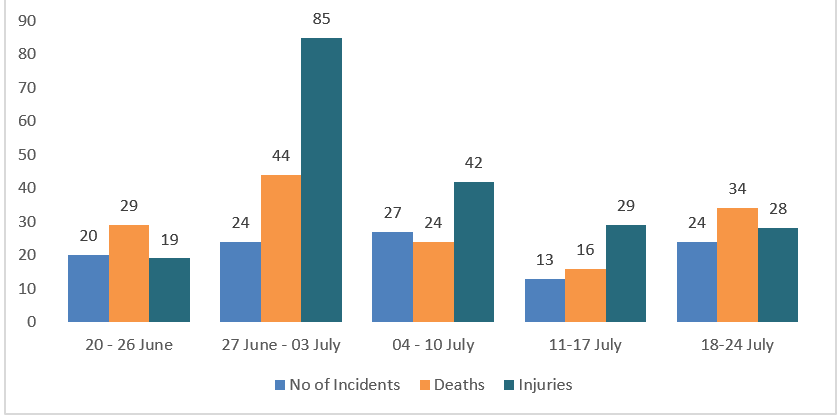
During the week of 18–24 July 2025, Pakistan experienced a sharp rise in militant violence, with 24 reported attacks—nearly double the previous week’s total—resulting in 34 deaths, including 17 security personnel and 11 civilians, and 28 injuries. Balochistan and Khyber Pakhtunkhwa (KP) were the hardest-hit regions, while the tribal areas recorded the highest fatalities, mostly among militants. Targeted attacks and killings were the most common tactics, alongside IEDs, drone strikes, and other forms of violence. In response, security forces conducted nine counterterrorism operations, eliminating 32 militants and arresting 15 others. Despite these efforts, the surge in violence highlights the persistent threat posed by militant groups, particularly in KP, Balochistan, and the former FATA region.
Khyber Pakhtunkhwa Chief Minister Ali Amin Gandapur has firmly opposed any future military operations and denounced the practice of supporting “Good Taliban” or state-aligned militias, calling instead for a civilian-led response to militancy. Speaking at a multi-party conference, Gandapur criticized intelligence agencies for undermining police efforts and equated the use of security force-operated drones with militant tactics. The conference rejected further military interventions, proposing instead localized policing, coordination among institutions, and disbanding all armed groups. A grand tribal jirga was announced to develop these proposals further. However, the federal government, including Interior Minister Mohsin Naqvi, dismissed the KP government’s stance and reaffirmed the continued use of all counterterrorism tools. Meanwhile, a delegation of tribal elders met Prime Minister Shehbaz Sharif, who rejected calls to reverse the FATA-KP merger but promised developmental and representational measures for tribal areas.
Amid rising militant threats in Balochistan and KP, Prime Minister Shehbaz Sharif chaired a high-level meeting on July 23, reaffirming the government’s commitment to safeguarding Chinese nationals, especially as work on CPEC’s second phase accelerates. The meeting reviewed upgraded security measures, including Safe City surveillance, secure airport facilitation, and armed escorts. Interior Minister Mohsin Naqvi noted heightened risk levels and shared that targeted protections are already in place. With recent attacks renewing fears of threats to foreign nationals, these measures aim to reassure China of Pakistan’s seriousness in maintaining a secure business environment, particularly as Chinese concerns over safety have grown in light of recurring attacks on their citizens in Pakistan.
Pakistan Tehreek-e-Insaf (PTI) faces escalating turmoil as anti-terrorism courts sentenced multiple senior leaders, including Dr. Yasmin Rashid and Omer Sarfraz Cheema, to 10 years in prison over the May 9, 2023 riots, sparking disqualification concerns under Article 63(1)(g). PTI rejected the verdicts as politically driven and vowed legal appeals, while intra-party discord and rival alliances, particularly during KP Senate elections, exposed growing fractures. Yet, the Punjab Assembly reinstated suspended PTI MPAs, and cross-party unity emerged in condemning sectarian violence in Balochistan. Despite internal unrest, Imran Khan urged party cohesion for an August 5 protest movement, warning of existential risks amid state pressure, defections, and legal battles. Whether these setbacks demoralize or galvanize PTI’s base remains an open question.Pakistan and Afghanistan are cautiously re-engaging diplomatically amid rising tensions over Afghan refugees and cross-border militancy. The upcoming visit of Afghan Foreign Minister Amir Khan Muttaqi and a series of recent institutional dialogues signal a shift toward cooperative engagement, with both sides discussing counterterrorism, TTP presence, refugee management, and trade. Pakistan’s Interior Minister Mohsin Naqvi’s Kabul visit and the signing of a Preferential Trade Agreement (PTA) highlight mutual interests in stabilizing ties. While Islamabad claims progress on disarming TTP fighters, no formal confirmation came from Kabul. Nonetheless, technical-level security talks and economic cooperation frameworks such as the PTA and Joint Coordination Committee suggest an emerging but fragile roadmap for long-term bilateral stability.
Pakistan has rejected the US designation of The Resistance Front (TRF) as a terrorist group, calling it politically biased and part of India’s anti-Pakistan narrative. The Foreign Office emphasized Pakistan’s counterterrorism track record, including arrests of key militants, and refuted any linkage between Lashkar-e-Taiba and the recent Pahalgam attack. Islamabad criticized India’s alleged misuse of global platforms to deflect attention from its actions in Indian Illegally Occupied Jammu and Kashmir and called for the designation of groups like the Majeed Brigade as terrorist aliases. Former US President Donald Trump’s remark confirming aircraft losses during April hostilities added fuel to Pakistan’s claims over past aerial engagements, further escalating diplomatic tensions in the region.
Pakistan’s Army Chief Field Marshal Asim Munir’s visit to China reinforced the depth of bilateral military and strategic cooperation, with Chinese leaders praising Pakistan’s stabilizing role in South Asia. High-level meetings focused on regional security, CPEC expansion, defence modernization, and enhanced counterterrorism coordination. The Chinese military expressed strong confidence in Pakistan’s armed forces, while both sides agreed on deepening institutional linkages and joint training efforts. The visit underscored the growing alignment of military and economic interests between Beijing and Islamabad as they confront evolving geopolitical and hybrid security threats together.
Pakistan and Bangladesh have agreed to grant visa-free entry to diplomatic and official passport holders, signaling a thaw in relations following the political shift in Dhaka. The agreement, reached during Interior Minister Mohsin Naqvi’s visit to Bangladesh, also included pledges to deepen cooperation in counterterrorism, policing, and anti-trafficking efforts. The move comes amid rising regional diplomacy, including trilateral talks with China, and reflects growing goodwill between the two nations in a post-Hasina political landscape. A high-level Bangladeshi delegation is set to visit Pakistan’s National Police Academy, with both sides emphasizing implementation through regular coordination and committee oversight. Pakistan is actively expanding its military diplomacy, with high-profile engagements across the Middle East and Asia. Army Chief Asim Munir hosted Libya’s top general to initiate defence collaboration, while Pakistan’s naval and joint chiefs engaged counterparts from Saudi Arabia, Turkey, and Azerbaijan to strengthen maritime cooperation, defence production, and training programs. The Pakistan Navy’s joint exercises and naval academy support drew praise from Saudi officials. Concurrently, Munir’s visit to China reaffirmed strategic military ties,particularly around CPEC, counterterrorism, and regional security. These engagements signal Pakistan’s evolving role as a proactive regional defence partner, leveraging military diplomacy to bolster its strategic footprint across land, sea, and air domains.
International engagement with the Taliban-led government is intensifying, reflecting broader recognition of Afghanistan’s role in regional stability. UNHCR Chief Filippo Grandi met Afghan FM Amir Khan Muttaqi in Kabul to discuss returnee challenges, while UK officials explored humanitarian cooperation. Russia’s formal recognition, along with Pakistan-Afghanistan diplomatic exchanges and new trade agreements, signaled growing regional acceptance. Afghanistan advanced regional integration via railway and energy deals with Uzbekistan, Pakistan, and Turkmenistan. However, tensions with Iran flared over migrant expulsions, and CSTO concerns over terrorism on the Tajik-Afghan border drew reassurances from Kabul.