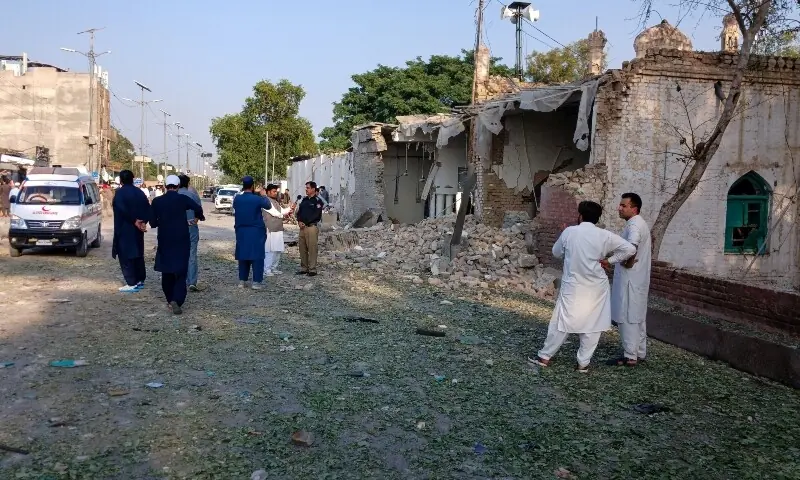
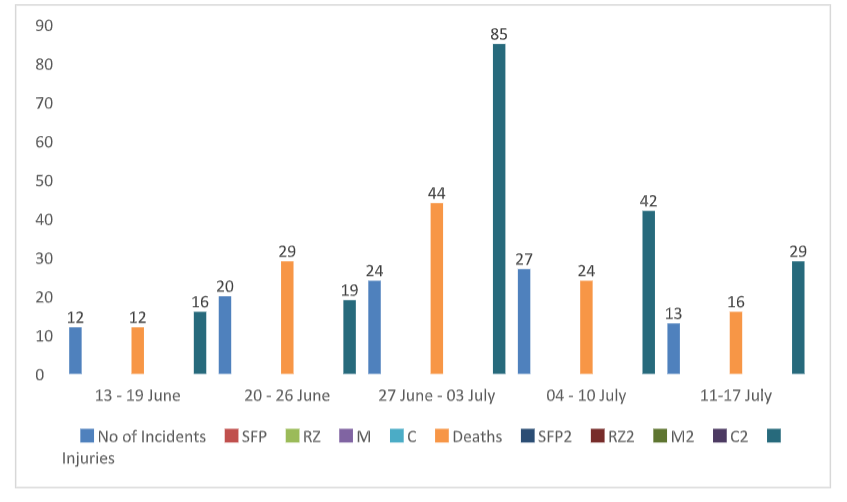
During the week of 11–17 July 2025, Pakistan experienced a sharp decline in militant
attacks, with 13 incidents reported compared to 27 the previous week; however, the lethality
of these attacks remained high, resulting in 16 deaths—including security personnel and
civilians—and 29 injuries. Khyber Pakhtunkhwa (KP) was the most affected province, followed
by Balochistan and FATA. Most attacks involved targeted violence and improvised explosive
devices. Meanwhile, security forces carried out three counterterrorism operations across KP,
Balochistan, and Punjab, killing four suspected militants and arresting 28 others.
Recent developments in Bangladesh have raised concerns about the growing presence
of Tehrik-e-Taliban Pakistan (TTP) operatives and sympathizers, signaling an expanding regional
footprint. The July arrests of Shamin Mahfuz and Md Foysal, both linked to TTP, reflect a
transnational trend in militancy. These arrests follow the detention of 36 Bangladeshi nationals
in Malaysia for suspected Daesh affiliations, further suggesting that Bangladesh may be
emerging as a node in regional jihadist movements. Although the scope of TTP’s operations in
Bangladesh remains unclear, the group’s shift toward broader regional engagement—whether
internally motivated or externally facilitated—marks a troubling evolution. This expansion
poses growing security risks for South Asia and may also complicate diplomatic dynamics across
the region.
Political tensions in KP are mounting amid speculation over a leadership change, with
JUI-F chief Maulana Fazlur Rehman advocating for an internal reshuffle within PTI rather than a
no-confidence motion. While critical of CM Ali Amin Gandapur’s leadership, Fazl emphasized
stability over confrontation due to KP’s fragile security environment. Meanwhile, PTI is facing
internal discord following Gandapur’s surprise deadline for Imran Khan’s release, leading to a
public spat among senior leaders and a warning from Khan’s camp for party unity ahead of an
August 5 protest. With federal pressures and increasing uncertainty, the KP government may
find itself forced to collaborate more closely with the Centre, particularly on security matters.
The federal government’s reorganization of the Frontier Constabulary into a nationwide
Federal Constabulary has sparked intense constitutional debate and political backlash,
especially from Khyber Pakhtunkhwa (KP). Enacted via presidential ordinance, the move grants
sweeping powers to the Centre for deploying the force nationwide in internal security roles.
While the government claims the shift enhances operational capability and national security,
opposition parties, particularly the ANP and PTI, argue it violates provincial rights and
undermines the 18th Amendment. Critics fear the force could be misused without provincial
oversight, especially in KP, where tensions with the federal government remain high.
At the SCO Council of Foreign Ministers meeting in Tianjin, Pakistan’s Deputy Prime
Minister Ishaq Dar emphasized the importance of diplomacy and multilateralism amid growing
regional tensions. Without directly naming India, Dar criticized the normalization of force
following the Pahalgam incident and called for dialogue to avoid escalation between nuclear
neighbors. He also condemned Israel’s military actions in Gaza and strikes on Iranian targets.On the sidelines, Dar engaged in a flurry of bilateral meetings with counterparts from Russia,
China, Iran, and Central Asian states, advancing cooperation in trade, energy, security, and
connectivity. His meeting with Russian FM Lavrov highlighted growing ties, while discussions
with Iran focused on solidarity and border cooperation. The summit, complemented by high-
level Chinese and Russian interactions, reinforced Pakistan’s strategy to blend principled
foreign policy with pragmatic regional engagement.
Indonesia’s Defence Minister Lt Gen (Retd) Sjafrie Sjamsoeddin’s recent visit to Pakistan
reaffirmed both countries’ intent to deepen strategic and defence ties. Meetings with Army
Chief Field Marshal Asim Munir and Prime Minister Shehbaz Sharif focused on enhancing
military cooperation, defence production, and counterterrorism efforts. Discussions also
explored opportunities for joint ventures and broader engagement across economic and
strategic domains. The visit underscored a strong bilateral relationship rooted in shared values
and historical ties, with both nations aiming to expand cooperation in stability, security, and
regional collaboration.
On the sidelines of the SCO summit, Foreign Ministers Ishaq Dar and Wang Yi reaffirmed
the enduring Pakistan-China strategic partnership, focusing on enhanced cooperation through
CPEC, regional peace, and development. The two sides reviewed progress ahead of PM Shehbaz
Sharif’s planned visit to China, which is expected to involve high-level defence discussions and
development planning. Military ties were spotlighted through mutual appreciation of Pakistan’s
operational experience and China’s defence technology. China reiterated support for Pakistan’s
counterterrorism efforts and expressed confidence in Islamabad’s ability to secure Chinese
projects, further solidifying bilateral trust amid evolving regional tensions.
At the 10th Pakistan-EU Political Dialogue in Brussels, both sides reaffirmed
commitment to broadening cooperation under the Strategic Engagement Plan, particularly in
counterterrorism, security, trade, and migration. Discussions included shared views on
international law, conflict resolution, and humanitarian issues such as Gaza. The EU praised
Pakistan’s progress under GSP+ and agreed to deepen engagement ahead of the 2025
Comprehensive Migration Dialogue. The growing partnership, amid warming ties with other
Western actors, reflects Pakistan’s strategy to integrate more deeply into the global economic
and diplomatic order through principled engagement and mutual interests.
The US designation of The Resistance Front (TRF) as a Foreign Terrorist Organisation and
Specially Designated Global Terrorist has heightened regional tensions, as the group was
allegedly involved in the April 22 Pahalgam attack in India-held Kashmir that left 26
dead—though it later retracted its claim. Despite ambiguity surrounding the group’s origins and
credibility, India quickly blamed Pakistan and used the incident to justify cross-border strikes.
The U.S. action, echoing India’s view that TRF is a front for the banned Lashkar-e-Taiba, has
drawn criticism for reinforcing an unproven narrative while ignoring the complexities of the
case. Pakistan, through former Foreign Minister Bilawal Bhutto, expressed a willingness to
cooperate on countering TRF, even as reports emerged that China may have blocked a UN
designation request on Islamabad’s behalf—an allegation Pakistan has not officially addressed.
The episode reflects how evolving militancy in Kashmir is entangled in geopolitical rivalries, withIslamabad viewing the U.S. move as politically expedient and aimed at appeasing India amid its
recent diplomatic setbacks.
To get access to the complete report please become a subscriber. For the details of subscription please Click Here