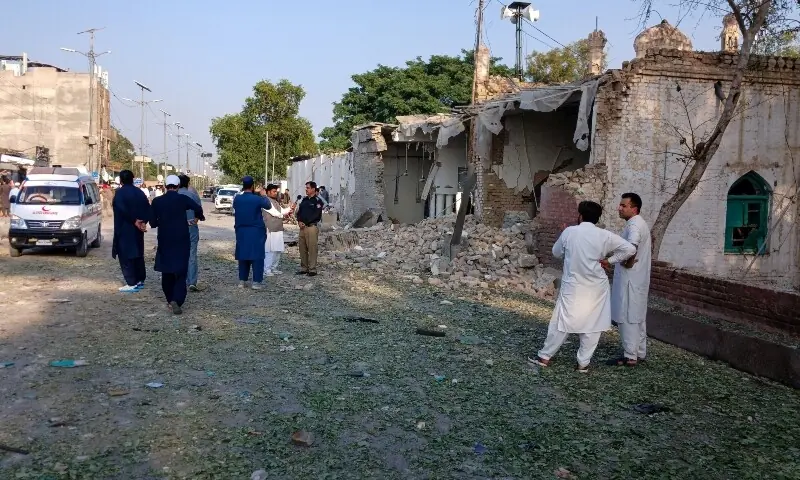
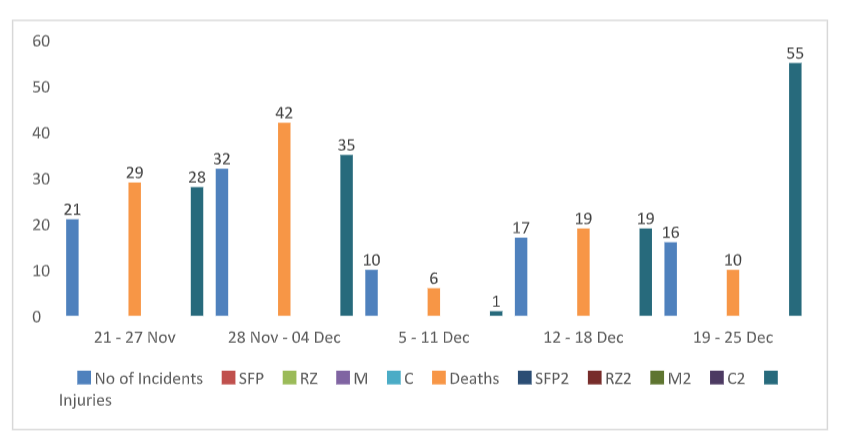
During the week under review, Pakistan experienced a notable rise in militant violence,
with 16 attacks nationwide resulting in 10 fatalities and 55 injuries, underscoring a
deteriorating security environment across the western belt. Khyber Pakhtunkhwa remained the
most affected region with nine attacks, causing the deaths of five security personnel and
injuries to 17 civilians, while erstwhile FATA recorded three attacks leading to four security
force casualties and Balochistan saw four incidents without reported casualties. Tactical
assaults and IED attacks were the most prevalent, accounting for six incidents each and
resulting in significant casualties, alongside two quadcopter attacks, and isolated rocket and
vehicle-borne suicide assaults. In response, security forces carried out eight counterterrorism
operations, killing 33 militants, with KP accounting for seven operations and Balochistan for
one, reflecting an intensified security response amid rising militant activity.
Judicial pressure on Pakistan Tehreek-e-Insaf (PTI) intensified with the sentencing of
Imran Khan and Bushra Bibi to 17 years’ imprisonment in the Toshakhana-2 case, alongside
additional convictions of senior PTI leaders linked to the May 9 unrest, reinforcing a sustained
legal squeeze on the party’s leadership. While incarcerated PTI figures and government officials
have publicly endorsed dialogue as a way out of prolonged political and economic instability,
PTI’s internal posture remains fragmented, with party spokespersons and Imran Khan’s close
family rejecting talks and KP-based leaders signalling a turn toward street mobilisation. This
confusion is unfolding against a firm military stance emphasising security red lines, leaving PTI
divided between confrontation and negotiation at a time of shrinking political space.
Pakistan’s economy has shown signs of stabilisation, marked by foreign exchange
reserves rising to $21.1 billion, a declining external debt-to-GDP ratio, and renewed multilateral
backing through reform-linked financing. Progress has been reinforced by the privatisation of
Pakistan International Airlines, the first major divestment in nearly two decades, which is being
closely watched by the IMF as a test of reform credibility. Despite these gains, persistent
reliance on domestic bank borrowing and revenue shortfalls highlight that stabilisation remains
fragile, with long-term sustainability dependent on deeper fiscal reforms and the translation of
headline improvements into inclusive growth.
The clearance of a $686 million US-funded F-16 sustainment and upgrade package
underscores continuity in Pakistan–US defence ties while focusing on lifecycle extension rather
than force expansion. The timing overlaps with sensitive diplomatic signalling over a potential
Gaza stabilisation force, where Islamabad has adopted a cautious posture shaped by domestic
political, religious, and regional considerations. Simultaneously, a Pentagon report highlighting
Pakistan’s deepening airpower partnership with China—particularly through the J-10C and JF-
17 programmes—illustrates Islamabad’s calibrated strategy of balancing Western and Chinese
defence relationships without over-commitment to either side.
Saudi Arabia’s conferment of its highest national honour on Pakistan’s army chief
reflects the deepening strategic and defence alignment between Islamabad and Riyadh,
particularly in counterterrorism cooperation and regional security coordination. Although
official statements focused on the symbolic significance of the award, the visit itself pointed to
broader strategic consultations at a time of heightened regional tensions, underscoring the
continued centrality of Pakistan–Saudi ties in the wider Middle Eastern security context.
Pakistan’s engagement with Iraq gained momentum during President Asif Ali Zardari’s
visit to Baghdad, where both sides agreed to expand cooperation against extremism, terrorism,
and narcotics while exploring untapped potential in trade, investment, and labour mobility.
Discussions emphasised institutional mechanisms, defence training, reconstruction support,
and improved facilitation for religious pilgrims, signalling a pragmatic effort to broaden bilateral
relations beyond political symbolism.
The commissioning of the Pakistan Navy’s MILGEM-class corvette PNS Khaibar in Türkiye
highlighted the growing depth of defence-industrial and naval cooperation between the two
countries. High-level participation and exchanges on regional maritime security and future joint
initiatives underscored a shared emphasis on interoperability, signalling a maturing strategic
partnership in the maritime domain.
Pakistan’s reported multi-billion-dollar defence export agreement with Libya’s eastern
authorities represents a significant step in Islamabad’s effort to expand its arms export
footprint, potentially involving fighter aircraft and multi-domain military equipment. While the
deal is likely to attract international scrutiny due to Libya’s political fragmentation and the UN
arms embargo, Pakistani officials have framed it as part of a broader export-driven economic
strategy, reflecting ambitions to leverage domestic defence manufacturing for global markets.
Pakistan–Afghanistan relations remain strained following a major militant attack in
North Waziristan and Islamabad’s subsequent demarche to Kabul over TTP-linked activity, even
as Taliban officials highlight selective cooperation against Islamic State elements and reaffirm
commitments under the Doha framework. Persistent differences in threat perceptions continue
to shape the relationship, with Pakistan focused on cross-border militancy and the Taliban
projecting territorial control and openness to dialogue. These security frictions intersect with
mounting humanitarian pressures as large-scale Afghan returns under Pakistan’s repatriation
drive strain Afghanistan’s limited absorption capacity, adding a humanitarian dimension to an
already volatile bilateral relationship.
To get access to the complete report please become a subscriber. For the details of subscription please Click Here