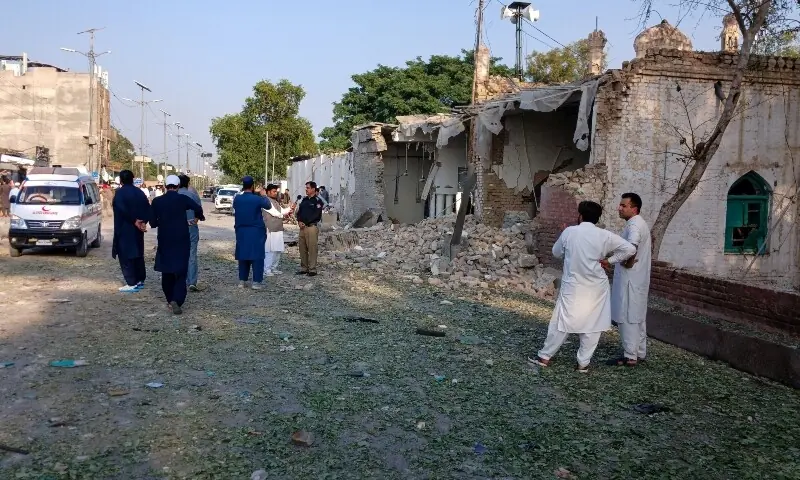
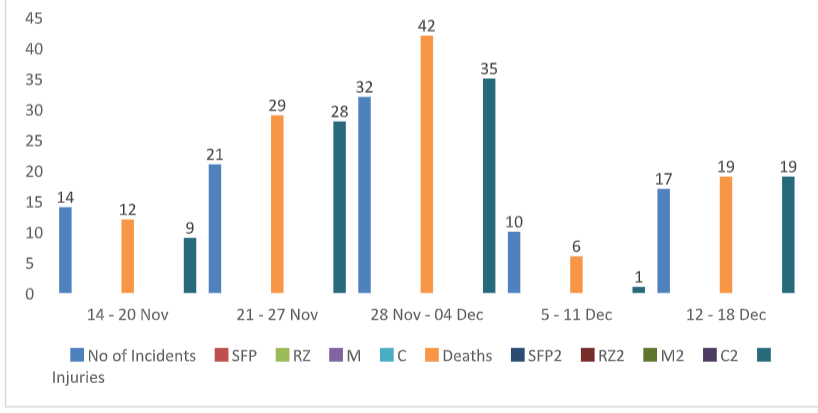
Militant violence increased again during the week, with 17 attacks nationwide resulting in 19
deaths and 19 injuries, reversing the decline seen earlier. The surge was concentrated across Pakistan’s
western belt, with Balochistan, Khyber Pakhtunkhwa (KP), and erstwhile FATA all reporting higher
activity. Balochistan recorded five attacks, erstwhile FATA four, and mainland KP seven, collectively
causing security force and civilian casualties, while Sindh reported one non-lethal incident. Coordinated
attacks in Panjgur’s Chitkan Bazaar highlighted militants’ operational capability and ongoing intelligence
gaps. Targeted killings dominated the attack profile, alongside quadcopter and IED attacks. In response,
security forces carried out seven counterterrorism operations, killing 27 militants and arresting four,
with most operations conducted in KP. Large scale military operations in part of KP and erstwhile FATA
especially in Tirah Valley of Khyber district seems imminent as evacuation of residents has started. Some
understanding seems to have been reached between provincial and federal government in this regard.
Pakistan Tehreek-e-Insaf (PTI) has adopted a dual strategy of contesting upcoming local
government elections while simultaneously intensifying street protests, legal challenges and
institutional confrontation. Despite alleging systemic rigging and flawed electoral reforms, PTI has
moved to operationalise its campaign in Islamabade. This engagement coincides with heightened
tensions marked by arrests, anti-terrorism charges against party leaders and supporters, and criticism
from international rights groups. The government, meanwhile, has framed PTI’s
mobilisation—particularly in the digital sphere—as part of coordinated information warfare. Internal
party restructuring and escalating rhetoric indicate a compressed phase of political contestation with
limited prospects for near-term de-escalation.
The Islamabad High Court’s removal of Justice Tariq Mehmood Jahangiri over the absence of a
valid law degree marks an unprecedented intervention within the superior judiciary. While the court
framed the decision as a strict enforcement of constitutional eligibility criteria, the ruling has triggered
strong backlash from segments of the legal community, who allege procedural haste, selective
accountability and possible executive influence. Critics argue the case risks setting a precedent that
could weaken judicial security of tenure and chill independence, particularly amid politically sensitive
adjudication. The episode has reopened debate over judicial accountability mechanisms and the balance
between constitutional compliance and institutional autonomy.
The latest UN Security Council assessment reinforces concerns that Taliban-ruled Afghanistan
remains a hub for transnational militancy, with over 20 militant groups operating from its territory
under permissive or cooperative conditions. The report identifies the TTP as the most immediate threat
to Pakistan, citing its Afghan sanctuaries, leadership presence in Kabul, and more than 600 attacks in
2025 alone. Operational linkages among TTP, Al Qaeda and ETIM, alongside ISKP’s continued resilience,
have intensified regional insecurity, triggering border tensions, economic disruptions and diplomatic
strain. Recent arrests linked to ISKP and cross-border attacks involving Chinese interests further
highlight Afghanistan’s role as a regional security flashpoint, compounded by worsening humanitarian
pressures and limited diplomatic convergence.
Pakistan and Azerbaijan are seeking to translate strengthened political ties into substantive
economic cooperation, with Baku signalling potential investments of up to $2 billion. Engagements have
focused on energy, oil, gas and mining, including early-stage discussions between SOCAR and Pakistan
on a proposed oil pipeline project. While negotiations remain preliminary, the momentum reflects a
shift from symbolic diplomacy toward commercially anchored collaboration, supported by sustained
high-level exchanges. The partnership is being positioned as a long-term economic engagement rather
than a short-term transactional arrangement.
Pakistan has raised alarm over erratic Chenab River flows, citing sharp reductions at Marala
headworks that disrupted irrigation during the winter cropping cycle and threatened food security in
Punjab. Islamabad attributes the fluctuations to upstream regulation by India and has formally raised
the issue under the Indus Waters Treaty (IWT). The dispute has gained international traction following a
UN rapporteurs’ report warning that any disruption of treaty-protected flows could violate fundamental
human rights, particularly in a water-stressed, climate-vulnerable country like Pakistan. The
convergence of treaty tensions, UN legal scrutiny and broader India-Pakistan frictions has reframed
water security as both a legal and humanitarian concern.
The joint US-India call for expanded UNSC sanctions against militant groups signals deepening
counterterrorism coordination, but the conspicuous absence of any reference to Pakistan reflects
Washington’s calibrated diplomatic balancing. Analysts interpret the omission as an effort to maintain
strategic engagement with Islamabad while reinforcing security cooperation with New Delhi. This
approach aligns with a broader US recalibration in South Asia, prioritising flexibility amid shifting
regional dynamics. The move underscores Washington’s attempt to counter militancy without
hardening regional fault lines.
Plans for UN-authorised International Stabilisation Force in Gaza remain unsettled, with
uncertainty over mandate, enforcement authority and political legitimacy. While the force is envisioned
as part of a post-ceasefire stabilisation framework, divergent interpretations and Hamas’s refusal to
disarm complicate prospects. Pakistan has adopted a cautious stance—open in principle but insisting on
mandate clarity and rejecting any role in forced disarmament. The debate highlights broader
international hesitation, operational risks and legitimacy concerns, suggesting that without consensus
on objectives and authority, the force risks becoming a source of diplomatic friction rather than stability.
The misattribution of the Sydney Bondi Beach attack to Pakistan illustrates how disinformation
and premature reporting can distort narratives during crises. Pakistani officials condemned the attack
while criticising the rapid spread of unverified claims later disproven by Australian authorities. While
Islamabad alleged hostile external involvement, available evidence points more toward systemic
verification failures in media ecosystems rather than coordinated state action. The episode underscores
the diplomatic and reputational risks posed by misinformation and highlights the need for stronger
verification standards and corrective mechanisms.
Pakistan’s high-level military engagement with eastern Libya’s Arab Armed Forces reflects an
effort to expand defence diplomacy focused on training and counterterrorism cooperation. However,
engagement with an authority not recognised by the UN introduces diplomatic sensitivities, given
Pakistan’s formal ties with Libya’s Tripoli-based government. The move suggests a compartmentalised,
security-driven approach that prioritises military effectiveness over political legitimacy. While offering
opportunities to project Pakistan’s training expertise, the engagement also underscores the risks of
navigating fragmented conflict theatres marked by contested authority and regional rivalries.
To get access to the complete report please become a subscriber. For the details of subscription please Click Here