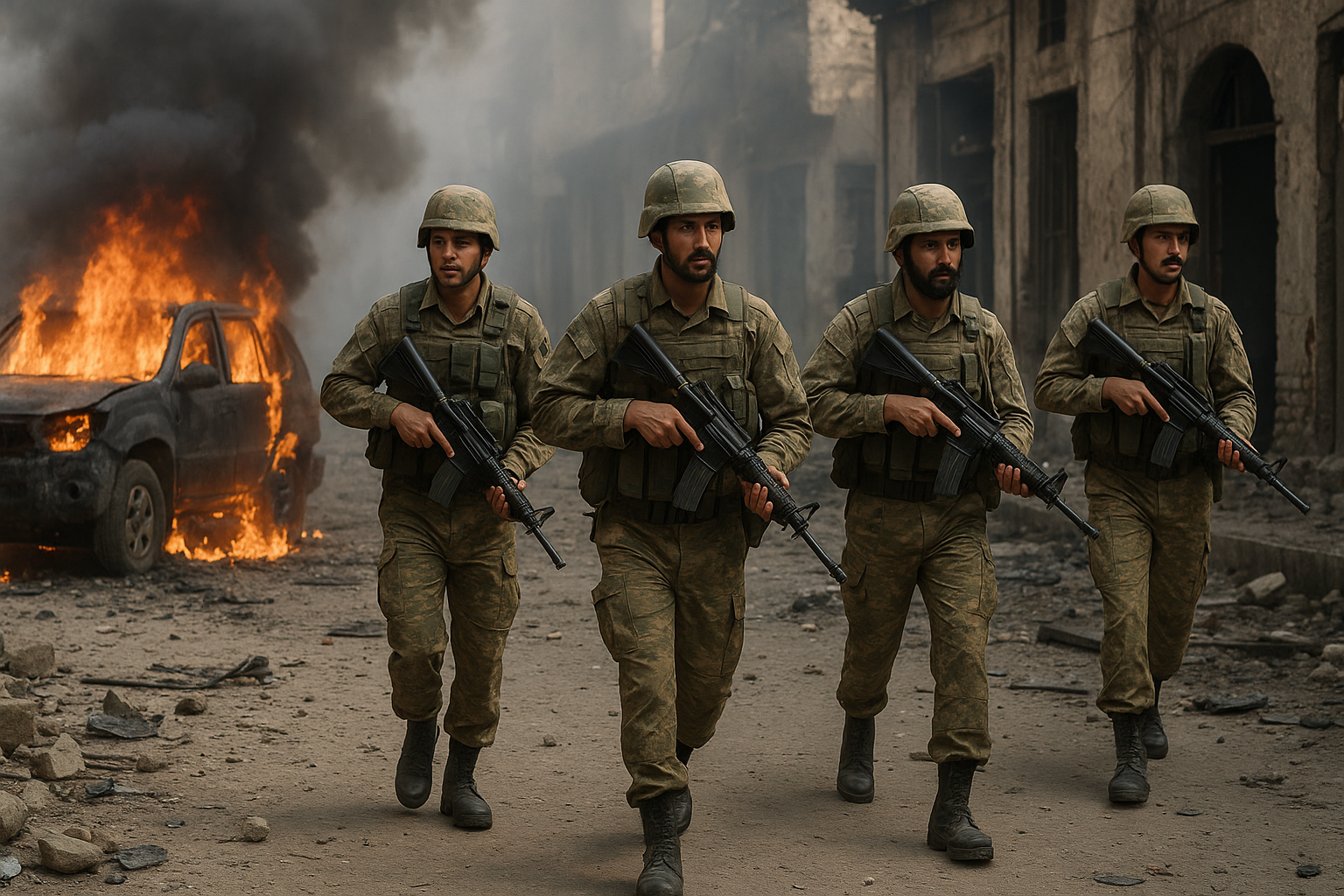
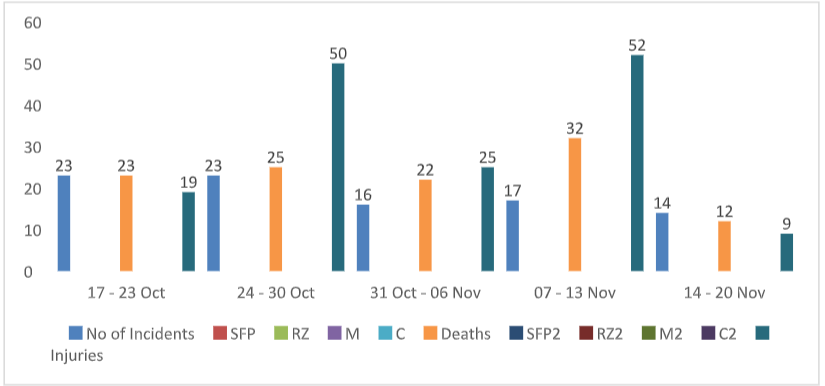
Militant attacks declined during 14–20 November 2025, with 14 attacks reported
compared to 17 the previous week, resulting in 12 deaths and nine injuries, down from 32
fatalities and 52 casualties earlier. Mainland KP witnessed seven attacks, Balochistan and
erstwhile FATA three each, and Sindh one, involving IEDs, targeted killings, tactical assaults, and
isolated incidents of kidnapping, a quadcopter strike, and a grenade attack. The decline reflects
both tactical restraint by groups—particularly the TTP amid strained Pakistan–Afghanistan
relations—and intensified counterterrorism operations, which included 15 engagements killing
62 militants and apprehending four, almost entirely in KP and merged districts.
Militant propaganda surged as HGB highlighted new factional allegiances, IMP circulated
unverifiable attack claims, and the TTP pushed narratives of strength through coerced videos,
advertised units, mergers, and cross-border support, even while internally debating civilian
targeting. Baloch insurgents—BLA, BRG, and BLF—publicised attacks on security forces,
infrastructure, and collaborators to reinforce influence across Balochistan. Meanwhile, the KP
government’s withdrawal of defence under the Action in Aid of Civil Power Regulations and
inquiry into the May 9 Radio Pakistan attack signalled a confrontational posture challenging
federal security narratives, though military counterterrorism operations continued unabated.
The IMF’s Governance and Corruption Diagnostic highlighted Pakistan’s systemic
governance failures, citing entrenched corruption, elite policy capture, weak oversight, and
fragmented accountability as key obstacles to sustainable growth. Notable governance lapses
included the 2019 sugar crisis and deficiencies across budgeting, procurement, taxation, and
judiciary. The report urged transparency, unified asset-declaration systems, digitised processes,
and empowered anti-corruption bodies, while warning that vested interests perpetuate
corruption, informal economies, and militant financing.
In Punjab, the crackdown on the banned TLP targeted finances, networks, and
operational capacity through asset freezes, arrests, and regulatory oversight of religious
institutions. This has caused internal fractures as former ticket-holders publicly disassociated,
while surveillance, Fourth Schedule expansions, and JIT investigations strengthened state
control. The TLP’s legal challenge to proscription reopened debates on due process, even as the
PML-N government seeks to weaken a rival that leverages religious mobilisation.
AJK experienced another leadership change as a no-confidence motion ousted PM
Anwarul Haq, elevating PPP’s Raja Faisal Mumtaz Rathore—the fourth PM in four
years—highlighting persistent factionalism and fluid loyalties. Rathore announced extensive
administrative reforms, including restructuring departments, controlling expenditures,
revitalising the Public Service Commission, enforcing biometric systems, and pursuing judicial
and service reforms. The 18-member cabinet, dominated by PPP and PTI defectors, reflects
efforts to consolidate control ahead of 2026 elections, while PTI condemned defections and
threatened legal action. Stability and successful reform implementation remain uncertain in a
historically volatile region.
Pakistan and Saudi Arabia deepened defence cooperation through high-level
engagements in Riyadh, operationalising the Strategic Mutual Defence Agreement that treats
aggression against either as mutual. Talks focused on interoperability, joint defence-industrial
projects, and alignment with Saudi Vision 2030. The Defence Industrial Forum reviewed
ongoing initiatives and new capacity-building opportunities, reflecting sustained tri-services
engagement and strategic alignment.
Pakistan–Afghanistan ties remained tense as Islamabad criticised Kabul for inaction
against cross-border militants while maintaining selective engagement with the Taliban,
excluding TTP and BLA dialogue. Pakistan framed the issue as security-driven, reinforced by UN
observations of growing ISKP and Al-Qaeda threats. Limited mediation by regional
actors—including China and Turkey—has yet to yield substantive commitments, leaving
bilateral relations under pressure amid rising security and economic challenges.
The Pakistan Air Force showcased the JF-17 Thunder Block-III and Super Mushshak
trainers at Dubai Airshow 2025, highlighting indigenous aviation capabilities. The Block-III’s
radar, missile systems, and operational performance demonstrate Pakistan’s defence industry
growth and export potential, with MoUs signed for procurement. Engagements with UAE
officials emphasised training, cooperation, and aerospace technology, while joint exercises like
Shaheen Strike-II reinforced counterterrorism readiness.
Pakistan and Jordan strengthened strategic, defence, and humanitarian ties during King
Abdullah II’s visit, focusing on regional stability, Palestinian support, and expanded bilateral
cooperation across trade, education, health, and defence. Ceremonial honours, MoU
exchanges, and joint military exercises culminated in reciprocal awards—Nishan-i-Pakistan for
the King and the Order of Military Merit for Pakistan’s COAS—underscoring deepening bilateral
relations.
In India, a car bombing in Delhi and an accidental explosives detonation in Nowgam,
Kashmir, exposed ongoing vulnerabilities, while the Indian Army Chief’s remarks on the May
Pakistan confrontation signalled continued readiness. The BJP’s focus on development and
welfare in Bihar elections, coupled with restrained anti-Pakistan rhetoric, suggests a calibrated
domestic and foreign approach. Pakistan’s performance during the May conflict and reliance on
Chinese systems highlight evolving India–Pakistan–China dynamics.
The EU signalled stricter scrutiny of Pakistan’s GSP Plus compliance, emphasising human
rights, labour protections, and governance reforms ahead of the 2027 review. Enforcement
gaps in forced disappearances, women’s rights, and labour standards will influence continued
preferential access, underscoring that diplomatic assurances alone are insufficient without
tangible reforms.
The UN Security Council’s adoption of the US-drafted Gaza peace plan offered cautious
optimism but faced implementation challenges. Pakistan supported the resolution to halt
violence, facilitate humanitarian relief, and emphasise the Palestinian Authority’s central role,
while ambiguities in ISF operations, Hamas rejection, and Israeli opposition pose risks.
plan’s success will require international commitment, clarity in mandate, and political will from
all parties to ensure civilian protection, reconstruction, and eventual Palestinian sovereignty.
To get access to the complete report please become a subscriber. For the details of subscription please Click Here