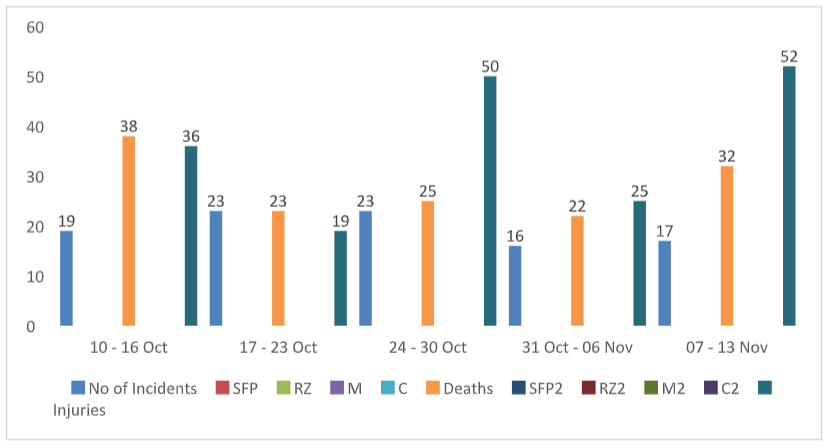
During the week, Pakistan experienced a slight rise in militant attacks, though of greater
significance, resulting in 32 deaths and 52 injuries compared to 16 incidents the previous week.
Khyber Pakhtunkhwa (KP) faced the highest impact with nine attacks, followed by Balochistan
and the former FATA with three each, and one attack each in Islamabad and Sindh. The
incidents encompassed targeted killings, tactical assaults, IEDs, suicide attacks, and
kidnappings. Notable events included a vehicle-borne suicide attack on Cadet College Wana in
South Waziristan, where security forces neutralized all five assailants and safely evacuated over
650 individuals, and the suicide bombing outside Islamabad District and Sessions Courts, which
killed 12 and injured 36. In KP, militants carried out kidnappings, shootings, and attacks on
police posts, while security forces eliminated 25 militants and arrested eight in intelligence-led
operations across Bannu, Tank, Mardan, Hangu, and Kohat.
Provincial authorities intensified security measures, with Punjab and Sindh extending
Section 144 restrictions while Balochistan suspending mobile and internet services, and
imposing transport and school closures to pre-empt attacks. Concurrently, the federal
government launched the “Safe Secure Islamabad” initiative after the district courts suicide
blast, including household surveys, electronic vehicle tagging, and enhanced surveillance to
monitor residents and mobility in the capital. These measures reflect a national emphasis on
preventive control, balancing public safety with concerns over civic freedoms, privacy, and
mobility.
The KP Grand Peace Jirga convened political leaders, tribal elders, civil society, and
religious figures to address security challenges, advocate inclusive policymaking, and improve
coordination with the federal government on cross-border and counterterrorism issues.
Participants emphasized dialogue with Afghan authorities, equitable resource allocation, and
empowering law enforcement, including police, Frontier Corps, Levies, and CTD. While past
jirgas yielded limited results, the latest gathering demonstrated unprecedented political unity
and reinforced KP’s commitment to security, development, and cooperative governance.
The suicide bombing outside Islamabad’s district courts highlighted persistent threats to
the capital, with Jumaat Ul Ahrar claiming responsibility while the TTP denied involvement. The
attack coincided with international events and prompted arrests of facilitators, along with
implementation of the “Safe Secure Islamabad” initiative. This underscores the challenges of
protecting civilians and critical institutions amid regional tensions and ongoing militant threats.
Despite heightened security concerns, Pakistan successfully managed the ongoing Sri
Lanka cricket tour, rescheduling matches from Lahore to Rawalpindi and providing
comprehensive protection for visiting teams. Coordinated civil-military and diplomatic efforts
ensured the continuation of remaining ODIs and the T20I tri-nation tournament, demonstrating
the country’s capacity to host international events amid security risks.
Pakistan’s Parliament passed the controversial 27th Constitutional Amendment,
restructuring the judiciary and military. The amendment establishes the Federal Constitutional
Court (FCC), alters the Chief Justice’s powers, consolidates operational authority under the new
Chief of Defence Forces, and grants lifetime protections to senior military officers. The
legislation sparked political opposition, judicial resignations, and criticism from legal experts
and the International Commission of Jurists, highlighting concerns over judicial independence,
centralized authority, and democratic norms.
The judiciary faces turmoil following the amendment, with the FCC assuming
constitutional jurisdiction from the Supreme Court, prompting senior justices’ resignations and
widespread alarm. Critics argue that the reform duplicates functions, increases executive
influence, and threatens legal integrity, while the government contends it streamlines
governance and reduces backlog. The judiciary remains divided on how to respond, reflecting a
key challenge to Pakistan’s constitutional order and executive-judicial balance.
The National Assembly approved amendments to armed forces laws, extending COAS
Field Marshal Asim Munir’s tenure as Chief of Defence Forces, abolishing the Chairman Joint
Chiefs post, and consolidating operational authority under a single command. These changes
align with the 27th Amendment but drew opposition criticism over speed, lack of debate, and
potential impacts on civilian oversight and institutional accountability.
Pakistan-Afghanistan talks in Istanbul collapsed over cross-border security
disagreements, straining relations and disrupting trade. Pakistan demanded assurances that
Afghan territory would not host TTP or BLA operations, which Afghanistan rejected. Border
closures caused losses exceeding $45 million for Pakistani traders, prompting alternative trade
routes via Iran, Turkey, and Central Asia. Despite mediation efforts by Turkiye and Iran,
entrenched mistrust and economic pressures maintain high tensions, with Pakistan restraining
military action to allow diplomacy and investigations.
Chief of Naval Staff Admiral Naveed Ashraf’s visit to Bangladesh reflected warming
bilateral relations and maritime cooperation. Meetings with senior military leadership, visits to
defence institutions, and a reception aboard PNS Saif emphasized professional collaboration,
training, and regional security in the Bay of Bengal and Indian Ocean, signaling potential for
strengthened defence, economic, and people-to-people ties.
A car explosion near Delhi’s Red Fort on November 10 killed eight and injured around
20, prompting an investigation under India’s UAPA and oversight by the National Investigation
Agency. Authorities are exploring potential terrorist links, including prior arrests and explosive
seizures in Indian-administered Kashmir and Faridabad. The blast, occurring a day before
Islamabad’s major attack, heightened security across Delhi and underscores vulnerabilities in
high-profile urban areas.
To get access to the complete report please become a subscriber. For the details of subscription please Click Here