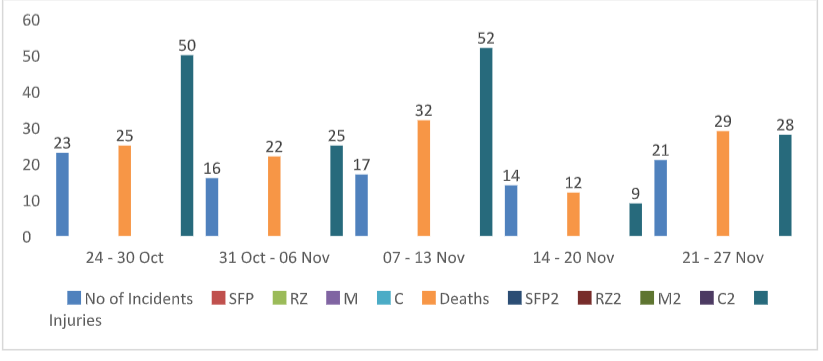
During the week, militant violence surged, with 21 attacks causing 29 deaths and 28
injuries, compared with 14 attacks and 21 casualties the previous week. Civilians, security
personnel, razakars, and militants were all affected, reflecting militants’ continued expansion of
targets beyond security forces alone. Eleven attacks occurred in mainland KP, six in erstwhile
FATA, and four in Balochistan, involving tactical assaults, IEDs, targeted killings, mortar fire, and
drone and suicide operations. In response, security forces maintained high operational
momentum, conducting 13 major counterterrorism actions that killed 68 militants and arrested
six, largely concentrated in southern KP districts—Bannu, Dera Ismail Khan, and Lakki
Marwat—where the security situation remains fragile. Clashes also occurred between militants,
security forces, and tribal lashkars, with militants increasingly targeting peace committee
members to undermine local resistance structures.
In Khyber Pakhtunkhwa, the provincial government’s evolving political–security strategy
reflects a dual-track approach by Chief Minister Sohail Afridi, who continues to publicly reaffirm
loyalty to PTI founder Imran Khan while engaging the federal government on counterterrorism
cooperation. The most consequential development is Afridi’s decision to revive and expand the
Special Branch as an intelligence arm reporting directly to the chief minister. Through increased
funding, recruitment, and technological upgrades, the Special Branch has been repositioned as
a parallel intelligence structure operating outside the police chain of command. While framed
as a step to improve intelligence-led counterterrorism, this shift risks diverting attention from
strengthening the police and CTD, potentially weakening security capacity in an already volatile
province and signalling an effort to consolidate power within the CM’s office.
National political activity was shaped by the latest by-elections, which produced a
sweeping victory for the ruling PML-N. The party secured 12 of 13 contested seats across
Punjab and KP amid low turnout and renewed PTI accusations of manipulation. Decisive wins in
key National Assembly constituencies further cemented PML-N’s parliamentary strength, while
the PPP won a single provincial seat in Muzaffargarh. PTI rejected the results—despite largely
boycotting the polls—alleging tampered Form-45s and interference. With these gains, PML-N
has emerged as the largest party in the National Assembly and can survive without PPP support
if other coalition partners remain aligned, thereby increasing its leverage in political,
administrative, and economic negotiations.
Pakistan–Saudi Arabia ties continued to deepen as both sides accelerated efforts to
operationalise the Strategic Mutual Defence Agreement signed earlier this year. The visit of
Saudi Chief of General Staff General Fayyadh Al-Ruwaili to Islamabad and the conclusion of the
Al-Battar II counterterrorism exercise in Tabuk highlighted growing military interoperability and
an intensified pace of high-level exchanges. Discussions between senior military leadership
focused on strengthening defence cooperation, enhancing operational readiness, and adapting
to evolving regional security challenges. The sustained momentum of reciprocal visits suggests
that both sides are working toward structured mechanisms for long-term defence
collaboration.
Pakistan and Iran have intensified diplomatic, security, and economic engagement,
underscored by the two-day visit of Iran’s National Security Council Secretary Ali Larijani.
Meetings with Pakistan’s civil and military leadership emphasized shared concerns over cross-
border terrorism, the need for closer border management, and long-pending economic projects
such as the Iran-Pakistan gas pipeline. Both sides reiterated their commitment to boosting
bilateral trade to USD 10 billion and agreed to enhance cooperation through national-currency
settlements. Larijani’s visit also coincided with reports of Pakistan quietly facilitating
communication channels between Iran and the United States, placing Islamabad in a subtle
intermediary role. Iran seems to be playing role in bringing Pakistan and Afghanistan closer.
While the atmosphere is positive, questions remain about how much of this renewed
engagement will translate into practical cooperation, particularly on counterterrorism and
trade.
The seventh EU–Pakistan Strategic Dialogue reinforced cooperation on trade,
governance, and regional security. Discussions in Brussels reflected shared priorities around
GSP+ compliance, human rights reforms, and export competitiveness. The EU acknowledged
Pakistan’s progress on legislative reforms but called for stronger implementation mechanisms
as its monitoring team assessed compliance with 27 international conventions. Both sides
expressed convergence on Afghanistan, urging the Taliban to act against terrorist groups,
uphold women’s rights, and engage constructively in political processes. With Pakistan eager to
retain its GSP+ advantage amid economic pressures, the dialogue reaffirmed a framework
where trade-linked conditionality and regional security imperatives incentivise Islamabad to
maintain reforms and deepen coordination with the EU.
Pakistan–Afghanistan tensions escalated as Islamabad linked the reopening of border
trade and transit to Kabul’s willingness to curb cross-border terrorism. Pakistan accused the
Afghan Taliban of harbouring TTP operatives involved in recent attacks in Islamabad, Wana, and
Peshawar, while Kabul alleged Pakistani airstrikes—claims rejected by Islamabad. The growing
involvement of Afghan nationals in attacks within Pakistan, alongside reports of infighting
among TTP factions, has heightened concerns over the evolving militant landscape. Pakistan’s
near-total disengagement—border closures, halted trade, and restricted movement—has
sparked debate over economic repercussions, especially in border districts dependent on cross-
border commerce. Meanwhile, Iran, Russia, and Türkiye are reportedly exploring a regional
initiative to pressure the Afghan Taliban on counterterrorism, though its feasibility remains
unclear.
Pakistan reacted strongly to provocative remarks by Indian Defence Minister Rajnath
Singh about Sindh, with both national and provincial legislatures condemning the comments as
revisionist and inflammatory. The controversy unfolded as Pakistan successfully tested an
indigenously developed ship-launched anti-ship ballistic missile, reinforcing naval deterrence at
a time when India’s rhetoric on Sindh and Sir Creek is viewed with suspicion by Pakistani
defence circles. The test, following recent cruise missile developments, was widely interpreted
as a strategic signal underscoring Pakistan’s resolve to maintain credible maritime deterrence
amid rising friction in the region.
Pakistan–Bahrain relations advanced significantly during Prime Minister Shehbaz Sharif’s
visit to Manama, where both sides committed to doubling bilateral trade to USD 1 billion and
strengthening defence, cybersecurity, and counterterrorism cooperation. High-level
engagements, including a meeting with King Hamad who awarded the prime minister Bahrain’s
highest state honour, demonstrated renewed political warmth and growing institutional
connections. Parallel parliamentary and security-level mechanisms—such as working groups on
counter-narcotics, immigration, and defence training—signal an emerging comprehensive
partnership driven by economic and strategic interests.
Pakistan and Bangladesh signalled tentative openness to expanding defence ties during
a rare high-level meeting between the chairman of Heavy Industries Taxila and the Bangladesh
Army chief in Dhaka. While exploratory, the engagement reflects Pakistan’s broader strategy of
diversifying military partnerships, following new defence pacts with Saudi Arabia and increased
interest from Middle Eastern states such as Jordan. Despite political sensitivities, the dialogue
suggests potential space for incremental cooperation rooted in Pakistan’s defence production
capabilities.
To get access to the complete report please become a subscriber. For the details of subscription please Click Here