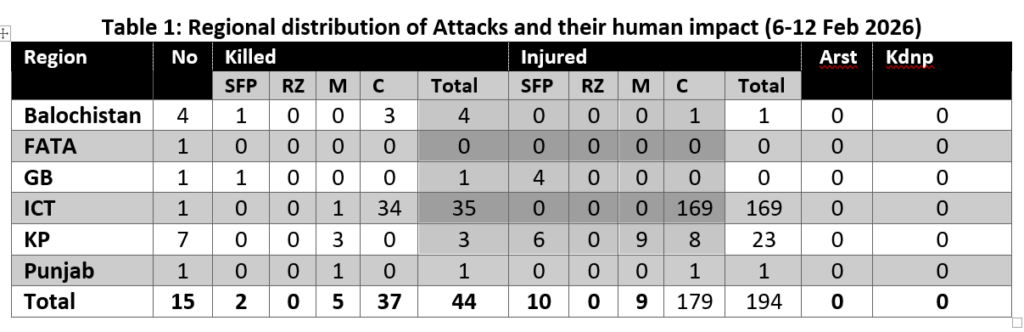
Pakistan recorded 15 militant attacks nationwide in which 44 people were killed snd 194
others were injured, marking a significant escalation in lethality despite fewer incidents.
Islamabad Capital Territory (ICT) accounted for the deadliest event of the week, where one
high-impact attack caused 35 deaths and 169 injuries. Khyber Pakhtunkhwa (KP) recorded the
highest number of attacks (seven), though with comparatively lower fatalities (three deaths and
23 injuries). Balochistan experienced four attacks, resulting in four deaths and one injury.
Punjab and Gilgit-Baltistan each recorded one incident, while erstwhile FATA reported one
attack without casualties. Civilians bore the brunt of the violence, with 37 of the 44 fatalities
and 179 of the 194 injuries recorded among non-combatants.
On the counterterrorism front, security forces conducted seven operations nationwide,
killing 35 militants. However, six security personnel also lost their lives during engagements in
KP, highlighting continued operational risks. Most militant fatalities (29) occurred in erstwhile
FATA during three separate operations, while Balochistan saw five militants killed in one
operation.
The February 6 suicide bombing at Islamabad’s Khadija al-Kubra Mosque, which killed 35
and injured 169, exposed ISIS-linked networks and security gaps in the capital. Claimed by ISPP,
the attack involved cross-border linkages to Afghanistan and Bajaur, with investigations
pointing to family-based recruitment patterns and possible coordination between ISPP and
ISKP. Despite swift arrests, the incident demonstrated ISIS’s continued ability to mount high-
casualty sectarian attacks and raised concerns about intelligence failures and site security.
Following the attack, authorities arrested four facilitators, including an alleged Afghan
mastermind, during raids in Khyber Pakhtunkhwa that left one police officer dead. Officials
cited links to Afghanistan and broader militant networks, while also alleging external
sponsorship—claims denied by India. The government pledged enhanced security and action
against extremist online content, but the episode intensified debate over cross-border militancy
and counterterrorism coordination.
In Khyber Pakhtunkhwa, a high-level civil-military meeting agreed on a phased transfer
of security responsibilities from the army to civilian authorities, beginning with Malakand. A
provincial subcommittee will oversee development and stabilisation efforts, alongside
continued crackdowns on militancy-related networks. The move signals improved centre-
province coordination and could serve as a pilot model for civilian-led governance in conflict-
affected districts.
The Pakistan Air Force concluded its AI-driven “Golden Eagle” exercise, highlighting
multi-domain warfare and manned-unmanned teaming, while Pakistan unveiled the hypersonic
‘SMASH’ missile in Riyadh. Together with recent missile advancements, these steps underscore
efforts to strengthen conventional deterrence and airpower amid regional competition,
particularly with India.
Parliament held a debate on terrorism, with calls for national consensus and a stronger
counterterrorism strategy following recent attacks. A joint parliamentary session is under
consideration as political leaders seek broader alignment to address escalating security threats.
Attention also shifted to Imran Khan’s health after a court-appointed report highlighted
severe vision loss in his right eye. While PTI accused jail authorities of negligence, the
government denied wrongdoing, and the Supreme Court ordered a medical board review. The
issue has reshaped political discourse, fuelling speculation about possible medical relief.
A UN Security Council report warned that the TTP has intensified cross-border attacks
from Afghan territory, potentially deepening cooperation with Al Qaeda affiliates. Pakistan
welcomed the extension of the Monitoring Team’s mandate and urged Kabul to curb militant
safe havens.
Meanwhile, Field Marshal Asim Munir met Saudi Defence Minister Khalid bin Salman,
reaffirming strategic defence ties. The engagement likely also aligns with Pakistan’s
participation in the upcoming Gaza-related diplomatic initiative, reflecting broader regional
coordination.
To get access to the complete report please become a subscriber. For the details of subscription please Click Here