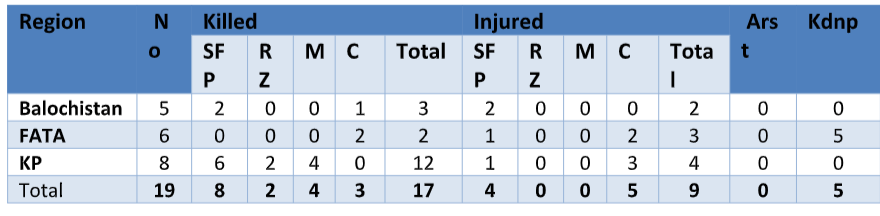
During the week (17–23 April 2026), militant activity increased slightly to 19 attacks
from 17, while fatalities remained stable at 17 and injuries declined, indicating continued
moderate-intensity violence without major escalation. Khyber Pakhtunkhwa remained the most
affected region, with districts such as Bannu and Lakki Marwat witnessing the highest
casualties, reflecting ongoing engagements between militants and security forces. The former
FATA districts recorded fewer fatalities but a rise in kidnappings, suggesting a shift toward
coercive tactics, while Balochistan saw limited yet persistent insurgent activity. Targeted killings
remained the most lethal method, alongside selective attacks and occasional suicide incidents.
Security forces maintained pressure through 13 operations, killing 39 militants and arresting 7,
indicating effective intelligence-led actions with minimal own losses.
The Pakistan Navy conducted a successful live firing of the indigenously developed
Taimoor Air-Launched Cruise Missile on 21 April, demonstrating enhanced precision strike
capability and operational readiness, particularly against sea-based targets at extended ranges.
This followed an earlier flight test by the Pakistan Air Force on 3 January, which confirmed the
missile’s ability to strike both land and sea targets up to 600 km with high accuracy while flying
at low altitudes to evade modern defense systems. Together, these developments highlight
Pakistan’s growing technological maturity, emphasis on indigenous defense production, and
efforts to strengthen its conventional deterrence and multi-domain strike capabilities.
Pakistan’s mediation efforts in the ongoing U.S.–Israel–Iran crisis reflect a proactive but
increasingly constrained diplomatic role shaped by regional complexity and strategic
limitations. While Islamabad engaged intensively through high-level visits and multilateral
outreach—including efforts involving Gulf states and China—the process faces significant
hurdles, including disagreements over maritime security in the Strait of Hormuz, Iran’s nuclear
program, and the lack of credible security guarantees for Tehran. Despite some temporary de-
escalatory signals, such as limited ceasefire arrangements and Iran’s conditional flexibility, the
persistence of blockades, indirect confrontation, and media-driven signaling has deepened
mistrust. Pakistan’s ability to facilitate dialogue remains intact, but the absence of decisive
leverage and the structural limits of third-party mediation suggest that meaningful progress will
depend on direct engagement and political will from the principal actors.
To get access to the complete report, please become a subscriber. For the details of subscription click here