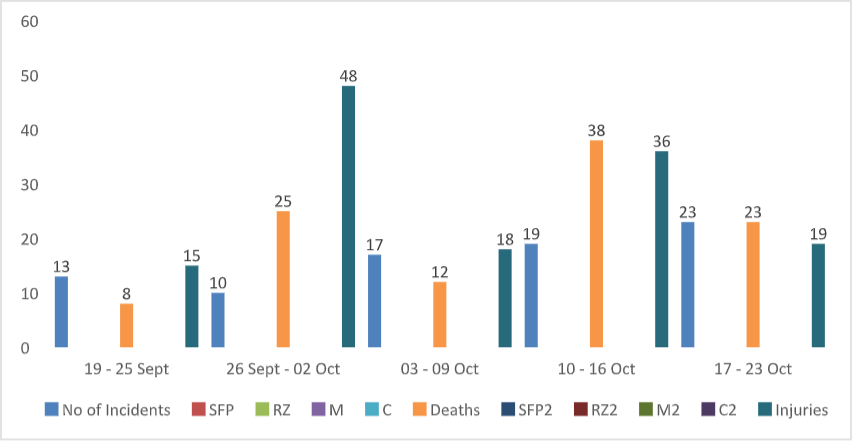
Militant violence registered a moderate increase during the week of 17–23 October,
with 23 attacks reported nationwide compared to 19 the previous week, resulting in 23 deaths
and 19 injuries. Security personnel continued to be primary targets, accounting for nearly half
of the fatalities. Khyber Pakhtunkhwa recorded the highest number of incidents, followed by
Balochistan and the erstwhile FATA region, where TTP-linked ambushes and targeted killings
persisted alongside separatist violence by BLA and BLF factions. Despite militants displaying
tactical adaptability through IEDs, suicide attacks, and mortar assaults, counterterrorism
operations maintained momentum, with 11 actions resulting in the elimination of 35
militants—mostly in KP—without any reported security force casualties. The week’s
developments reflect both the sustained operational capability of militant networks and the
continued precision and intensity of security responses across key conflict zones.
The federal government on 23 October imposed a fresh ban on Tehreek-e-Labbaik
Pakistan (TLP) under the Anti-Terrorism Act following violent protests earlier in the month,
marking a renewed attempt to curb the group’s extremist activities. The decision, taken on
Punjab’s recommendation, followed reports detailing TLP’s involvement in sectarian incitement
and violent unrest during its “Gaza solidarity” march. Authorities have frozen the assets of TLP
chief Saad Rizvi, seized affiliated mosques and seminaries, and arrested hundreds of party
members. Analysts warn that dismantling the deep-rooted social and ideological networks
underpinning TLP’s influence will be a far greater challenge. While the state’s resolve appears
stronger than in previous crackdowns, the outcome will depend on judicial proceedings and the
government’s capacity to sustain enforcement beyond short-term measures.
Khyber Pakhtunkhwa Chief Minister Sohail Afridi’s announcement of a grand peace jirga
in Khyber district on 25 October reflects a revival of local conflict-resolution traditions amid
rising militancy and strained ties with the federal government. Afridi criticized Islamabad’s
counterterrorism policies, accusing it of neglecting KP’s security and financial needs, while
returning federally provided bulletproof vehicles as a symbolic protest. Federal Minister of
State Talal Chaudhry, condemned Afridi’s statements as political posturing that undermines
national counterterrorism efforts. Meanwhile, informal jirga talks with militant factions in the
Tirah Valley have stalled, with groups refusing to vacate the areas. The KP Police’s creation of a
specialized Sniper Squad under the Elite Force signals provincial efforts to enhance operational
independence. However, growing policy divergences between Peshawar and Islamabad—over
dialogue versus kinetic operations—highlight the fragility of center-province coordination at a
time of mounting militant activity.
Pakistan and Afghanistan extended their ceasefire following prolonged border clashes,
with delegations from both countries meeting in Doha on 18 October under Qatari and Turkish
mediation. The 14-hour talks concluded with an agreement to establish a verification
mechanism, with follow-up discussions scheduled in Istanbul on 25 October. While the truce
was widely welcomed by regional and international actors, ambiguity remains over the
agreement’s contents, as Pakistani and Afghan officials issued conflicting statements regarding
alleged secret clauses. Both sides indicated commitments to refrain from cross-border
hostilities and to curb militant activity from their territories. Despite diplomatic progress,
border closures and suspended trade continue to strain bilateral relations, impacting local
economies on both sides. Pakistan’s concurrent focus on the repatriation of undocumented
Afghan nationals and its criticism of growing Taliban-India engagement further complicate
prospects for normalization, as mutual mistrust and competing regional alignments persist
beneath the surface of tentative diplomacy.
Amid regional tensions, the Islamic Emirate of Afghanistan broadened its diplomatic
outreach through renewed engagements with major powers and regional actors, signaling a
cautious shift from isolation toward pragmatic interaction. Zabihullah Mujahid confirmed that
the United States had offered mediation during border clashes with Pakistan, followed by
informal talks in Kabul between Acting Foreign Minister Amir Khan Muttaqi and former U.S.
envoy Zalmay Khalilzad. India’s decision to upgrade its Technical Mission in Kabul to a full-
fledged embassy marked a significant restoration of bilateral ties, interpreted as an effort to
strengthen New Delhi’s regional influence. Meanwhile, the European Union initiated
discussions with Kabul over the deportation of Afghan migrants, viewed as both a policy
necessity for Europe and an opening for the Taliban to engage diplomatically. Visits by China’s
and the UK’s special envoys underscored growing international recognition of Afghanistan’s
role in regional stability.
To get access to the complete report please become a subscriber. For the details of subscription please Click Here