Militant violence remained steady across Pakistan, with 23 attacks recorded during the
week (24–30 October), mirroring the previous week’s tally but resulting in slightly higher
casualties—25 killed and 50 injured. Security personnel accounted for most fatalities, while
Balochistan and FATA remained the main theatres of violence. Despite the persistent threat,
counterterrorism operations intensified, with 17 actions leading to 77 militant deaths
compared to 35 earlier, indicating improved precision and intelligence-based targeting.
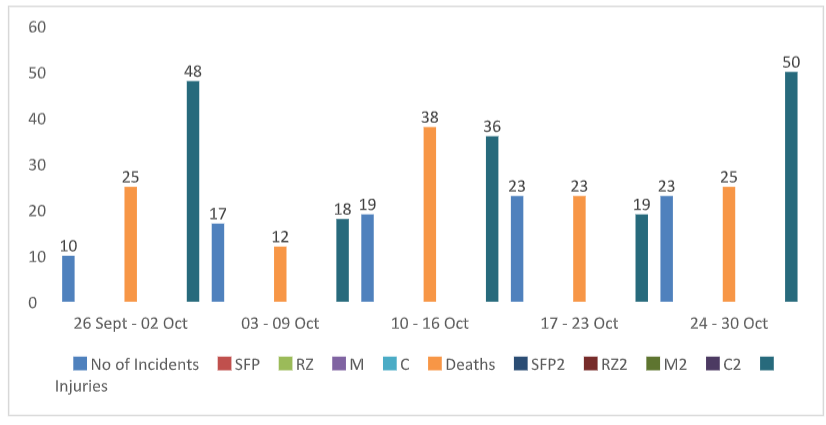
The week’s data suggests militants have maintained operational tempo but not territorial influence,
while security forces have enhanced their strike efficiency and reduced own losses.
Pakistan achieved a major counterterrorism breakthrough with the killing of Qari Amjad
alias Mufti Mazahim, the TTP’s shadow defence minister and deputy emir, in a precision
intelligence-based operation in Bajaur. The takedown, executed without foreign assistance,
underscores Pakistan’s growing counterterrorism and intelligence autonomy. TTP’s own
confirmation of the killing—while blaming “insiders”—suggests possible infiltration within its
senior ranks, reflecting deepening internal vulnerabilities. The episode signals a shift toward
leadership-targeted operations rather than broad military campaigns, which could weaken the
group’s cohesion but also provoke retaliatory violence. Strategically, it boosts Pakistan’s
leverage vis-à-vis Kabul while exposing the Taliban’s dilemma in balancing ties with TTP
elements and global legitimacy.
The government’s renewed ban on Tehreek-e-Labbaik Pakistan (TLP) under the Anti-
Terrorism Act marks a decisive crackdown on violent religio-political activism. Unlike past
instances, the move has encountered little political resistance, with mainstream religious
leaders endorsing the decision and aiding the state’s efforts to prevent radical control of
mosques and seminaries. Punjab’s administration has combined firmness with selective
leniency—penalizing violence while releasing innocents—to avoid unnecessary confrontation.
The state’s swift and coordinated enforcement has contained potential blowback, while the
episode has revived debate over balancing religious freedom with national security and
reaffirmed political consensus against weaponizing religion for political ends.
Tensions between the Khyber Pakhtunkhwa government and the military establishment
escalated after Chief Minister Sohail Afridi labelled civilian deaths in security operations as “war
crimes.” His remarks, viewed as part of PTI’s broader confrontational strategy, drew a firm
response from Army Chief Field Marshal Asim Munir, who reiterated Pakistan’s commitment to
eradicate terrorism and hinted at accountability for political abettors. The PTI appears to be
sustaining a high-intensity confrontation in the belief it may politically benefit Imran Khan, but
the military’s assertive messaging from Peshawar underscores its national security priorities.
Persistent defiance by the KP government risks prompting constitutional recourse, including the
possible imposition of governor’s rule, to preserve stability.
Pakistan and Afghanistan agreed to maintain a fragile ceasefire after intensive
mediation by Türkiye and Qatar in Istanbul, though deep mistrust endures. Both sides
consented to establish a monitoring mechanism and continue technical-level talks ahead of a
principal meeting on November 6. Islamabad pressed Kabul for verifiable action against TTP
militants, while Afghan officials insisted they lacked full control over the group, avoiding formal
designation of TTP as terrorist. The talks, though preventing a collapse in dialogue, yielded no
written guarantees and reflected continued divergences over terrorism, water resources, and
Indian influence. An unrelenting media war further complicates efforts toward durable peace,
leaving the truce tenuous and heavily dependent on external mediation.
Pakistan’s stepped-up defence diplomacy in the Middle East reflects a broader bid to
align with emerging regional security frameworks amid the Gaza crisis. Army Chief Field
Marshal Asim Munir’s visits to Egypt, Jordan, and Saudi Arabia, alongside Interior Minister
Mohsin Naqvi’s engagements in Iran and Oman, highlight an integrated approach linking
defence, economic, and political cooperation. Discussions in Cairo, Amman, Riyadh, Tehran, and
Muscat emphasized counterterrorism, intelligence-sharing, energy cooperation, and labour
mobility, while also exploring the concept of an Islamic Stabilisation Force (ISF) for Gaza. These
interactions underscore Pakistan’s intent to strengthen bilateral partnerships while helping
shape a collective Muslim response to regional conflicts under a coordinated, multilateral
framework.
Pakistan and Bangladesh are moving toward normalization and enhanced military
cooperation following CJCSC General Sahir Shamshad Mirza’s landmark visit to Dhaka. Meetings
with top Bangladeshi officials reaffirmed mutual intent to deepen defence collaboration,
training exchanges, and strategic dialogue. The visit, the first of its kind in years, symbolizes
warming ties since Sheikh Hasina’s ouster, with both sides signalling readiness to reset relations
based on mutual respect and pragmatic engagement. Regional observers note India’s unease
over this rapprochement, viewing it as a potential rebalancing in South Asia’s security
dynamics. The outreach highlights Islamabad’s effort to diversify its partnerships and foster
stability through military diplomacy rather than ideological alignment.
Afghanistan returned to the international spotlight during the UN’s 80th anniversary
week, as global bodies renewed calls for humanitarian aid and engagement despite the Taliban
regime’s continued diplomatic isolation. While Kabul seeks recognition through limited dialogue
with the U.S. and UK, regional actors, including Iran, Turkey, and Pakistan, are pursuing
connectivity and infrastructure initiatives linking Afghanistan to wider Eurasian trade routes.
Meanwhile, Iran-Afghanistan ties have improved, India has expressed readiness to assist in
hydropower projects, and Saudi Arabia has joined Pakistan in trilateral health cooperation.
Despite these openings, border tensions and mutual distrust with Pakistan persist, leaving
Afghanistan’s reintegration into the global order gradual and uncertain.
To get access to the complete report please become a subscriber. For the details of subscription please Click Here