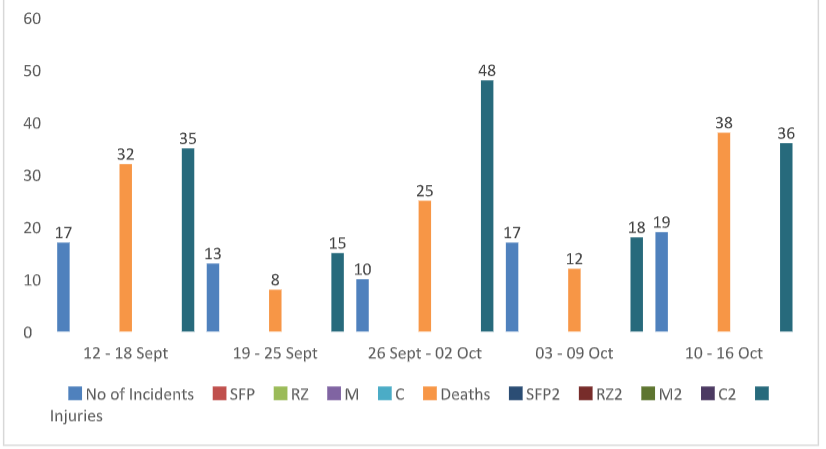
Militant attacks in Pakistan saw a slight uptick during the week under review with 19 attacks compared to 17 earlier, leaving 38 dead and 36 injured. Security personnel remained the main targets, accounting for nearly half of the fatalities. Most incidents occurred in Khyber Pakhtunkhwa and the erstwhile FATA region, while Balochistan saw one. Targeted shootings dominated, followed by mortar and IED strikes, reflecting cross-border tensions along the Afghan frontier. In response, security forces intensified counterterrorism operations, conducting 11 actions that killed 132 militants—over three times more than the previous week—mainly in KP and FATA.
The absence of casualties among security personnel suggests improved planning, intelligence, and precision. Sohail Afridi’s oath-taking as Chief Minister of Khyber Pakhtunkhwa on 16 October ended a week-long political standoff but opened new tensions between provincial and federal authorities. His appointment, secured amid boycotts and legal challenges, consolidated PTI’s control over the province while signaling confrontation with Islamabad and the military. Afridi’s pledge to revoke the Action in Aid of Civil Power Ordinance, oppose military operations, and promote local engagement reflected PTI’s populist and anti-establishment stance. His criticism of the Afghan refugee repatriation policy and demand for inclusive policymaking aligned with Imran Khan’s narrative. Although Prime Minister Shehbaz Sharif offered cooperation, Afridi’s insistence on meeting Khan and defiant tone deepened political rifts. The military’s reminder that 70 percent of terrorism occurs in KP and warning against politicizing counterterrorism highlighted growing civil–military strain.
The Punjab government launched its most sweeping crackdown against the Tehreek-i- Labbaik Pakistan (TLP) following the 13 October Muridke violence, marking a major shift in policy. Over 2,700 arrests, asset freezes, and money-laundering probes against leaders, including Saad Rizvi, showed the government’s resolve to dismantle TLP’s networks. Recommendations for a fresh ban under the Anti-Terrorism Act and moves to dissolve TLP as a political party ended years of appeasement. Authorities sealed TLP-linked mosques and seminaries and imposed Section 144 across Punjab. While rights groups called for a judicial inquiry, the government defended the measures as essential for restoring order. Analysts viewed the crackdown as a reversal of the establishment’s earlier “TLP project,” though implementation faces hurdles given the group’s street power and volatile context. Pakistan’s staff-level agreement with the IMF under the Extended Fund Facility and Resilience and Sustainability Facility boosted market confidence despite rising regional tensions. Announced on 9 October and confirmed on 14 October, the deal unlocks about US$1.2 billion, reflecting the Fund’s trust in Pakistan’s reform efforts. Markets reacted positively, and the government pledged to raise tax revenues, improve governance, and expand social protection.
The IMF projected fiscal and debt improvements but cautioned against policy slippages and persistent structural risks. Border hostilities and unrest over the TLP crackdown may temper gains, but international partners remain optimistic that continued reforms could stabilize Pakistan’s economy—if political calm and regional peace persist.
The Balochistan government’s decision to merge provincial and federal levies with the police across six of its seven divisions marks a landmark law enforcement reform. The 16 October cabinet decision designates Quetta, Kalat, Makran, Zhob, Rakhshan, and Nasirabad as “A-Areas” under police jurisdiction, integrating Levies into a unified policing structure. The reform aims to enhance coordination, efficiency, and state presence in a province long marred by insurgency and weak governance. The exclusion of Sibi division appears temporary. While the move reflects a strategic shift toward professional policing, its success depends on political will, adequate funding, and careful handling of local sensitivities. Pakistan and Afghanistan’s agreement on a temporary ceasefire on 15 October ended a week of fierce border clashes that risked escalation. The truce, reportedly mediated by Qatar, followed deadly exchanges in Chaman, Kurram, and Dir, where both sides suffered heavy losses.
Pakistan’s reported precision strikes, Taliban retaliation, and disputed casualties underscored the fragility of relations. International actors welcomed the truce, urging restraint. Prime Minister Shehbaz Sharif linked peace to Kabul’s action against the TTP, while Defence Minister Khawaja Asif termed it “fragile.” Border disruptions affected trade and movement, and Pakistan’s shift toward targeted strikes signals a harder line amid doubts over sustainability given the Taliban–TTP nexus and tense diplomacy.
Pakistan and Kazakhstan began their joint counterterrorism exercise “Dostarym-V” on 13 October at Cherat, marking another step in bilateral defence cooperation. The exercise, involving Pakistan’s SSG and Kazakhstan’s Special Forces, focuses on enhancing interoperability and tactical proficiency. Such engagements reflect Pakistan’s expanding defence diplomacy and intent to position itself as a responsible regional actor while strengthening security partnerships with Central Asian states. Amid escalating border tensions with Pakistan, Afghanistan’s outreach to India signaled a recalibration of regional alignments. Foreign Minister Amir Khan Muttaqi’s 10–15 October visit to India—the first since 2021—led to India’s decision to reopen its embassy, expand humanitarian aid, and resume development projects. Engagements with Deoband scholars, Russia, and Gulf states highlighted Kabul’s effort to gain legitimacy through diversified ties. While India’s pragmatic engagement acknowledges Taliban governance, Afghanistan’s concurrent confrontation with Pakistan underscores its delicate balancing act. The shift reflects Kabul’s pursuit of regional inclusion amid ongoing mistrust and evolving geopolitical dynamics across South and Central Asia.
To get access to the complete report please become a subscriber. For the details of subscription please Click Here