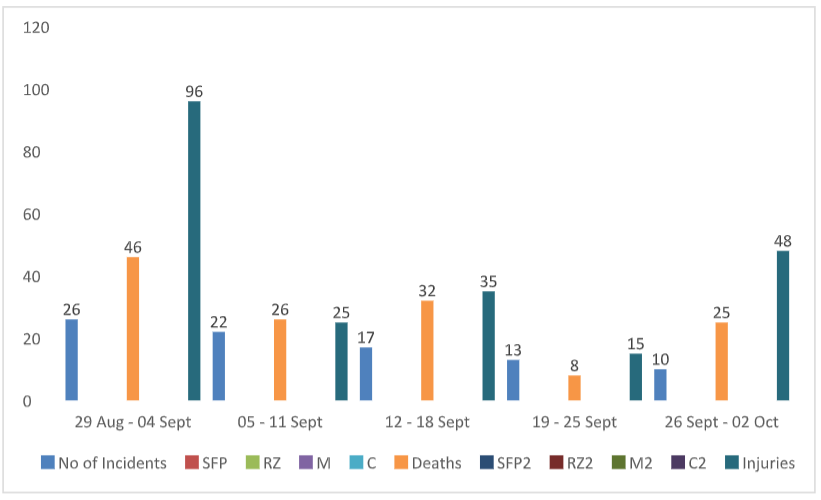
During the week of 26 September – 02 October 2025, militant violence in Pakistan declined in frequency but intensified in lethality, reflecting a shift towards more destructive tactics. While only 10 attacks were reported compared to 13 the previous week—a 23 percent drop—these incidents caused 25 deaths, including five security personnel and 15 civilians, and injured 48 others. The week’s incidents included four IED blasts, three targeted attacks, and high-profile assaults such as a combined vehicle-borne suicide attack in Quetta. Regionally, five incidents occurred in Khyber Pakhtunkhwa, three in the erstwhile FATA, and two in Balochistan. Meanwhile, security forces maintained elevated pressure through 12 intelligence-based operations, killing 49 militants and arresting four, underscoring a robust counter-terrorism response amid evolving militant strategies.
Azad Jammu and Kashmir witnessed its worst unrest in years as protests led by the JKJAAC over unmet demands escalated into deadly clashes with security forces, leaving at least ten dead and over a hundred injured. While the government conceded on issues such as electricity tariffs and health cards, it refused to abolish reserved seats for refugees, a flashpoint that protesters argue enables Islamabad’s undue influence in AJK politics. The violence, centred around Muzaffarabad’s Neelum Bridge, quickly paralyzed life across the region and spread to other towns. Despite efforts by federal leaders to mediate, protest leaders have demanded accountability for civilian deaths before continuing talks.
The dispute over refugee representation underscores deeper grievances about limited autonomy in AJK, reflecting wider regional discontent linked to the unresolved Kashmir issue and present socio-economic challenges. Fresh violence in Sialkot highlighted Pakistan’s chronic struggle to protect its Ahmadi minority, as a TLP-led mob attacked community members over a burial dispute, torching property and injuring at least five Ahmadis. Police arrested 30 suspects under terrorism charges, yet critics note a pattern of weak protection, dual FIRs implicating both victims and attackers, and inconsistent enforcement that emboldens extremists. The Sialkot incident follows a string of similar attacks across Punjab and Sindh in recent months, underscoring the recurring nature of mob violence against Ahmadis. While immediate administrative measures such as securing graveyards may calm tensions, long-term protection hinges on confronting extremist narratives and demonstrating political will to uphold equal rights under law.
Pakistan has cautiously supported US President Trump’s proposed Gaza peace framework while emphasizing alignment with a broader Muslim bloc demanding ceasefire, humanitarian relief, and Palestinian-led governance. Islamabad highlighted its diplomatic role at the UN, portraying participation as a step toward alleviating Palestinian suffering. Domestically, however, opposition parties and civil society criticized the plan as favoring Israel and warned against any “sellout” under US pressure. The mixed reactions reflect the sensitivity of the issue, with public sentiment strongly pro-Palestinian. For now, Pakistan is balancing active diplomacy with the need to maintain credibility at home, mindful that any arrangement perceived as compromising Palestinian aspirations risks rejection both domestically and regionally.
The Asia Cup final in Dubai exposed how cricket has become an extension of India–Pakistan political rivalry, as Indian players refused to accept the trophy from Pakistan’s Mohsin Naqvi, sparking a diplomatic row. The controversy was amplified by nationalist rhetoric from leaders, including PM Modi’s militaristic framing of India’s win, which drew criticism even within India. In Pakistan, the episode was viewed as an insult to sporting norms and national pride. Analysts argue that cricket, once a tool of soft diplomacy, now mirrors the hardened political divide, with bilateral series abandoned and even neutral-ground matches overshadowed by politics. Without deliberate depoliticisation, cricket is likely to remain another proxy arena for nationalist competition rather than a bridge for dialogue.