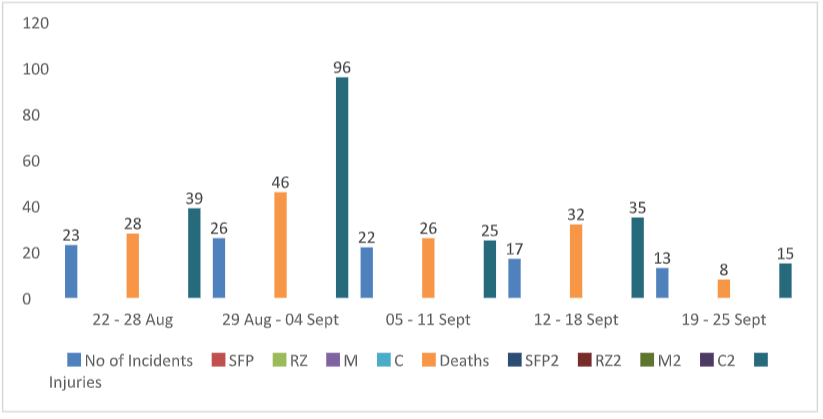
During the week of 19–25 September 2025, militant violence in Pakistan declined in
frequency and intensity, with 13 attacks compared to 17 the previous week, marking a 23
percent drop. Fatalities and injuries also fell to eight killed and 15 injured from 32 and 35,
respectively. Khyber Pakhtunkhwa reported five attacks, Balochistan four, erstwhile FATA
three, and Sindh one, ranging from targeted killings and armed assaults to IED blasts and
kidnappings. Security forces maintained pressure, carrying out eight intelligence-based
operations that killed 29 militants, including Afghan nationals and TTP commanders, and
arrested several others.
The deaths of about two dozen people in Tirah valley, including 10 civilians, sparked
protests, parliamentary debate, and calls for accountability. Conflicting accounts persist over
whether the casualties resulted from militant explosives or aerial bombardments. Political
leaders and rights groups have demanded an impartial probe, while locals seek apologies and
guarantees against recurrence. The provincial government condemned the incident, announced
compensation, and promised a jirga, but the absence of clarity and a formal statement from
government has deepened mistrust, underscoring risks civilians face in counterterrorism
operations, which remain a serious challenge in CT operations.
The Supreme Court reinstated provisions of the Army Act allowing civilians to be tried in
military courts under limited circumstances, while directing Parliament to legislate within 45
days to ensure independent appeals before civilian courts. The ruling overturned a 2023
judgment barring such trials, with the bench emphasising that constitutional safeguards must
remain intact. Pending reforms, High Courts may review convictions. The Court sought to
balance security imperatives, particularly after the May 9 unrest, with constitutional
protections, underlining Parliament’s role in harmonising military justice with due process.
In a major show of unity, thousands in Swat marched under the Swat Aman Pasoon
banner, declaring zero tolerance for militancy and demanding decisive action. The gathering,
attended by politicians and elders, warned the valley would not again become a terrorist haven
and criticised government inaction despite heavy police presence. The marchers gave
authorities a one-month deadline to act, threatening broader protests if ignored.
Pakistan’s economy faces a mix of reforms, weaknesses, and external support, with
progress toward stability overshadowed by rising poverty, energy inefficiencies, and climate
shocks. Government initiatives and international financing show some gains, but poverty has
reached an eight-year high, and circular debt in the power sector has ballooned to Rs2.4 trillion.
Structural flaws, weak service delivery, and youth unemployment remain persistent, while
floods and other shocks have worsened vulnerabilities. Sustained growth depends on reforms,
investment, and ensuring gains reach the poor.
Current protests in Gilgit-Baltistan and prospective protests in Azad Jammu and Kashmir
highlighted rising grievances in Pakistan’s administered regions. In GB, the government
conceded to demands by granting conditional tax exemptions on imports through Sost Dry Port
to revive border trade with China. In AJK, the JKJAAC mobilised demonstrations, prompting
Islamabad to send reinforcements and open talks. Federal concessions may ease immediate
tensions, but without deeper reforms unrest is likely to resurface.
Pakistan has intensified diplomatic efforts to pressure the Afghan Taliban over cross-
border militancy, warning that groups such as TTP, BLA, and ETIM exploit Afghan sanctuaries. At
the OIC, Foreign Minister Ishaq Dar urged Kabul to take verifiable measures, while officials
revealed Afghan nationals now make up most fighters in TTP attacks inside Pakistan. The killing
of a senior BLA commander in Helmand further underscored Afghan soil’s role as a militant
haven. Islamabad is coordinating with Iran and Russia to build regional pressure, but Kabul’s
reluctance risks making cross-border militancy a flashpoint.
At the UNGA, U.S. President Donald Trump launched a new Gaza peace initiative,
meeting Muslim leaders including Pakistan’s Prime Minister Shehbaz Sharif to propose a
ceasefire-for-prisoners framework with phased Israeli withdrawal, regional peacekeepers, and
reconstruction under Arab leadership. Pakistan endorsed the plan, with Shehbaz also meeting
Trump and military leaders on counterterrorism, economic cooperation, and U.S. investment.
The engagement signalled warming U.S.-Pakistan ties, even as Washington manages strained
relations with India. Analysts view the initiative as both a stabilisation effort for Gaza and a
recalibration of U.S.-Pakistan relations aligned with recent Saudi defence cooperation.
The Kashmir dispute resurfaced at the OIC and UNGA, with Pakistan and allies criticising
India’s rhetoric on AJK and GB and condemning rights abuses in Indian-administered Kashmir.
India’s Defence Minister Rajnath Singh hinted at possible military moves on AJK, citing
Operation Sindhoor, which has already escalated into deadly exchanges. Reports of Muslim
deportations to Bangladesh fuelled further concerns. Leaders including Turkey’s Erdogan
reiterated calls for a UN-backed resolution, stressing Kashmir remains one of the most
militarised and volatile conflicts globally.
The recently signed Pakistan-Saudi defence pact has generated debate, particularly over
speculation of a nuclear element. Defence Minister Khawaja Asif initially suggested Pakistan’s
full capabilities could extend to Riyadh but later denied a nuclear dimension, while the Foreign
Office kept ambiguity. Welcomed by Iran as a step toward Muslim security cooperation, the
pact formalises Pakistan’s longstanding commitment to Saudi security. Still, uncertainty over its
scope—especially amid Riyadh’s concerns—ensures questions about Pakistan’s doctrine and
regional implications will persist.
India is preparing for a large joint military exercise in October under its Cold Start
doctrine, while finalising a $7 billion order for nearly 100 indigenously built Tejas Mk-1A jets to
replace ageing MiG-21s. The exercise, described as the biggest since Operation Sindoor, will
test drone warfare and integrated operations, highlighting India’s focus on readiness against
Pakistan while managing escalation risks. India’s wider modernisation—including Rafale
acquisitions, AMCA development, and hypersonic missile testing—reflects its strategy to bolster
deterrence and self-reliance, strengthening both near-term preparedness and long-term
defence capacity.
At the UN, Afghanistan’s isolation and contested legitimacy came into focus as regional
states urged engagement while Western governments stressed conditionality tied to rights.
Despite billions in aid, Afghanistan remains excluded from UN representation due to unpaid
dues and non-recognition. Leaders from India, Iran, China, and Central Asia called for trade and
infrastructure integration, while the Taliban rejected U.S. calls to reopen Bagram. The Islamic
Emirate has undertaken limited humanitarian gestures and outreach but faces scepticism over
restrictive policies. The debates highlighted a divide between regional pragmatism and Western
conditionality, leaving Afghanistan in partial engagement and persistent isolation.
To get access to the complete report please become a subscriber. For the details of subscription please Click Here