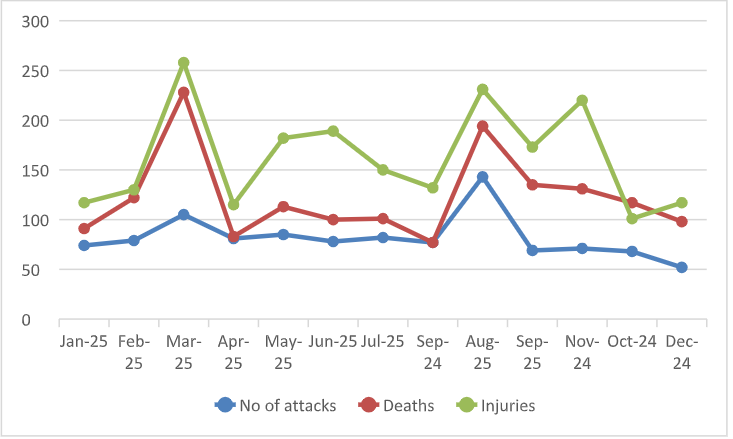
In September 2025, militant violence in Pakistan fell sharply compared to August, with 69 attacks causing 135 deaths and 173 injuries — a 52 percent decline in incidents from the previous month but with continued lethality, particularly in Khyber Pakhtunkhwa and Balochistan, which accounted for 96 percent of the violence. Balochistan reported 21 attacks, including four suicide bombings, leaving 79 dead and 122 injured, while mainland KP saw 25 attacks that killed 33 people, mostly security personnel. The tribal districts recorded 20 attacks causing 21 fatalities, and Sindh saw three minor incidents, whereas Punjab, GB, Islamabad, and AJK remained unaffected. Despite the monthly dip, overall violence in the third quarter rose, with 294 attacks causing 430 deaths and 554 injuries — reflecting a 20 percent rise in attacks and a 45 percent surge in fatalities compared to the previous quarter — highlighting the entrenched militancy in key regions, evolving Baloch strategies under BRAS, and intensified counterterrorism operations nationwide.
Pakistani security forces intensified counterterrorism operations, conducting 47 major actions nationwide that killed 197 militants, arrested 15, and left 58 people injured, but also resulted in 23 security personnel and 24 civilian deaths. Mainland Khyber Pakhtunkhwa saw the highest number of operations (22), with 88 militants and 11 security personnel killed, while the erstwhile FATA region recorded 18 operations that eliminated 83 militants but caused significant collateral damage, including 12 security personnel and 24 civilian fatalities. Balochistan witnessed seven operations that killed 26 militants and led to 10 arrests. Overall, militant fatalities nearly doubled compared to August, marking September as the deadliest month for militants this year, though the sharp rise in state and civilian losses show the intensifying and costly nature of counterterrorism engagements in trouble zones. Security forces in Khyber Pakhtunkhwa maintained steady counterterrorism operations in September, making some gains but facing militant resistance and political divides.
Operation Sarbakaf in Bajaur cleared 11 villages, enabling the return of thousands of families, and was highlighted as a possible model for other districts. Yet clashes in Mohmand, Waziristan, Bannu, and Lower Dir showed militant resilience, with heavy casualties including seven Frontier Corps personnel. Civilian harm in Tirah valley and political opposition to security ordinances eroded public trust, while the Swat Aman Pasoon peace march underscored society’s rejection of militancy. Progress remained fragile in the absence of political consensus and amid recurring civilian losses. Legislative changes expanded Pakistan’s counterterrorism framework but drew criticism over rights concerns. Amendments to the Anti-Terrorism Act extended detention powers, while Balochistan strengthened witness protection in terrorism trials. Officials framed reforms as security necessities, but rights groups warned of potential misuse, pointing to the unresolved issue of enforced disappearances.
The laws may bolster operations in militancy-hit regions but risk fueling further grievances. In Gilgit-Baltistan, a 68-day protest at the Sost Dry Port ended on 27 September after a conditional tax exemption deal with the federal government. The sit-in disrupted cross- border trade through Khunjerab Pass and reflected GB’s unresolved constitutional status. While the agreement restored movement and offered temporary relief, its fragility underscores the region’s dependence on trade and vulnerability to unrest.
Azad Jammu and Kashmir witnessed deadly unrest after protests by the Joint Awami Action Committee over subsidies and political reforms escalated into clashes that killed at least ten people. While socioeconomic concessions were made, Islamabad refused demands to abolish refugee seats in the assembly. Federal intervention restored calm, but deeper grievances over autonomy and representation remain unaddressed. The Supreme Court reinstated provisions of the Army Act allowing limited military trials of civilians while mandating parliamentary safeguards and appeal rights. The decision restored jurisdiction for security-related offences but emphasized constitutional protections, leaving Parliament to define the scope within 45 days.
Pakistan’s economy stayed under strain, balancing IMF-driven reforms with poverty, weak institutions, and climate shocks. Despite growth projections of around 4%, high poverty, circular debt, and flood damage weighed heavily. Some progress on reforms was made, but sustainable recovery remains tied to structural transformation beyond short-term financing. The federal government launched the National Paigham-i-Aman Committee to counter extremism and sectarianism through interfaith dialogue. Welcomed by religious leaders, the initiative builds on earlier narrative projects but its effectiveness will depend on broad grassroots engagement. Reports indicated Pakistan has overtaken Afghanistan as the world’s top opium producer following the Taliban’s cultivation ban. Large-scale farming in Balochistan, linked to ISKP and Baloch insurgents, risks fueling militancy and corruption, making the narcotics- militancy nexus a major challenge for stability. Pakistan’s politics grew more confrontational as PTI leaders received long prison terms over May 9 unrest while Shah Mahmood Qureshi was acquitted. Imran Khan rejected operations and urged talks with the TTP, while PTI boycotted parliamentary committees and staged rallies. International scrutiny rose with the US Congress considering sanctions, deepening pressure on Islamabad.
Pakistan–Afghanistan ties remain tense, strained by cross-border militancy, deportations, and trade disruptions. Islamabad accuses Kabul of sheltering TTP camps and points to clerical rhetoric legitimising militancy, while the Taliban reject the claims. Deportations of Afghans continue despite UN appeals, worsening humanitarian pressures and trade blockages. Domestically, Imran Khan urges dialogue, but the government insists Afghanistan must “choose between Pakistan and the TTP.” Regional partners, including China, Iran, and Russia, back Pakistan’s call for Kabul to act, though Taliban resistance suggests security frictions will persist.
Pakistan and China renewed their strategic partnership with the launch of CPEC 2.0 and $8.5 billion in new deals spanning agriculture, mining, industry, ad technology. Xi Jinping pledged economic support while demanding stronger protection for Chinese nationals. Both sides stressed early completion of projects such as ML-I and Gwadar Port, though Pakistan’s security and fiscal constraints remain obstacles.
The Pakistan–Saudi defence pact marked a major upgrade, committing both states to collective defence and fuelling speculation over nuclear dimensions. It formalises training, interoperability, and defence-industry cooperation while reflecting Gulf efforts to diversify security ties. For Pakistan, it offers prestige and potential investment, though risks of overstretch remain. Iran cautiously welcomed the accord as a step toward Muslim security cooperation. Pakistan also expanded its Middle East profile. At the Doha summit, Shehbaz Sharif urged an Arab-Islamic task force on Israel, while meetings with U.S. officials signalled gradually improving ties. These engagements boost Pakistan’s diplomatic weight but raise concerns over balancing external commitments with domestic security challenges. India–Pakistan tensions have deepened across politics, security, and sport. Leaders exchanged veiled barbs at the SCO, but hostility grew outside the forum, with Kashmir disputes, Indian military posturing, and Pakistan’s nuclear signalling reinforcing confrontation. Even cricket became politicised, reflecting entrenched hostility likely to persist given India’s electoral climate and militarised rhetoric. Pakistan strengthened its external ties in September through engagements with Russia, Türkiye, Kazakhstan, and Bahrain. Meetings with Presidents Putin and Erdoğan emphasized deeper economic cooperation, regional coordination, and joint advocacy on global issues like Gaza. Islamabad also advanced trade and connectivity with Kazakhstan ahead of President Tokayev’s visit, while agreements with Bahrain focused on counterterrorism, border security, and investment.
To get access to the complete report please become a subscriber. For the details of subscription please Click Here