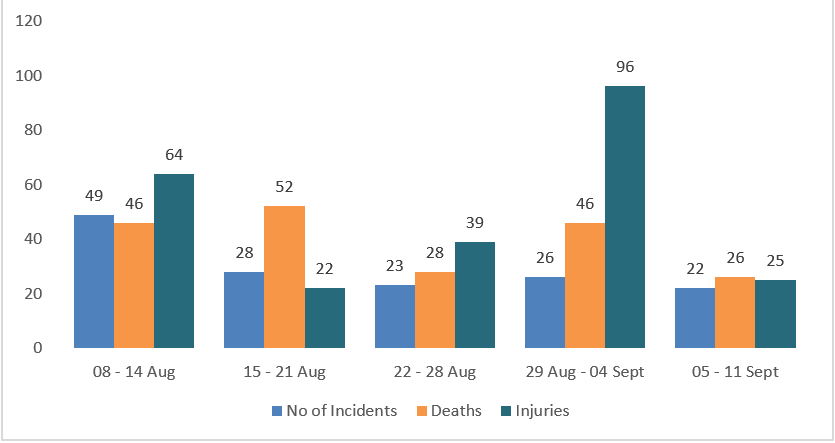
Militant violence in Pakistan declined during 5–11 September 2025, with 22 attacks compared to 26 the previous week, marking a 15 percent drop in frequency and operational intensity. Despite the decrease, security forces bore most of the casualties, with 16 personnel among the 26 killed and 18 of the 25 injured. Attacks were concentrated in mainland Khyber Pakhtunkhwa (10), former FATA (7), Balochistan (4), and Sindh (1). Tactically, incidents included nine armed assaults, five targeted killings, six IED blasts, and one mortar and rocket attack. In parallel, security forces intensified operations, mainly in KP and FATA, killing 43 suspected militants.
Operations in Khyber Pakhtunkhwa continued with Bajaur the main focus under Operation Sarbakaf. Authorities claimed the writ of the state restored, allowing over 3,000 families to return, though locals demanded faster clearance. Bajaur’s location and militant history make it strategic, prompting a mix of military action and community engagement. Fighting also continued in Mohmand, Waziristan, Bannu, and Lower Dir, with militants offering strong resistance. The strategy aims to push them toward border zones where heavy weapons and drones can be deployed, but political rifts hinder progress. The KP Assembly rejected the KP Action (in Aid of Civil Power) Ordinance, clashing with the federal government. Imran Khan, from prison, continues to call for dialogue with the TTP, while Islamabad insists on surrender, leaving operations without consensus.
The federal government declared a climate and agriculture emergency after floods displaced over two million people, submerged 1.3 million acres of farmland, and caused Rs536 billion in losses. Punjab’s cotton and rice crops were worst hit, threatening textile exports and food supplies, while livestock losses risk further inflation. Relief has been announced, but shortages remain. With the IMF review due September 25, growth is expected to slow, inflation to rise, and deficits to widen, worsening the economic toll.
The Balochistan Assembly passed amendments to the Anti-Terrorism Act 1997 to strengthen protection of judges, prosecutors, and witnesses through anonymity, virtual hearings, and trials at secure locations. Oversight of sensitive cases will be assigned to a BS-21 officer. The government said this would improve terrorism-related trials, but opposition warned of abuse and pressed for broader reforms. The Levies were also merged into police and forensic laws revised, aligning provincial steps with federal ATA amendments in a wider counterterrorism push.
A deadly suicide attack at a BNP-M rally prompted opposition-led strikes across Balochistan on September 8, shutting trade, transport, and schools, with highways to Afghanistan and Iran blocked. Police arrested over 300 protesters, including senior leaders, as clashes erupted in Quetta. Talks on September 9 led to detainees’ release and withdrawal of cases, briefly easing tensions, though opposition parties warned of renewed protests if demands are unmet.
An anti-terrorism court in Lahore convicted several senior PTI leaders for alleged roles in the May 9 riots, sentencing Yasmin Rashid, Omer Sarfraz Cheema, Mian Mehmoodur Rashid, and Ejaz Chaudhry to 10 years in prison, while Shah Mahmood Qureshi was acquitted. Imran Khan condemned ongoing operations, opposed drone strikes, and repeated calls for dialogue with the TTP, labeling May 9 a “false-flag operation.” Following his instructions, PTI senators resigned from parliamentary committees, signaling escalation against state institutions.
Reports suggest Pakistan has overtaken Afghanistan in opium production, with cultivation on 8,100 hectares in Balochistan, managed with Afghan expertise and solar irrigation. Proceeds are believed to fund ISKP, BLA, and other militant groups, raising security concerns and risks for Chinese projects. Despite official claims of a “poppy-free” policy, the trade flourishes under weak governance and corruption. Breaking this link is seen as crucial for stability in the province.
Protests in Gilgit-Baltistan against federal taxation have stretched over 50 days, closing the Khunjerab Pass, stranding Chinese nationals, and disrupting trade. Losses for local traders have reached billions, with protesters arguing taxation is unconstitutional without parliamentary representation. Talks have begun after officials admitted flaws, but the deadlock continues, harming livelihoods and undermining CPEC connectivity.
The federal government formed the National Paigham-i-Aman Committee under the NCNB to counter extremism and hate speech through a unified national narrative. Including clerics, minorities, and officials, and led by Maulana Tahir Ashrafi, the initiative builds on Paigham-i-Pakistan to promote sectarian dialogue and inclusivity. Its effectiveness, however, will depend on genuine community engagement beyond clerical and political circles.
Pakistan’s relations with Afghanistan remain tense as Islamabad continues deportations of undocumented Afghans while pressing Kabul over militant sanctuaries. The Foreign Office called the TTP a regional threat, but Taliban leaders accused Pakistan of shifting blame. Taliban ideological affinity with the TTP, reflected in public endorsements of armed struggle, complicates cooperation. Deportations through Chaman and Torkham continue despite UN appeals, with uncertainty around Afghans holding registration cards. Tighter border rules have slowed trade and raised costs. Domestically, Imran Khan urged dialogue with the Taliban government, but this has been ignored, suggesting relations will worsen.
Pakistan and Kazakhstan have intensified efforts to expand trade and connectivity ahead of President Kassym Jomart-Tokayev’s November visit to Islamabad, the first in over two decades. A Kazakh delegation prioritized a railway through Afghanistan linking Central Asia to Pakistani ports. Both sides agreed to boost trade from $239 million to $1 billion through a transit trade pact, logistics consortium, and sectoral cooperation in agriculture, IT, leather, and SMEs. Engagements also emphasized port access, technology transfer, and IT partnerships. An Action Plan of Cooperation 2025–26 was signed, covering trade, defence, science, culture, and humanitarian assistance, reflecting intent to institutionalize ties.
Pakistan and Bahrain agreed to expand cooperation in counterterrorism, narcotics control, and border security, establishing a Joint Working Group to structure collaboration. Both sides advanced MoUs on extradition, legal assistance, and training, with Bahrain appointing a Drug Liaison Officer in Islamabad. Pakistan highlighted record narcotics seizures and its expatriate community in Bahrain, while Manama reaffirmed its commitment to closer ties. Talks also covered coast guard coordination, police training, and investment facilitation. Prime Minister Shehbaz Sharif assured expedited visas and favorable conditions for Bahraini investors, pairing security ties with broader economic cooperation.
To get access to the complete report please become a subscriber. For the details of subscription please Click Here