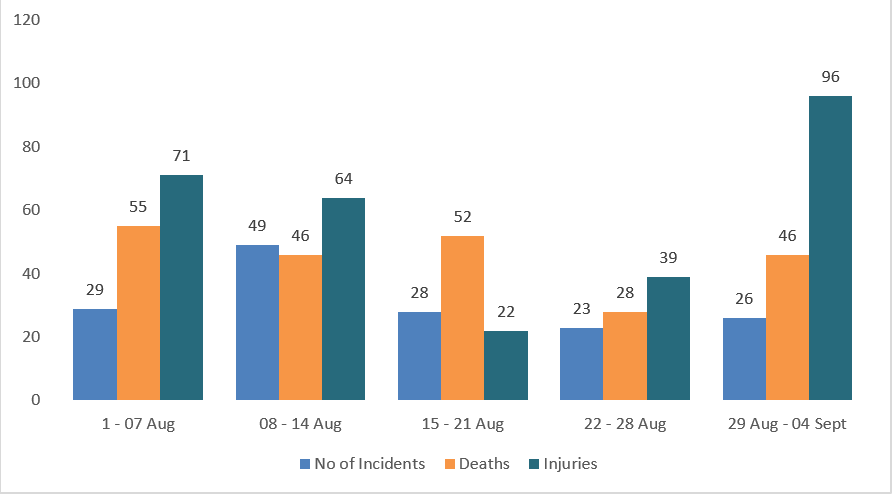
During 29 Aug-4 Sep 2025, militant violence escalated with 26 attacks compared to 23 the previous week, causing 60 deaths—including 28 security personnel and 19 civilians—and 96 injuries. Erstwhile FATA and mainland Khyber Pakhtunkhwa each reported 10 incidents, while Balochistan saw six. Tactics included armed assaults, IEDs, grenade and mortar attacks, suicide bombings, quadcopter strikes, and a VBSA-TA. Security forces carried out 13 intelligence-based operations, killing 15 suspected militants and arresting five, mainly in KP, erstwhile FATA, and Balochistan.
The Balochistan government extended Section 144 across the province until September 14, marking its third consecutive extension since August 1, citing fragile law and order conditions. The restrictions, which ban public gatherings, unregistered vehicles, and concealment of identity, were reinforced by a suicide bombing on September 2 targeting a BNP rally in Quetta that killed 15 and injured around 30. Claimed by the Islamic State of Pakistan Province (ISPP), the attack highlighted the province’s worsening security environment, where Baloch separatist groups and religiously motivated militants such as the TTP have both escalated activities.
In response to the Quetta bombing, six opposition parties announced a province-wide strike on September 8 to protest the attack and broader failures of state institutions. Party leaders, including Akhtar Mengal and Mehmood Khan Achakzai, condemned recurring violence, criticised intelligence agencies for failing to prevent attacks, and accused the state of targeting political workers instead of militants. They framed the incident within a history of impunity and neglect of provincial rights, arguing that justice and accountability have repeatedly been denied.
Human rights groups and civil society organisations renewed criticism of enforced disappearances, describing the practice as an entrenched state tool of repression. They denounced the ineffectiveness of the Commission of Inquiry on Enforced Disappearances, which has failed to pursue prosecutions despite recording thousands of cases. Concerns intensified with the recent amendment to the Anti-Terrorism Act, granting security forces expanded detention powers that rights advocates fear will worsen arbitrary arrests. While the government defends the changes as necessary counterterrorism measures with safeguards, activists argue they risk perpetuating impunity, especially against minorities, journalists, and political activists. Calls for Pakistan to align domestic laws with international human rights standards highlight the deepening tension between state security priorities and accountability.
Pakistan escalated its crackdown on undocumented Afghans after the August 31 deadline for voluntary repatriation, directing daily reporting of detentions and deportations under the Illegal Foreigners Repatriation Plan. Officials justified the measures as necessary for security and economic management, but the timing coincided with a devastating earthquake in Afghanistan that killed over 1,400 people and displaced half a million, intensifying humanitarian concerns. The UN and international agencies appealed for a pause, warning forced returns would worsen conditions and strain relief operations. Despite these appeals, Pakistan simultaneously sent humanitarian aid across the border, reflecting its effort to balance domestic enforcement with gestures of regional solidarity.
Prime Minister Shehbaz Sharif’s visit to Beijing deepened Pakistan–China ties with the launch of CPEC 2.0, new trade agreements, and $8.5 billion in business deals. The second phase prioritises agriculture, mining, industrial relocation, and emerging technologies, while also stressing security for Chinese nationals in Pakistan following repeated militant attacks. Both sides reaffirmed their strategic partnership through the Joint Action Plan 2024–2029, with Pakistan highlighting key infrastructure projects such as the ML-I railway and Gwadar Port. Marking a symbolic dimension, Shehbaz invited President Xi to Pakistan in 2026, the 75th anniversary of diplomatic relations, underscoring the partnership’s long-term significance.
At the SCO Summit, Prime Ministers Shehbaz Sharif and Narendra Modi avoided direct confrontation, instead relying on veiled references in their speeches. Shehbaz framed Pakistan as a victim of terrorism and pressed for dialogue on water disputes under the Indus Waters Treaty, while Modi condemned states supporting terrorism without naming Pakistan. The joint declaration balanced references to attacks claimed by each side, reflecting Chinese mediation and the SCO’s effort to preserve consensus. The exchanges highlighted the fragile balance between confrontation and cooperation in South Asia, with multilateral platforms serving as controlled arenas for engagement despite persistent disputes.
On the sidelines of the summit, Shehbaz also held bilateral meetings with Russian President Vladimir Putin and Turkish President Recep Tayyip Erdoğan. Discussions with Putin focused on broadening economic ties, balancing regional relations, and an invitation for Shehbaz to visit Moscow. Talks with Erdoğan emphasised deepening political, defence, and economic cooperation, as well as solidarity over humanitarian crises, particularly in Gaza. These engagements reflected Islamabad’s strategy of diversifying partnerships with major powers while reinforcing bonds with traditional allies in the Muslim world.
The SCO Summit concluded with the Tianjin Declaration, reaffirming counterterrorism and security as core priorities. Leaders condemned recent attacks in India and Pakistan, pledged to implement the 2025–2027 cooperation programme, and advanced plans for new centres to address terrorism and organised crime. The declaration also addressed regional flashpoints, calling for an immediate ceasefire in Gaza, condemning U.S. and Israeli strikes on Iran, and urging a peaceful resolution to Afghanistan’s crisis through an inclusive settlement. The outcomes underscored the SCO’s dual role as a security forum and a platform for political alignment on global and regional issues.
Russia has warned of growing militant presence in Afghanistan, estimating 23,000 fighters from groups like ISIS-K, TTP, and ETIM, while accusing Western intelligence of exploiting Afghan territory. Moscow, aligning with Pakistan and China, stressed that recognition of the Taliban depends on their ability to counter militancy, though Kabul denies hosting foreign threats and cites its Doha Agreement commitments. At the SCO summit in China, Afghanistan’s stability and connectivity potential were highlighted, even without Taliban participation. Tensions rose after Pakistani airstrikes in Nangarhar and Khost drew Kabul’s condemnation, though both sides engaged diplomatically following Afghanistan’s deadly earthquake. Meanwhile, the Taliban continued reshuffling key posts to tighten control amid calls for inclusivity.
To get access to the complete report please become a subscriber. For the details of subscription please Click Here