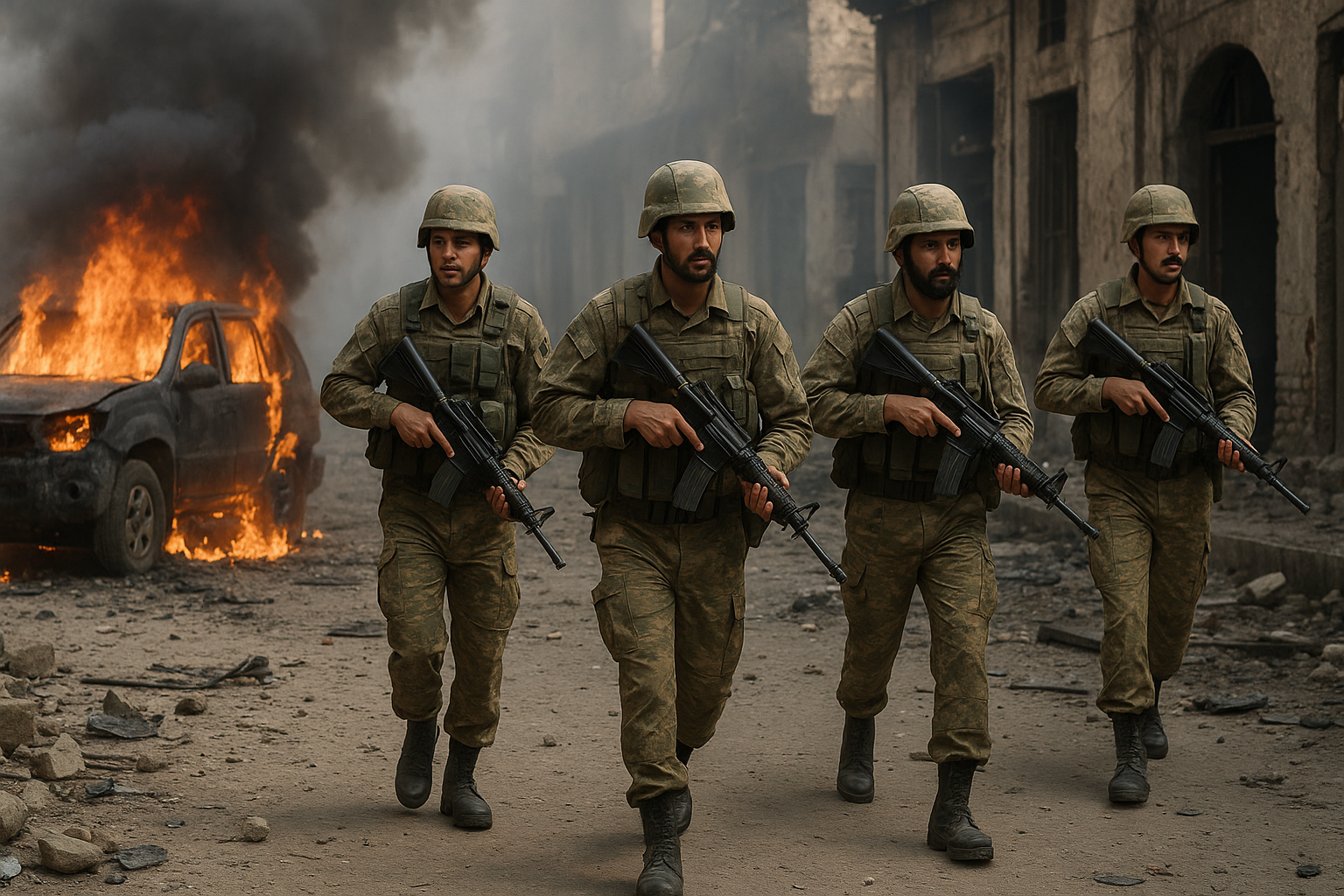
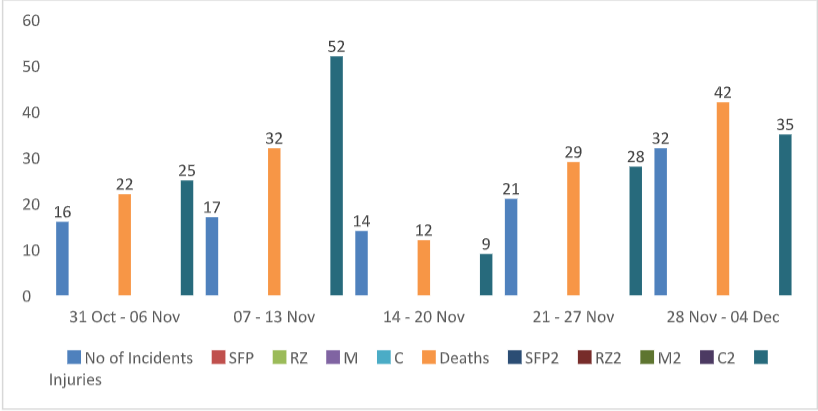
Militant attacks surged sharply during the week under review, with attacks rising from
21 to 32 and resulting in 42 deaths and 35 injuries—significantly higher than the previous
week’s toll. The escalation reflects militants’ sustained operational capability and expanding
geographic reach, with Khyber Pakhtunkhwa and Balochistan each reporting 14 attacks and
erstwhile FATA registering four. The spike in Balochistan was particularly concerning, as
targeted killings and assaults on security personnel drove much of the lethality. Tactical assaults
and IED attacks remained the most prevalent methods, while the growing use of hybrid tactics,
including suicide-cum-assaults and quad-copter strikes, points to increasing sophistication. With
only four counterterrorism operations conducted—killing nine militants and arresting two—the
reduced CT tempo contrasted sharply with the rise in militant activity, suggesting that miliant
groups may be regaining tactical momentum and exploiting operational gaps in several high-
risk regions.
The federal government’s approval of Field Marshal Asim Munir as Pakistan’s first Chief
of Defence Forces (CDF) marked a major restructuring of the country’s military command,
replacing the abolished Chairman Joint Chiefs of Staff Committee under the newly enacted 27th
Constitutional Amendment. Munir will serve a five-year term overseeing both the army and the
unified defence command, while Air Chief Marshal Zaheer Ahmed Babar Sidhu received a two-
year extension. The transition requires significant legal revisions to the National Command
Authority Act to clarify the roles of the Air Force and Navy within the reorganised strategic
command, signalling a complex reshaping of Pakistan’s defence architecture.
Political tensions continued to intensify as disputes over access to Imran Khan,
provincial–federal friction in KP, and renewed debates over administrative restructuring
converged. Restrictions on PTI leaders visiting Imran Khan, repeated denial of meetings to KP’s
chief minister, and protests under Section 144 highlighted growing mistrust. Within KP, the
assembly’s unanimous resolution for a separate Hazara province revived longstanding
administrative demands, while federal discussions on imposing governor’s rule—citing
governance failures and security concerns—added further uncertainty. Though seen partly as
leverage to pressure the PTI-led provincial government, the option remains on the table,
particularly if Islamabad adopts a “hard” measures against Afghanistan.
The passage of the National Commission for Minority Rights Bill 2025 marked a
significant institutional milestone after years of delay, establishing a statutory body mandated
to safeguard minority rights, investigate violations, and monitor implementation of
constitutional protections. While the bill overcame political disagreements, some religious
parties raised concerns over legal ambiguities, leading to the removal of a contentious clause.
The commission’s success will depend on its ability to operate independently, the state’s
commitment to enforce its recommendations, and societal willingness to confront hate speech,
discrimination, and targeted violence against minorities.
The inaugural meeting of the 11th National Finance Commission opened with
expressions of consensus but quickly revealed divergences over whether expenditure
responsibilities should be included in negotiations, with Sindh and KP insisting on adhering
strictly to the constitutional revenue-sharing mandate. A breakthrough came when all parties
agreed to explore modalities for increasing KP’s share following the FATA merger. Nonetheless,
the Centre highlighted severe fiscal constraints and urged provinces to enhance their own-
source revenues, while stakeholders formed seven thematic working groups to develop a
future-oriented NFC Award.
The government advanced its proposed Cybersecurity Act as a flagship reform intended
to strengthen national digital resilience by establishing a National Cybersecurity Authority,
enhancing incident response capacity, and building secure digital public infrastructure.
However, persistent vulnerabilities, repeated cyber breaches, and concerns over expansive
surveillance and internet restrictions underscore that meaningful progress will require a
transparent, civilian-led architecture that balances security imperatives with rights protections
and technological competence.
Pakistan–Afghanistan relations remained fraught, with Islamabad declaring that its
informal ceasefire understanding with Kabul was no longer effective amid continued cross-
border attacks. High-level statements revealed that Pakistan had contemplated kinetic strikes
but held back due to Qatari mediation, while unconfirmed reports suggested a brief,
unproductive Saudi-mediated meeting in Riyadh. Border closures, humanitarian exemptions,
economic fallout in KP, and Taliban demands for guarantees further illustrated the deepening
impasse, with both sides appearing constrained and no credible mechanism in sight to restore
trust or curb militant activity emanating from Afghan territory.
Pakistan expressed conditional willingness to contribute personnel to the proposed
Gaza International Stabilisation Force, insisting that it would not participate in any effort to
disarm Hamas and framing its role strictly as peacekeeping rather than enforcement. With
other Muslim-majority countries expressing similar reservations and troop commitments
uncertain, Pakistan’s position reflects a cautious diplomatic calibration sensitive to domestic
opinion, geopolitical dynamics, and the unresolved terms of the force’s mandate.
Pakistan signalled openness to new regional cooperation frameworks as SAARC remains
defunct, with the foreign minister advocating for flexible, inclusive regionalism and highlighting
emerging trilateral engagement with China and Bangladesh as a potential model. Efforts to
build new platforms reflect shifting geopolitical dynamics, persistent India–Pakistan tensions,
and renewed space for alternative groupings involving Sri Lanka, the Maldives, and possibly
Afghanistan, though New Delhi’s participation remains unlikely.
Bilateral engagement between Pakistan and Egypt gained momentum with the visit of
Egypt’s foreign minister, resulting in commitments to deepen cooperation on defence,
counterterrorism, trade, investment, education, and cultural exchange. Discussions highlighted
opportunities for expanded economic ties, coordination on regional issues such as Gaza, and
the revival of institutional mechanisms to strengthen strategic partnership, signalling renewed
energy in Pakistan’s diplomatic outreach.
To get access to the complete report please become a subscriber. For the details of subscription please Click Here