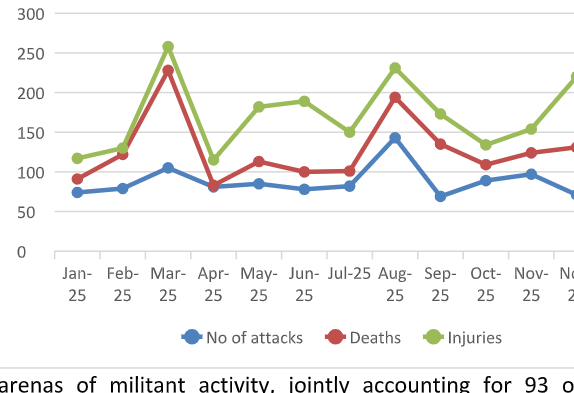
Militant attacks in Pakistan continued to intensify in November, with 97 attacks—an
increase of nine percent from the previous month—resulting in 124 fatalities and 154
injuries. Khyber Pakhtunkhwa and Balochistan remained the epicentres of this violence,
accounting for majority of incidents. Mainland KP experienced sustained pressure on police
posts, peace committees, and security convoys, while the merged districts faced complex
assaults, cross-border infiltrations, and high-profile attacks such as the strike on Cadet
College Wana. Balochistan recorded increased ambushes, targeted killings, and kidnappings,
primarily affecting civilians. Islamabad witnessed its most serious attack in years—a suicide
bombing near the District Courts—signalling a worrying expansion of militant operational
space. The national trajectory remains sharply upward: 1,005 militant attacks from January
to November caused 1,451 deaths, surpassing 2024 totals, while overall conflict-related
fatalities reached 3,144, underscoring the resilience and adaptive capacity of militant
networks despite CT pressures.
Security forces maintained an intensive counterterrorism posture eliminating 168
militants in November. Although lower than October’s extraordinary toll, the month still
reflected sustained operational pressure and improved intelligence coordination. Losses to
the security forces remained minimal, with only four personnel injured and no fatalities. KP
once again formed the core of operational activity, with 26 actions resulting in 116 militant
deaths mainly in Bannu, Lakki Marwat, and DI Khan—areas that have experienced persistent
militant resurgence. The erstwhile FATA witnessed 13 intelligence-driven operations that
killed 48 militants embedded in difficult border terrain. In Balochistan, four operations
resulted in four militant deaths, while Punjab and Sindh carried out preventive, intelligence-
led actions that disrupted plots without armed engagements.
These security dynamics unfolded against a backdrop of heightened preventive
measures across the country. Balochistan imposed mobile-internet shutdowns, mirroring a
continued reliance on communication blackouts as a tool to mitigate security risks despite
public frustration. Punjab and Sindh extended Section 144 restrictions amid concerns over
unrest following the proscription of Tehreek-i-Labbaik Pakistan (TLP). The federal
government, responding to the Islamabad suicide attack, launched the “Safe Secure
Islamabad” initiative—an expansive surveillance and data-collection programme involving
detailed neighbourhood surveys, compulsory documentation, and planned electronic
vehicle tagging. While authorities justified these measures on security grounds, they fuelled
debate over privacy, governance capacity, and the narrowing of civic space.
The ban on TLP triggered visible internal fragmentation, with several leaders publicly
distancing themselves from the organisation over its violent mobilisation and destabilising
effects. The Punjab government intensified its crackdown, freezing assets, blocking bank
accounts, assuming administrative control of TLP-linked religious sites, arresting thousands,
and placing dozens of activists on the Fourth Schedule. Joint investigation teams were
formed to pursue financial and legal cases. Although the party has challenged the ban
through a review petition, underlying ideological drivers that shape its support base remain
largely intact, highlighting a deeper governance and societal challenge.
Khyber Pakhtunkhwa faced its own political and institutional turbulence as
lawmakers confronted a deteriorating security environment and sought a unified provincial
counterterrorism strategy. Briefings revealed the presence of roughly 4,000 militants in the
province, concentrated in the merged districts. A broad-based peace jirga called for closer
coordination with the federal government, stronger civilian law enforcement capacities, and
enhanced cross-border policy coherence. Meanwhile, the PTI-led government expanded the
Special Branch into a parallel intelligence structure directly under the chief minister, raising
concerns about resource diversion away from the police and CTD. This restructuring
appeared aimed at consolidating political and institutional authority during a period of
mounting security pressure and strained civil–military relations.
National political developments were dominated by the sweeping 27th
Constitutional Amendment, which introduced far-reaching changes to Pakistan’s judicial and
defence architecture. The creation of the Federal Constitutional Court and expanded
executive influence over judicial appointments prompted the resignations of senior
Supreme Court judges, who warned of weakened judicial independence and excessive
concentration of power. Parallel amendments to the military command framework
consolidated authority under the army chief in the newly created position of Chief of
Defence Forces. Critics argued that these measures entrenched Pakistan’s hybrid
governance model and diminished civilian oversight. Further planned constitutional
changes—particularly regarding resource distribution and the creation of new
provinces—may deepen political polarisation.
The PML-N strengthened its political position by winning 12 of 13 seats in the 23
November by-elections across Punjab and KP, consolidating its status as the largest
parliamentary party. Although turnout fell sharply and PTI rejected the results as
manipulated, the ruling party framed the outcome as public validation of its governance
performance. With a stronger parliamentary presence, the PML-N now wields increased
leverage in shaping administrative reforms and potential restructuring initiatives.
Governance challenges were further highlighted by the IMF’s Governance and
Corruption Diagnostic, which issued a stark critique of Pakistan’s systemic corruption, elite
capture, and weak enforcement mechanisms. The report warned that fragmented oversight
and opaque decision-making structures—whether in budgeting, procurement, taxation, or
state-owned enterprises—pose critical barriers to economic stability. A 15-point reform
agenda recommended unified asset declarations, strengthened anti-corruption frameworks,
digitised procurement, and enhanced transparency within major institutions including the
SIFC. The IMF also underscored the link between corruption, illicit economies, and internal
security, noting how informal networks facilitate militant financing and erode state capacity.
In Azad Jammu and Kashmir, political instability persisted as a no-confidence motion
removed PM Chaudhry Anwarul Haq and installed PPP’s Raja Faisal Mumtaz Rathore. The
new prime minister announced an ambitious administrative reform agenda focused on
reducing bureaucratic excess, improving service delivery, and restructuring recruitment
mechanisms. A large cabinet dominated by PPP members and PTI defectors was sworn in to
consolidate political control ahead of the 2026 elections. Whether these reforms yield
substantive improvements remains uncertain given the region’s long-standing political
volatility.
Pakistan’s foreign relations reflected heightened complexity. Relations with
Afghanistan deteriorated sharply as Islamabad accused the Taliban of harbouring anti-
Pakistan militants and refusing verifiable action against TTP networks. Talks in Istanbul
collapsed, border closures inflicted heavy economic losses, and Kabul intensified efforts to
diversify trade away from Pakistan. Both sides exchanged accusations over cross-border
strikes, while Pakistan allowed limited humanitarian transit and signalled that its patience
was nearing exhaustion. Mediation attempts by Iran, Qatar, Russia, and reportedly Saudi
Arabia offered limited openings, but structural divergences—particularly Kabul’s reluctance
to curb anti-Pakistan militants—left ties precarious and raised the possibility of cross-border
strikes should violence continue.
India’s posture combined assertive signalling with selective restraint. Hard-line
statements by senior military and political leaders contrasted with the Modi government’s
decision not to blame Pakistan for domestic security incidents, reflecting a calibrated
political strategy ahead of national elections. Nevertheless, provocative comments on Sindh
heightened tensions, while Pakistan’s successful test of a ship-launched anti-ship ballistic
missile served as a deterrent signal amid growing Indian emphasis on maritime dynamics.
Pakistan deepened defence cooperation with Saudi Arabia, Iran, Jordan, Bahrain,
Russia, Bangladesh, Brunai, Indonesia, UK and Azerbaijan through a succession of high-level
exchanges, joint exercises, and economic-security initiatives. Defence ties with Saudi Arabia
moved closer to operationalising the Strategic Mutual Defence Agreement, while Iran’s
senior leadership signalled readiness for expanded cooperation across counterterrorism,
trade, and connectivity. Jordan’s king reinforced bilateral defence and humanitarian
collaboration, Bahrain committed to doubling bilateral trade and security coordination, and
Russia strengthened economic and strategic engagement through the Intergovernmental
Commission. Bangladesh, Azerbaijan, and Southeast Asian states also saw renewed defence
outreach, including training programmes, naval engagement, and senior military visits.
Pakistan’s counterterrorism training for Iraq and joint exercises with Indonesia further
highlighted its expanding role as a security capacity-builder in the region.
Overall, November was marked by escalating militant violence, intensifying
counterterrorism operations, expanding preventive controls, deepening political
polarisation, and complex external engagements. While Pakistan continued to deepen
defence partnerships and navigate shifting regional geopolitics, internal security pressures,
governance challenges, and strained relations with Afghanistan shaped a volatile strategic
environment heading into the final month of the year.
To get access to the complete report please become a subscriber. For the details of subscription please Click Here