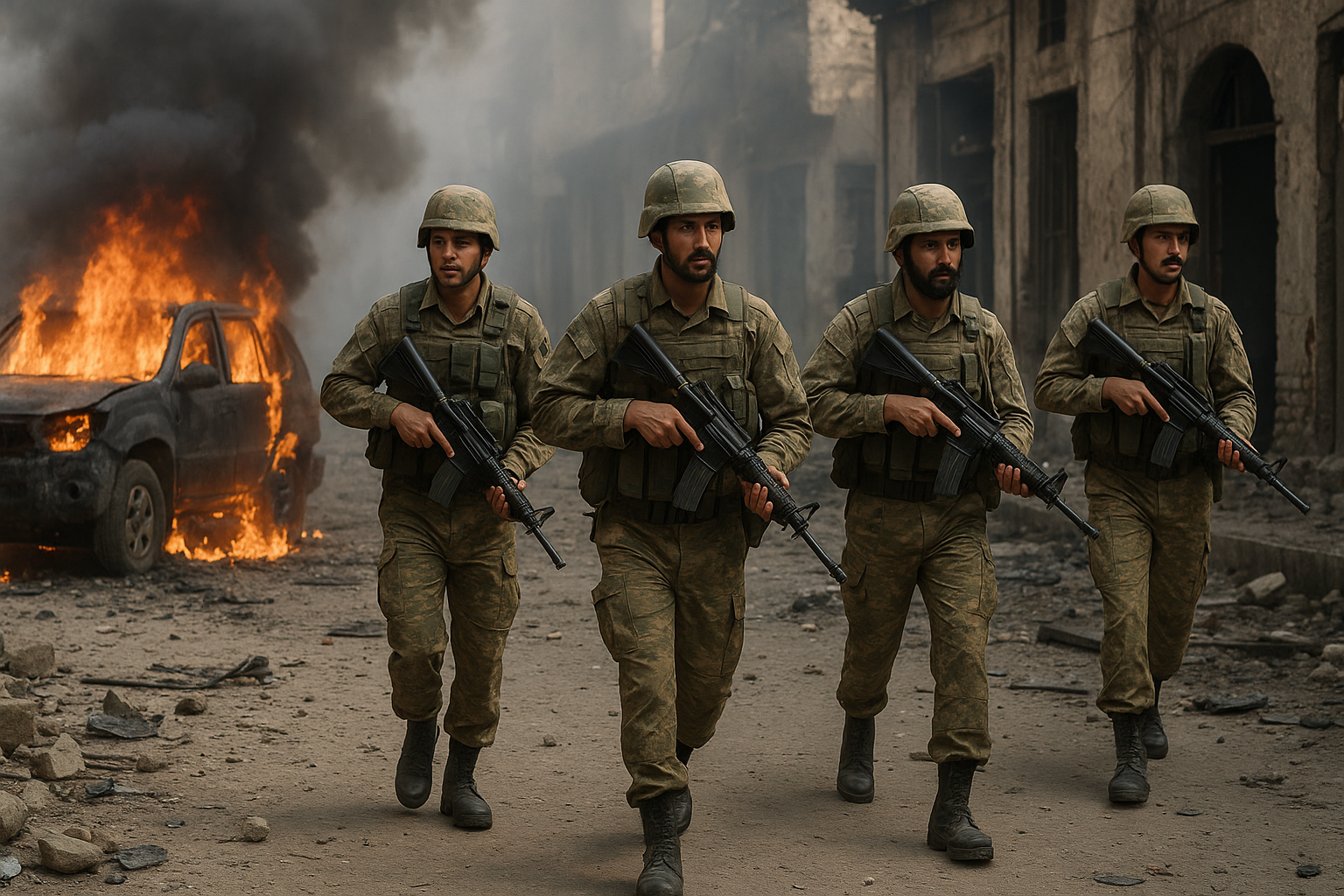
Pakistan recorded 17 militant attacks nationwide resulting in 13 fatalities and 12 injuries, indicating a short-term dip in violence. Khyber Pakhtunkhwa (KP) accounted for eight attacks , erstwhile FATA reported five attacks and Balochistan saw four attacks. Despite the decline, the reduction should be treated cautiously, as militant groups may be staging preparatory activity for larger, high-impact attacks, consistent with historical early-year escalation patterns. Tactical assaults dominated (six incidents), killing one security personnel and eight militants, suggesting either poor militant execution or improved force readiness. Five IED attacks caused no civilian or security force casualties, though two militants were killed, while three grenade attacks resulted in one civilian death and one injury. One quadcopter and one rocket attack injured eight civilians. Meanwhile, eight counterterrorism operations killed 14 militants and led to the arrest of 49 suspects, reflecting sustained operational pressure across KP, Balochistan, Punjab, and erstwhile FATA.
The military operation in Tirah (Khyber District) triggered sharp political debate, with senators questioning civilian displacement planning, governance coordination, and transparency. On 19 January, ANP and PTI lawmakers criticised both federal and provincial authorities, while PML-N figures challenged KP’s long-term security record and demanded accountability for counterterrorism funding. The crisis was worsened by heavy snowfall since 21 January, which stranded residents, blocked key routes to Bara and Peshawar, and delayed evacuations. Authorities extended the evacuation deadline to 5 February, while the army and civil administration continued relief operations amid deteriorating humanitarian conditions.
Federal–provincial rift over military operations in KP deepened. The federal interior ministry blamed the PTI-led provincial government for security failures and reaffirmed continued intelligence-based operations. In response, KP Chief Minister Sohail Afridi criticised operations conducted without provincial consent, called for broader stakeholder engagement, questioned the long-term effectiveness of repeated campaigns, raised concerns over civilian harm, and accused the Centre of delaying IDP funding and unfairly burdening provincial resources—warning that unresolved humanitarian and governance grievances could intensify instability.
In Balochistan, militants linked to the BLA carried out a coordinated urban assault in Kharan, targeting a police station and two banks, looting Rs3.4 million, and attempting to engineer a hostage situation before retreating. Clearance operations killed 12 militants, but the incident highlighted militants’ ongoing ability to conduct high-impact, coordinated attacks. The selection of financial and law-enforcement targets suggests a dual strategy: undermining state authority and generating funds, possibly reflecting reduced external financial flows. The episode signals tactical adaptation and underscores the need for financial disruption, intelligence-led operations, and governance outreach, not solely kinetic responses.
Separately, Chief Minister Sarfraz Bugti announced legal reforms to address enforced disappearances, counter politicisation of missing-person narratives, and strengthen accountability. The provincial cabinet approved detention and deradicalisation rules under the Balochistan Prevention of Detention and De-radicalisation Act, 2025, establishing regulated detention centres with mandatory family notification, visitation rights, and medical access. Amendments to the Witness Protection Bill were also approved, enabling faceless testimony to improve conviction rates in terrorism cases. These measures aim to enhance transparency, rebuild public trust, and strengthen institutional credibility amid persistent security and governance challenges.
On the political front, the opposition alliance Tehreek Tahafuz Ayeen-i-Pakistan (TTAP) consolidated leadership with Mehmood Khan Achakzai as Leader of the Opposition in the National Assembly and Allama Raja Nasir Abbas in the Senate. While Achakzai signalled conditional openness to dialogue, TTAP simultaneously advanced a confrontational mobilisation strategy, including a 14-point charter demanding election accountability, release of political prisoners, repeal of PECA, and a nationwide strike on 8 February. The opposition is therefore pursuing a dual-track approach—parliamentary engagement alongside street pressure—reshaping institutional contestation and political leverage.
The Gul Plaza fire in Karachi reignited debate over the 18th Constitutional Amendment, exposing divisions over decentralisation, governance capacity, and accountability. Some ruling coalition voices and MQM-P leaders argued that provincial devolution weakened urban governance, advocating stronger local governments or federal oversight, including proposals for federal control of Karachi. The PPP, however, defended the amendment as essential to provincial autonomy, warning against recentralisation. The tragedy has evolved into a broader constitutional and fiscal flashpoint, intersecting debates on local governance reform and potential revisions to the National Finance Commission (NFC).
In regional security and defence, a Pakistan Air Force contingent deployed to Saudi Arabia for Exercise Spears of Victory 2026, involving air forces from Saudi Arabia, Pakistan, France, Italy, Greece, Qatar, Bahrain, Jordan, the United Kingdom, and the United States. Operating F-16 Block-52 aircraft from King Abdulaziz Air Base, the exercise focuses on large-force employment, night combat, ISR integration, and electronic warfare, underscoring Pakistan’s expeditionary capability, interoperability, and readiness for high-tech conflict environments.
Pakistan also joined Egypt, Jordan, the UAE, Turkiye, Saudi Arabia, and Qatar in endorsing Donald Trump’s ‘Board of Peace’ initiative on Gaza, aimed at supporting a ceasefire, reconstruction, and a long-term political settlement under UN Security Council Resolution 2803. The board’s charter reportedly grants Trump extensive executive authority, raising concerns about undermining UN mechanisms. The move has triggered domestic political backlash, with opposition parties criticising the lack of parliamentary consultation, while the government frames participation as aligned with national interest and Palestinian solidarity. Amnesty International and other actors have warned the initiative may weaken international legal and multilateral norms, placing Pakistan at the intersection of global diplomatic realignment and internal political contestation.
Pakistan further warned that India’s decision to place the Indus Waters Treaty (IWT) in abeyance constitutes a “weaponisation of water”, posing severe risks to national water security and regional stability. Pakistan’s UN Ambassador cited disrupted river flows and withheld hydrological data since April 2025, stressing that the Indus Basin supports over 80 percent of Pakistan’s agriculture and millions of livelihoods. The Ministry of Water Resources warned that declining Chenab River flows could affect millions of acres of farmland, while per-capita water availability continues to fall toward critical scarcity thresholds. Islamabad has also raised concerns over abnormal Chenab flow reductions in December 2025, reinforced by UN expert warnings on humanitarian and economic risks.
Meanwhile, Pakistan–US security and defence cooperation expanded following talks between Interior Minister Mohsin Naqvi and a US delegation led by Natalie Baker, covering counterterrorism, border management, law enforcement, cybercrime, and financial crime prevention. Military engagement also intensified, highlighted by the conclusion of Exercise Inspired Gambit and the December 2025 approval of a $686 million F-16 upgrade package, signalling a more pragmatic phase in bilateral security relations amid shifting regional and Middle Eastern dynamics.
Finally, Pakistan–Afghanistan relations remained strained, as Islamabad reiterated concerns over cross-border militancy and Kabul announced a ban on Pakistani medicine imports effective 9 February, raising risks of healthcare shortages in Afghanistan. Prime Minister Shehbaz Sharif said Pakistan was forced to halt trade due to Afghanistan’s failure to act against groups such as the TTP and BLA, citing unmet commitments under the 2020 Doha Accord. Despite Saudi facilitation, no diplomatic breakthrough emerged, while Taliban-linked media and intelligence-affiliated accounts continued anti-Pakistan narratives, including accusations following a Kabul restaurant attack. Although ISKP remains a potential confidence-building area for joint counterterrorism cooperation, Afghanistan appears to prioritise political point-scoring over pragmatic engagement, limiting prospects for de-escalation.
To get access to the complete report please become a subscriber. For the details of subscription please Click Here