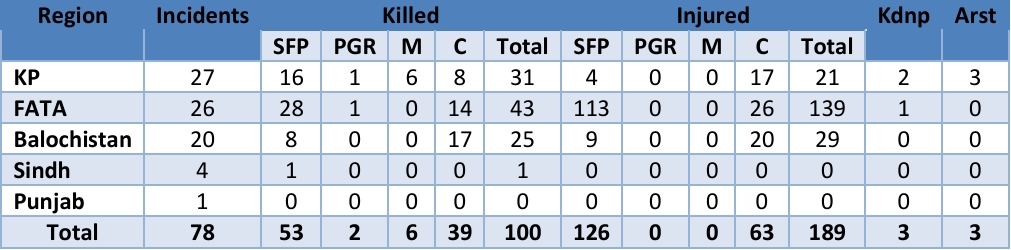
Despite several high-profile incidents, Pakistan witnessed a slight decline in militant
violence in June 2025, with 78 attacks resulting in 100 deaths and 189 injuries—an 8% drop
in attacks and 12% decrease in fatalities, though injuries rose by 4% compared to May. Yet,
the broader trend remains alarming: in the first half of 2025, 502 attacks caused 737 deaths
and 991 injuries, reflecting a 5% rise in incidents and a sharp increase in fatalities (121%) and
injuries (84%) year-on-year. Most violence remained concentrated in Khyber Pakhtunkhwa
(KP) and Balochistan, which saw 73 of the 78 June attacks. KP reported 53 incidents, with 74
killed—mainly security personnel—and 160 injured. Balochistan saw 20 attacks resulting in
25 deaths and 29 injuries. Sindh and Punjab recorded four and one incidents, respectively,
with no attacks in AJK or Gilgit-Baltistan.
Security forces responded with intensified operations, killing 71 militants and arresting
52 suspects. These actions also resulted in the deaths of two security personnel and two
civilians, while 10 militants and five civilians were injured. The erstwhile FATA region saw the
deadliest confrontations, with 44 militants killed, 10 injured, and two soldiers martyred. In
Balochistan, five operations led to 16 militant deaths and 40 arrests. Punjab saw five militants
killed and six arrested, while four suspects were detained in Sindh. Overall, 688 militants have
been killed and 225 arrested in the first half of 2025, reflecting the state’s aggressive posture
against rising militancy.
On political front, Pakistan Tehreek-e-Insaf (PTI) continues to face internal
fragmentation, legal challenges, and dwindling political space as Imran Khan attempts a
comeback from prison. His accusations and protest calls have not unified the party or shifted
public momentum. PTI remains divided, especially in Khyber Pakhtunkhwa, with inconsistent
protest strategies and deepening leadership rifts. Judicial decisions, particularly the loss of 74
reserved seats, further weakened its standing and gave the ruling coalition a supermajority.
With Khan’s legal troubles worsening and bail denials mounting, the federal government has
shown openness to engaging moderate PTI leaders. Yet, internal divisions between hawks and
pragmatists continue to paralyze the party.
Pakistan’s economy showed tentative signs of recovery in FY2024–25, bolstered by
macroeconomic stabilization, falling inflation, financial support from friendly countries
including China, and improved investor confidence. GDP growth reached 2.68%, with better
performance in industry and services, and inflation fell to 4.7%. The federal budget projected
4.2% growth, but structural issues remain, including Rs8.2 trillion in debt servicing and heavy
dependence on indirect taxes. Defence spending rose by over 20%, while BISP allocations
expanded. However, critics cited a narrow tax base, underinvestment in public services, and
weak job creation. Debt rollovers from China restored reserves to $14 billion, but $20 billion
in repayments are due next year. Despite positive reforms in energy, IT, and SMEs,
inconsistent policies and lack of inclusive development threaten long-term stability.
India-Pakistan ties remain fragile after the April 22 Pahalgam attack triggered cross
border strikes in early May. Though large-scale conflict was narrowly averted—reportedly
with U.S. mediation—the incident highlighted a dangerous absence of crisis communication
and growing mistrust. Pakistan launched an international campaign accusing India of treaty
violations and transnational repression, while India defended its actions as counterterrorism and rejected third-party mediation. Legal confrontations intensified over the Indus Waters
Treaty, where Pakistan won a jurisdictional ruling. Both sides clashed at multilateral forums
like the SCO and UN, and Pakistan claimed to dismantle an Indian spy network. Despite the
ceasefire, entrenched disputes and hardened narratives keep relations dangerously brittle,
with little hope of improvement absent formal dialogue frameworks.
Amid escalating Middle East tensions following Israeli strikes on Iranian nuclear facilities,
Pakistan adopted a balanced diplomatic approach—supporting Iran’s sovereignty while
maintaining ties with the U.S. Islamabad condemned the strikes in forums like the UN and
OIC, coordinated with Gulf and Chinese partners for de-escalation, and reportedly played a
backchannel role—via Prime Minister Shehbaz Sharif and Army Chief Asim Munir—in
brokering a ceasefire. Legalistic and neutral in tone, Pakistan positioned itself as a potential
mediator. Following this solidarity, Islamabad now expects Tehran’s cooperation in curbing
anti-Pakistan militants allegedly operating from Iranian soil, especially those linked to hostile
intelligence networks like India’s RAW. With new counter-militancy operations planned in
Balochistan, Pakistani officials hope for enhanced Iranian support.
Pakistan–U.S. relations have entered a more multidimensional phase, moving beyond
traditional security cooperation toward expanded economic, technological, and military
engagement. This shift was symbolized by Army Chief Field Marshal Asim Munir’s
unprecedented meeting with President Trump, and later by a visit by Pakistan’s Air Force
Chief. Discussions spanned regional stability, counterterrorism, trade, and advanced
technologies. Joint operations against IS-K and dialogue on airpower strategy underscored
growing trust. Pakistan’s controversial nomination of Trump for the Nobel Peace Prize drew
domestic backlash, but diplomatic momentum continued with civilian-military contacts and
trade talks. Still, U.S. priorities remain India-centric, and ties with Pakistan retain a
transactional tone. Nevertheless, Islamabad’s geo-economic pivot and institutional outreach
suggest a promising reset.
In Afghanistan, regional powers resumed cautious engagement with the Taliban amid
persistent Western hesitation and growing security concerns. Russia accepted a Taliban
ambassador and signaled broader cooperation in addition to recognition of Taliban
government, while Uzbekistan and Kazakhstan pursued structured dialogue on economic
integration. Pakistan upgraded diplomatic ties and promoted Afghan trade via Gwadar, even
as it expelled undocumented Afghans and pushed the Taliban for action against cross-border
militants. India resumed limited visa services. Western engagement remained conditional,
though symbolic moves—like Norway accepting a Taliban diplomat—suggested subtle shifts.
Security fears escalated with Russia’s claims of 15,000 militants in Afghanistan and rising TTP
activity in Pakistan. Meanwhile, Pakistan assumed the UNSC’s 1988 Sanctions Committee
chair to press for counterterrorism compliance. The Taliban continued efforts to control
borders and uphold the opium ban, but severe human rights violations, especially against
women, kept international skepticism high. Afghanistan’s future remains uncertain amid
fragmented recognition and unresolved challenges.
To get access to the complete report please become a subscriber. For the details of subscription please Click Here