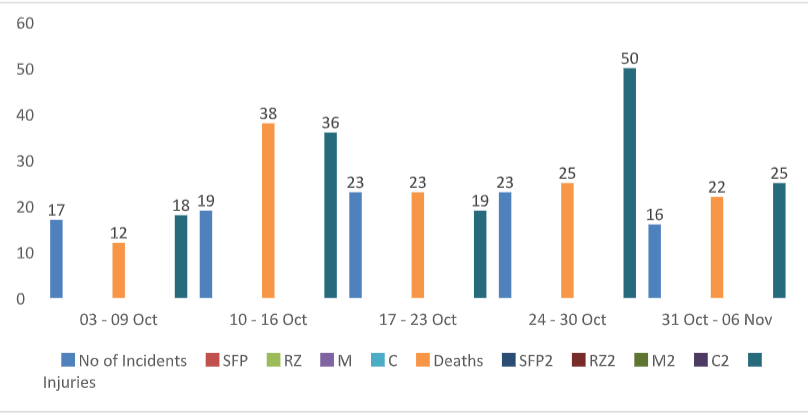
week. Despite this reduction, 22 fatalities—including seven security personnel and eight civilians—indicated that lethality remained high, though injuries dropped by half from 50 to 25. Khyber Pakhtunkhwa accounted for 10 attacks, Balochistan five, and one occurred in erstwhile FATA, suggesting a possible tactical restraint by militants as Pakistan-Afghanistan negotiations continue. The attacks mainly comprised 10 tactical assaults, four targeted killings, three IED blasts, and two grenade attacks. Security forces intensified intelligence-based operations, neutralizing 34 militants and arresting five others, with most operations concentrated in the tribal districts. The relative quietness, particularly in FATA, reflects a phase of strategic silence by the TTP, potentially aimed at preserving resources and avoiding escalatory confrontation amid ongoing diplomatic engagements.
The government’s ban on Tehreek-i-Labbaik Pakistan (TLP) has triggered a wave of defections, particularly in South and Central Punjab, as several leaders distanced themselves from the proscribed organisation over its violent actions and perceived anti-state agenda. The move follows violent protests and clashes in Muridke that prompted the federal and Punjab governments to outlaw the group and transfer control of its mosques and seminaries to moderate clerics. Analysts believe the defections may reflect both internal realisation of the state’s firm stance and possible external efforts to weaken the group from within by isolating violent elements. However, the deeper challenge lies in countering the entrenched mindset of extremism that persists beyond organisational restructuring, as authorities extend restrictions across Punjab to prevent renewed unrest.
The temporary suspension of mobile internet services in Quetta on November 1 highlighted Balochistan’s enduring security challenges and the state’s continued reliance on communication blackouts as a preventive counterterrorism measure. The move, prompted by intelligence alerts of possible unrest, disrupted daily life for residents dependent on digital connectivity and drew criticism for exacerbating public frustration and feelings of isolation. Though authorities justified the measure as necessary for public safety, critics argue that such blanket shutdowns reveal weaknesses in intelligence and crisis management capacity and risk further alienating citizens in a province already struggling with instability and underdevelopment. Political and administrative leaders in Khyber Pakhtunkhwa have intensified efforts to forge consensus on counterterrorism policy amid worsening security conditions and rising militant presence in the merged tribal districts. Dissatisfied with official briefings, the provincial assembly’s special committee on law and order decided to summon the Corps Commander Peshawar, reflecting concerns over operational coordination. The PTI-led government plans to convene an all-parties peace jirga to unite stakeholders on a collective strategy, while opposition parties urge transparency and inclusion in future operations.
The disclosure that some 4,000 militants are active in the province underscores the urgency for a coordinated, bipartisan approach, as lawmakers stress that only unified political and institutional action can restore public trust and stability. Debate over the proposed 27th Constitutional Amendment has intensified, with the PPP confirming that the government is seeking its support for sweeping constitutional changes that could re-centralize powers devolved under the 18th Amendment. The proposed reforms reportedly include creating a Constitutional Court, revising Article 243 to introduce a new military command structure, and amending provincial financial protections under the NFC Award. While coalition partners show conditional support, the PPP has drawn red lines on provincial autonomy, and opposition parties, led by PTI, have vowed to resist the move. Critics warn that the government’s haste and lack of transparency could destabilize the political landscape, turning the amendment into a flashpoint for renewed institutional friction and public mistrust. Pakistan and Afghanistan engaged in cautious dialogue in Istanbul amid mutual accusations and persistent mistrust over cross-border militancy and resource disputes. Islamabad accused Kabul of sheltering TTP militants and warned against unilateral construction of the Kunar River dam, while the Taliban countered by alleging interference from Pakistan’s military establishment. Despite establishing a joint monitoring framework for counterterrorism cooperation, progress remained limited due to Kabul’s reluctance to act against anti-Pakistan groups. The Istanbul talks, attended by senior intelligence officials from both sides, underscored fragile diplomacy constrained by frequent border clashes and deep-seated suspicion, leaving the future of bilateral engagement uncertain. Pakistan maintained deliberate silence after former US President Donald Trump’s claim that the country was conducting nuclear tests, choosing strategic restraint to avoid unnecessary confrontation and sustain deterrence ambiguity. Islamabad’s non-response serves to prevent escalation with Washington while reinforcing uncertainty about its capabilities vis-à-vis India. Pakistan has not conducted any nuclear test since 1998 and continues to adhere to its doctrine of credible minimum deterrence. Analysts note that Trump’s baseless remarks reflect the volatility of nuclear discourse, and Islamabad’s composure helps preserve stability and avoid politicization of its nuclear posture. Pakistan’s military diplomacy gained momentum through high-level engagements with the United Kingdom and Southeast Asian countries, reflecting a broader strategy to diversify defence partnerships. COAS Field Marshal Asim Munir met the UK’s Army Chief General Charles Walker to enhance bilateral cooperation and discuss regional stability, building on earlier strategic engagements in London. Meanwhile, CJCSC General Sahir Shamshad Mirza visited Brunei and Bangladesh, focusing on defence collaboration, training exchanges, and regional security coordination.
These visits signal Pakistan’s intent to strengthen institutionalized defence dialogue, project stability, and expand its strategic footprint across South and Southeast Asia. Amid worsening humanitarian conditions in Afghanistan, India has intensified its soft- power diplomacy by expanding humanitarian aid and signaling plans to reopen its Kabul embassy, positioning itself as a leading regional partner. Iran also opened a new trade route to Afghanistan, while Tajikistan warned the Taliban over border encroachments, reflecting rising regional tensions. At the same time, Afghanistan’s humanitarian crisis deepened, with millions of children suffering acute malnutrition and UN officials warning against normalizing the Taliban regime due to systematic rights violations. Despite growing international concern, the Taliban’s dismissal of UN criticism underscores its continued isolation and strained ties with the global community. suggest suitable titles that cover all the events of the week
To get access to the complete report please become a subscriber. For the details of subscription please Click Here