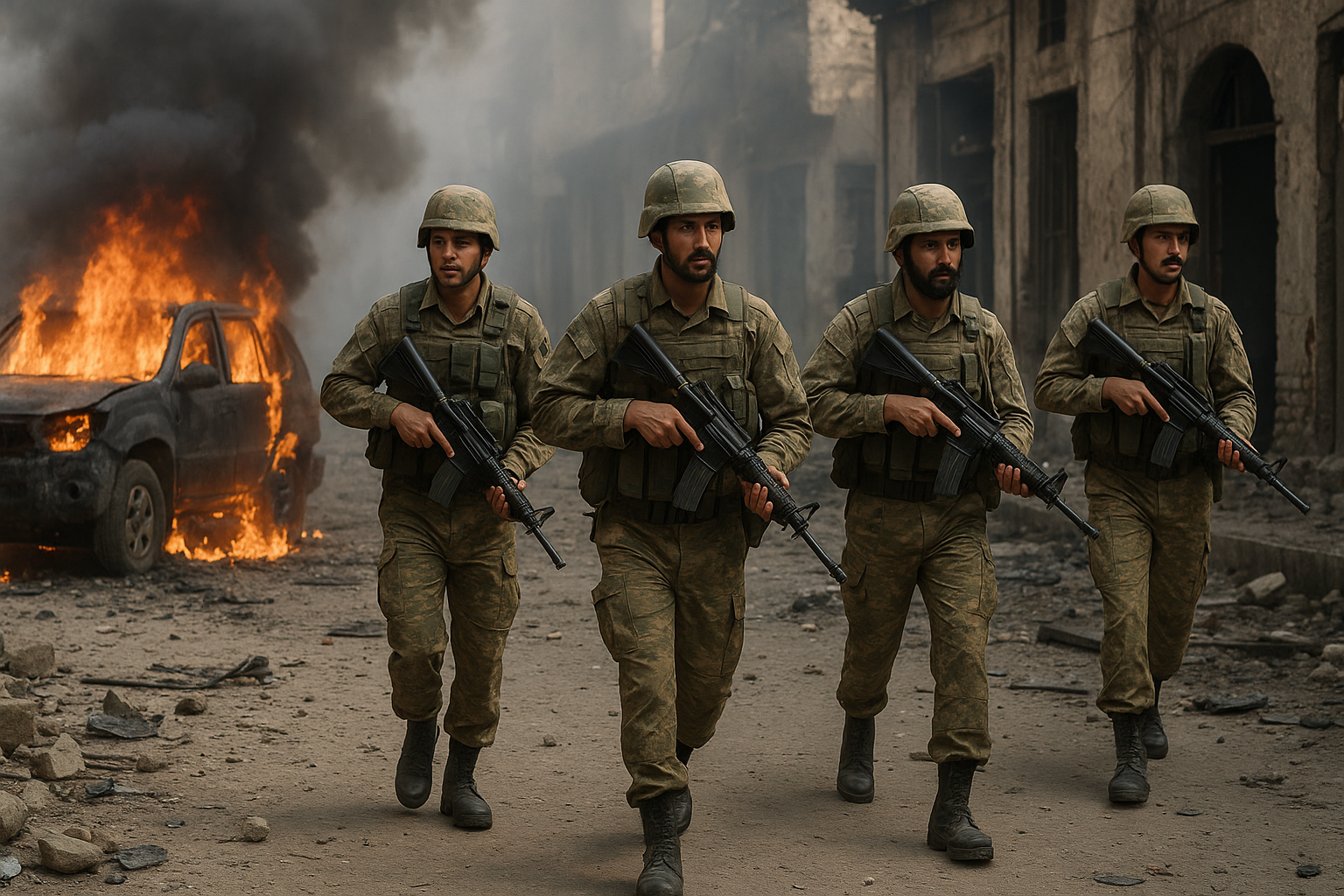
During the week of 27 June to 03 July 2025, Pakistan experienced its deadliest week in
recent months, marked by a sharp escalation in militant violence and intensified counterterrorism
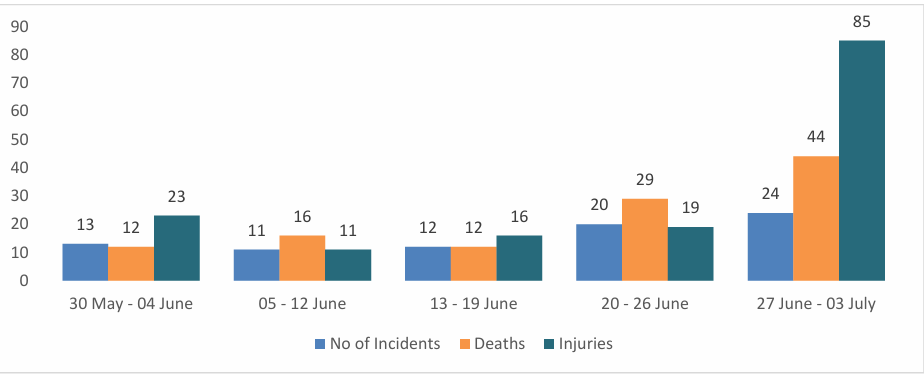
operations. A total of 24 militant attacks were recorded—a 20% increase from the previous week—
resulting in 44 fatalities (including 26 security personnel and 13 civilians) and 85 injuries. Khyber
Pakhtunkhwa (KP) remained the most affected region with 15 attacks, followed by seven in the
former FATA and two in Balochistan. The attacks included targeted shootings, IED blasts, grenade
and mortar assaults, suicide bombings, and a quadcopter strike. In response, security forces
conducted 11 operations nationwide, killing 51 militants—46 in FATA alone—and arresting three
suspects in Sindh, with no reported casualties among troops or civilians during these actions.
The continued detention of Dr Mahrang Baloch and four other Baloch Yakjehti Committee
(BYC) leaders under the Maintenance of Public Order law has drawn strong criticism from rights
groups, who view the repeated extensions—now entering a fourth term since their arrest on March
22—as unlawful and politically motivated. Despite the release of over 150 other activists detained
during a protest in Quetta, these five remain imprisoned without formal charges, prompting
accusations of constitutional violations and suppression of peaceful dissent. Meanwhile, Jamaat
e-Islami’s Balochistan chief, Maulana Hidayatur Rehman, announced a long march from Quetta
to Islamabad on July 25 to protest the federal government’s discriminatory policies. The protest’s
demands include recovery of missing persons, reopening of border trade, equitable inclusion in
CPEC, and restoration of full political rights, warning that ongoing marginalisation threatens
national unity.
Pakistan’s foreign exchange reserves crossed $14 billion by the end of FY 2024–25, driven
by Chinese loan rollovers, multilateral funding, and commercial inflows from Middle Eastern
banks. Key contributors included a $3.4 billion Chinese rollover—comprising a $2.1 billion
deposit and a refinanced $1.3 billion loan—alongside $1 billion from Gulf lenders and $500
million in multilateral assistance. The State Bank’s reserves rose by $3.66 billion in the last week
of June, bringing total national reserves to nearly $20 billion, marking a 54.5% year-on-year
increase. This reflects improved current account management, IMF-backed fiscal reforms, and
relative political stability. The rupee appreciated slightly, and the Pakistan Stock Exchange
continued its rally. While the buildup strengthens Pakistan’s economic position, sustaining it will
require further reforms and resilience against climate-related shocks such as potential monsoon
flooding.
In a significant development, the Supreme Court overturned its earlier decision allowing
PTI to claim reserved seats, disqualifying the Sunni Ittehad Council (SIC) and enabling the PML
N-led coalition to gain a two-thirds majority in the National Assembly. The Election Commission
reallocated 74 reserved seats, with PML-N, PPP, and JUI-F emerging as the main beneficiaries.
PTI condemned the ruling as a theft of public mandate, accusing the judiciary and government of
political engineering. Internally, PTI faces deepening disarray, limited coordination with Imran
Khan due to his imprisonment, and increasing support among senior leaders for dialogue with the
government—deviating from Khan’s hardline stance. While the ruling coalition has signaled
openness to talks, PTI remains skeptical. The ruling has drastically weakened PTI’s parliamentary
leverage and triggered speculation of political reconfigurations in KP, though federal authorities
are cautious about provoking instability amid growing security threatsThe Permanent Court of Arbitration (PCA) ruled in Pakistan’s favor in the Indus Waters
Treaty dispute, reaffirming its jurisdiction and rejecting India’s claim that the treaty could be
unilaterally suspended. The court upheld the treaty’s binding nature and stressed that India’s
withdrawal from arbitration had no legal effect. Pakistan challenged India’s Kishenganga and
Ratle hydroelectric projects as violations of the treaty, citing alleged water manipulation designed
to harm Pakistan. India dismissed the ruling as illegitimate, but Pakistan reaffirmed its legal and
diplomatic resolve, warning of a “quid-pro-quo-plus” strategy against provocations. Deputy Prime
Minister Ishaq Dar reiterated readiness for dialogue on all issues, including Kashmir, while Army
Chief Asim Munir condemned India’s efforts to equate the Kashmiri struggle with terrorism. The
court ruling, combined with Pakistan’s legal and diplomatic posturing, underscores Islamabad’s
commitment to defending its water rights, though meaningful bilateral engagement remains
unlikely.
Pakistan and the United States have intensified strategic and defence ties through high
level military engagements and parallel trade talks aimed at revitalizing bilateral relations. Pakistan
Air Force Chief Zaheer Ahmed Baber Sidhu concluded a landmark visit to the US—the first in
over a decade by a PAF chief—meeting senior Pentagon and State Department officials to discuss
joint training, interoperability, and technology exchange. US defence officials showed interest in
Pakistan’s asymmetric air combat capabilities, especially its successful operations during recent
tensions with India, while Pakistan sought resumption of F-16 support services. The air chief also
met with US lawmakers to discuss regional stability and defence collaboration. This visit followed
Army Chief Asim Munir’s historic engagement with former President Donald Trump, highlighting
Washington’s recalibrated approach to Pakistan’s military. A Pakistani trade delegation is also in
the US to finalize an economic deal, complementing defence diplomacy with Islamabad’s geo
economic pivot. A visit by the South African Air Force Chief to Pakistan further reflects
Islamabad’s bid to diversify international defence partnerships.
Afghanistan remains at the center of international concern as the Taliban struggle with
terrorism allegations, worsening humanitarian conditions, and the quest for broader diplomatic
legitimacy. While the Taliban deny hosting terrorist groups, U.S. Congressman Bill Huizenga and
other critics accuse them of violating the Doha Agreement and enabling groups like ISIS-K and
TTP. Despite Taliban denials, regional actors like Russia have expressed similar concerns, though
Moscow recently became the first to formally recognize the Taliban government, seeking to
enhance security cooperation and reduce reliance on Pakistan and Iran for trade. Afghanistan is
also facing a surge in returning migrants—mostly from Iran and Pakistan—which has
overwhelmed local infrastructure and triggered urgent humanitarian appeals. Taliban officials have
called for respectful, voluntary repatriation, but resources remain scarce. Meanwhile, the Islamic
Emirate has engaged in UN-led meetings and regional summits such as the ECO and the upcoming
Moscow Format, aiming to boost trade, address narcotics, and seek formal recognition. However,
without Western support and sanction relief, Afghanistan’s recovery prospects remain limited
despite expanding regional engagement.
To get access to the complete report please become a subscriber. For the details of subscription please Click Here