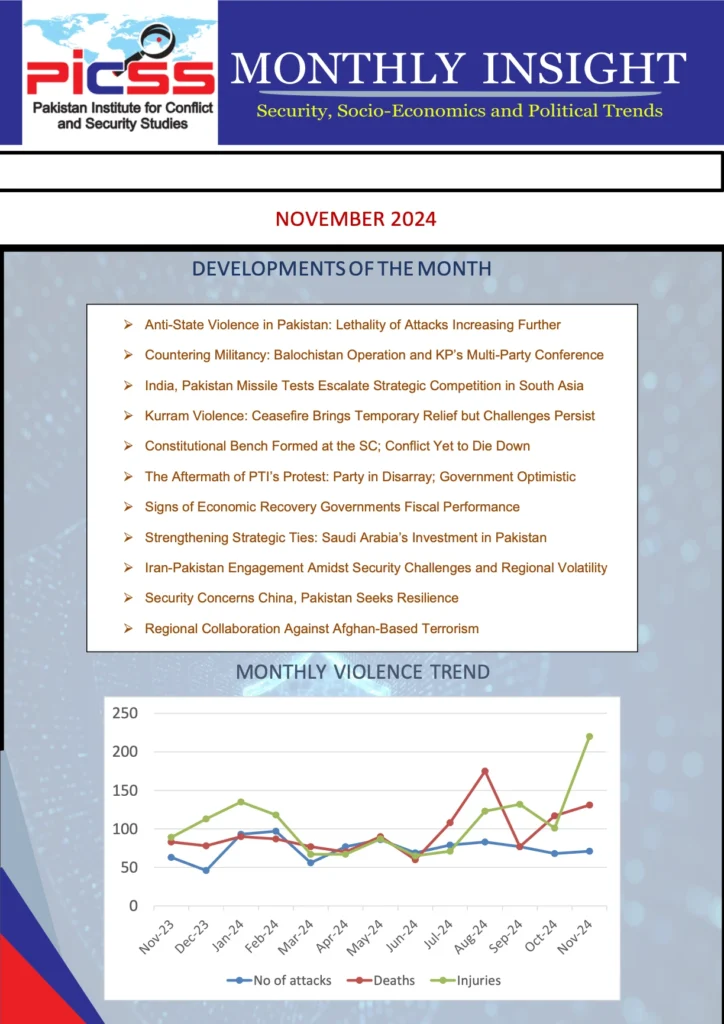
November saw an increase in militant attacks across Pakistan, with 71 incidents causing 131 deaths and 220 injuries, marking a modest 4% rise in attacks but a more significant 12% rise in fatalities and a 117% surge in injuries compared to October. Security forces suffered heavily, with 68 personnel killed, the highest monthly toll since January 2023. Overall violence claimed 245 lives, including 127 militants, 68 security personnel, and 50 civilians. Khyber Pakhtunkhwa (KP) with 50 attacks remained the most affected province with concentration of more violence in the south as well as tribal district of South Waziristan. Balochistan faced 20 attacks, resulting in 60 deaths and 135 injuries. Violence in Pakistan is primarily attributed to groups like the BLA, TTP, ISKP, and Hafiz Gul Bahaur Group.
In response, security forces intensified operations, killing 100 militants and arresting 28 suspects in 35 notable actions. KP’s tribal districts (erstwhile FATA) saw the highest militant fatalities, with 76 killed, marking the highest toll since February 2017. Balochistan and KP continued to struggle with governance and security challenges, particularly in Kurram, where sectarian violence persisted. Efforts in Punjab and Sindh focused on preventive measures, including arrests. The federal government approved a military operation in Balochistan under the National Action Plan (NAP), alongside measures like intelligence fusion centers and enhanced coordination among authorities. Communication services were suspended in affected districts to curb militant activity. In KP, a multi-party conference was planned to address resource and capacity constraints. However, no comprehensive socio-political initiatives were announced, leaving deep-rooted grievances in Balochistan unaddressed, which risks further instability.
The Pakistan Navy tested an indigenously developed ship-launched ballistic missile with a range of 350 kilometers, reflecting advancements in defense technology. Meanwhile, India’s first hypersonic missile test underscored an intensifying arms race in South Asia, posing strategic challenges to traditional defenses. These developments signal growing regional polarization, with Pakistan likely to deepen its strategic ties with China and pursue advanced countermeasures.
In Kurram, a fragile ceasefire provided temporary relief after sectarian violence that began on November 21, claiming over over 100 lives. Mediated by local officials and elders, the ceasefire allowed hostage exchanges and restored some security, though sporadic clashes persisted. Long-term peace requires impartial resolution of disputes, strengthened law enforcement, and governance reforms to address systemic issues like land disputes and sectarian divides.
Judicial reforms stirred tensions in Pakistan’s Supreme Court over the 26th Constitutional Amendment, which altered the Chief Justice selection process and enabled constitutional benches. Calls for a full court review of the amendment were declined, and aconstitutional bench was assigned to handle the matter. While this approach temporarily stabilized the judiciary, debates about transparency and the judiciary’s role continue.
PTI’s protest ended in disarray, exposing weak planning and internal divisions. Violent clashes in Islamabad led to arrests and casualties, with over 1,000 protesters detained. Internal rifts within PTI widened, leaving it struggling to recover as the government exploited the situation to maintain political stability while avoiding extreme measures like banning PTI or imposing governor rule in KP.
Pakistan’s economy showed signs of recovery with declining inflation, fiscal stability, and foreign investments. Inflation dropped to 4.9% in November, the lowest in six years, boosting investor confidence and spurring growth in key sectors. Commitments from Qatar, Azerbaijan, and Saudi Arabia totaling over $7 billion and fiscal surpluses in Q1 FY25 reinforced stability. Sustaining this progress requires addressing security risks and ensuring political stability.
Prime Minister Shehbaz Sharif’s visit to Saudi Arabia and Army Chief General Asim Munir’s subsequent trip underscored Pakistan’s focus on strengthening ties with Saudi Arabia. Saudi Arabia pledged an additional $600 million to support economic recovery, and discussions emphasized investment, trade, and military cooperation. These developments signal growing collaboration, though challenges in attracting foreign direct investment persist.
Iranian Foreign Minister Seyed Abbas Araghchi’s visit highlighted counter-terrorism and border security cooperation. Both countries condemned terrorism, expressed solidarity with Palestine, and revisited stalled projects like the Iran-Pakistan gas pipeline. Subsequent Iranian operations in its border province suggested potential joint counter-terrorism efforts,underlining shared security concerns.
Amid rising attacks on Chinese nationals, Pakistan intensified security measures for China-Pakistan Economic Corridor (CPEC) projects. High-level talks and joint exercises aimed to address Chinese concerns, with Pakistan committing to enhanced security and seeking Chinese support in technology and capacity-building. Regional partnerships with China and Russia also focused on pressing the Afghan Taliban to curb militant activity, reflecting Pakistan’s strategy to ensure regional stability while safeguarding its sovereignty.
To download complete report with fully charts and graphs please subscribe or login if you are a subscriber.