Following is just a summary. To get full detailed report contact at md@picss.net
Pakistan’s internal security environment deteriorated in 2025, marking one of the most violent years since the post–Zarb-e-Azb decline. The year was defined by a pronounced escalation in both the scale and lethality of militant violence, alongside an intensified state response. Overall violent incidents rose to 1,548, a 29 percent increase from 2024, while fatalities surged by 75 percent to 3,413. Injuries climbed by 54 percent, underscoring that violence in 2025 was not only more frequent but significantly more destructive. Militancy reasserted itself as the primary driver of insecurity, while civilians and security forces alike remained highly exposed despite expanded counter-terrorism operations
Militant attacks increased to 1,066 nationwide, resulting in 1,510 deaths and nearly 2,000 injuries. Security forces actions also expanded substantially, rising by 63 percent to 482 operations, reflecting a more kinetic counter-terrorism posture. This escalation led to an unprecedented rise in militant fatalities—2,138 militants were killed, more than double the previous year—yet losses among security personnel and civilians also increased, indicating that operational gains came at a high cost. Arrests rose sharply, suggesting improved intelligence penetration, but kidnappings surged to 215 cases, the highest level in over a decade, highlighting militants’ growing reliance on abductions for financing, coercion, and psychological impact.
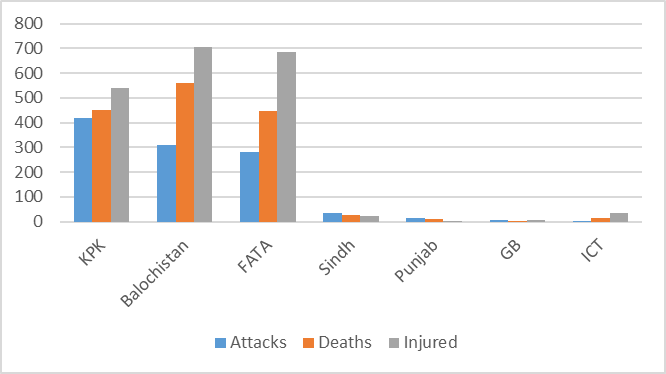
Geographically, violence remained concentrated along Pakistan’s western periphery. Mainland Khyber Pakhtunkhwa emerged once again as the epicentre of militant activity, while Balochistan recorded the highest overall casualties, reflecting the operational intensity and evolving tactics of Baloch separatist groups. The merged tribal districts (erstwhile FATA) continued to face sustained instability, demonstrating the limited success of post-merger stabilisation efforts. Although Punjab, Sindh, Gilgit-Baltistan, and Islamabad experienced comparatively fewer attacks, incidents in these regions carried disproportionate symbolic and psychological weight, reinforcing the nationwide reach of militant networks.
Tactically, 2025 witnessed significant militant adaptation. Tactical assaults became the deadliest form of violence, accounting for over half of all militant-related deaths, while suicide attacks resurged, increasingly executed as complex operations combined with armed assaults. Militants also expanded the use of commercial quadcopter drones, particularly in Khyber Pakhtunkhwa and the tribal districts, signalling a shift toward low-cost, standoff capabilities that complicate traditional security responses and disproportionately endanger civilians. IED attacks continued their upward trajectory, surpassing previous post-2016 highs and reversing gains achieved during earlier counter-terrorism campaigns. Targeted killings and grenade attacks further reinforced a climate of chronic insecurity, eroding public confidence and governance at the local level.
The militant landscape in 2025 was marked by fragmentation, competition, and tactical innovation. Islamist groups—particularly Tehreek-e-Taliban Pakistan and allied factions—sustained high operational tempo in border districts, while Baloch insurgent groups dominated violence in the south through infrastructure sabotage, high-impact assaults, and suicide operations. Sectarian outfits persisted with targeted killings, and transnational actors such as Islamic State Khorasan Province and Al-Qaeda in the Indian Subcontinent remained capable of sporadic but high-profile attacks. The banning of Liwa Zainebiyoun reflected growing state concern over sectarian militancy with external linkages, while cross-border dynamics involving Afghanistan and Iran continued to shape the threat environment.
State responses were characterised by intensified kinetic operations, expanded legal and surveillance powers, tighter border management, and a crackdown on militant use of social media. Pakistan also significantly expanded its own use of drones for surveillance and strike missions, combining indigenous capabilities with advanced Turkish systems. While these measures enhanced operational reach and reduced reliance on ground forces, incidents of civilian harm—particularly from drone strikes—triggered public backlash and raised questions about accountability, intelligence quality, and long-term effectiveness.
Beyond security metrics, the report situates militancy within a broader socio-political and economic context. Managed political calm at the national level masked deepening institutional fault lines, persistent polarisation, and governance deficits that militants continue to exploit. Economic stabilisation reduced immediate crisis pressures but failed to address structural vulnerabilities, while minority persecution, digital restrictions, and region-specific protests—especially in Balochistan, Azad Jammu and Kashmir, and Gilgit-Baltistan—highlighted unresolved grievances intersecting with security challenges.
Pakistan’s foreign relations witnessed a notable shift. While relations with India and Afghanistan deterioated, Pakistan made notable gains in its relations with other regional and international players while Pakistan also made inroads into Middle East and North Africa. Though, four-day India–Pakistan conflict was the defining external shock, it nevertheless demonstrated Pakistan defence capabilities with positive impact on Pakistan’s foreign policy outlook. Beyond India, Pakistan navigated a volatile neighbourhood: relations with Afghanistan oscillated between confrontation and conditional engagement amid persistent cross-border militancy and refugee pressures, increasingly shaped by third-party mediation; ties with Iran deepened through security coordination and quiet diplomacy during regional crises; and Islamabad adopted a more active Middle East posture, moving away from earlier restraint toward selective strategic involvement that carries both influence and risk.
Pakistan consolidated and diversified its strategic partnerships. Relations with China deepened into a tightly integrated economic–security alignment anchored in CPEC 2.0, defence modernisation, financial support, and coordinated regional diplomacy. A historic reset with Bangladesh revived defence, intelligence, and diplomatic engagement after decades of stagnation, while ties with Saudi Arabia, Türkiye, Azerbaijan, and Gulf partners expanded through defence integration, joint exercises, and investment outreach. Engagement with the United States regained momentum through counterterrorism cooperation, defence modernisation, trade, and critical minerals, while relations with Russia, the EU, and Southeast Asia reflected broader diversification. Defence diplomacy and arms exports emerged as central instruments of statecraft, positioning Pakistan as an aspiring net security provider. These shifts produced tactical diplomatic gains but also placed Pakistan in a more crowded and uncertain strategic environment heading into 2026.