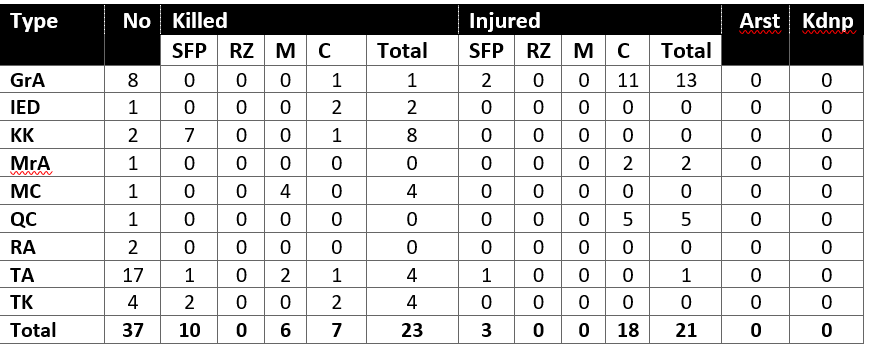
During the week under review (27 February–5 March 2026), militant violence remained widespread across Pakistan, with 37 attacks recorded compared to 31 in the previous week, indicating increased activity but lower lethality. The incidents caused 23 fatalities and 21 injuries, significantly down from 57 deaths and 42 injuries the week before, suggesting that most attacks involved small-scale assaults, grenade attacks, and targeted killings rather than mass-casualty incidents. Khyber Pakhtunkhwa recorded the highest number of attacks (18), while Balochistan saw 13 attacks but the highest fatalities (11), and the erstwhile FATA region reported six incidents resulting in seven deaths. Tactical assaults remained the most common tactic, followed by grenade attacks and targeted killings. The lower lethality may indicate temporary restraint by militant groups amid ongoing Pakistan–Afghanistan tensions, though the possibility of high-impact attacks cannot be ruled out. Meanwhile, six counterterrorism operations killed 35 militants, including 28 in a major operation in Duki district, though seven security personnel also lost their lives.
Pakistan also tightened internal security during the first week of March amid rising tensions with Afghanistan and the Middle East crisis. Security agencies were placed on high alert, a nationwide ban on drone flights was imposed following alleged cross-border drone incidents, and surveillance and snap-checking were intensified in major cities including Karachi and Rawalpindi. Authorities also increased actions against undocumented Afghan nationals while strengthening emergency preparedness in sensitive areas including Azad Jammu and Kashmir.
Meanwhile, widespread protests erupted across Pakistan on 1 March following the assassination of Iran’s Supreme Leader Ayatollah Ali Khamenei. Demonstrations in Islamabad, Karachi, Lahore and parts of Gilgit-Baltistan led to violent clashes with security forces as protesters attempted to march toward US diplomatic facilities and attacked public buildings in some cases. Security forces used tear gas, baton charges and warning shots to disperse crowds, while authorities imposed restrictions on public gatherings and deployed additional forces. Overall, the unrest resulted in at least 32 deaths and more than 100 injuries nationwide, with officials indicating that although some demonstrations reflected spontaneous public anger, organised elements were also involved.
Against this backdrop, the Sindh Apex Committee met in Karachi on 4 March to review the province’s security environment following the regional crisis and violent protests in the city. Civil and military leadership assessed progress under the National Action Plan, counterterrorism operations, and security arrangements for foreign nationals, particularly Chinese workers. Authorities directed law enforcement agencies to strengthen the writ of the state, crack down on illegal weapons, intensify operations against criminal networks, and continue the repatriation of undocumented immigrants. The meeting also approved a development plan aimed at stabilising the riverine Katcha areas through socio-economic investment.
Amid the regional tensions, Jamaat-i-Islami announced nationwide protests on 6 March to condemn US–Israel strikes on Iran and express solidarity with Tehran. Besides JI, several religious parties and civil society groups also planned demonstrations after Friday prayers in multiple cities. The expected gatherings at mosques and public spaces have raised security concerns, particularly the risk of militant groups exploiting the situation to target mosques and imambargahs in major urban centres.
At the same time, the Pakistan–Afghanistan confrontation continued to escalate following Pakistani strikes on militant hideouts inside Afghanistan on 22 February and subsequent clashes along the border. Afghan Taliban forces allegedly launched coordinated attacks on dozens of border positions, prompting Pakistan to initiate Operation Ghazab lil-Haq, involving cross-border strikes on Taliban military installations and militant infrastructure. Both sides issued competing casualty claims while expanding military operations across several provinces. Despite mediation attempts by China, Saudi Arabia, Qatar and Türkiye, clashes continued into early March, with Pakistan maintaining that its operations targeted militant networks operating from Afghan territory.
Parallel to the border crisis, Pakistan intensified diplomatic efforts to reduce tensions in the Middle East following US and Israeli strikes on Iran and subsequent Iranian retaliation against Gulf countries hosting US bases. Islamabad condemned the attacks on Iran at the United Nations while also expressing solidarity with Gulf states affected by the escalation, urging restraint and dialogue. Pakistani leaders engaged regional counterparts to encourage de-escalation, noting that instability in the Gulf directly affects Pakistan due to its strategic partnerships and the presence of millions of expatriate workers in the region.
The crisis has placed Pakistan in a difficult strategic position, as it seeks to balance relations with both Iran and Gulf allies, particularly Saudi Arabia. Policymakers fear that a wider regional war could have serious economic, geopolitical and security consequences, especially given Pakistan’s defence cooperation with Saudi Arabia and the possibility of Iranian strikes on US bases located in Gulf countries.
Amid concerns over disruptions to maritime energy routes following the closure of the Strait of Hormuz, Pakistan has begun exploring alternative oil supply routes. Islamabad requested Saudi Arabia to facilitate crude shipments through the Red Sea port of Yanbu while also considering imports through the United Arab Emirates. Authorities have reviewed petroleum reserves and initiated contingency planning and conservation measures to manage potential supply disruptions and rising global oil prices.
Pakistan also reaffirmed its commitment to protecting Chinese nationals and investments during a meeting between Prime Minister Shehbaz Sharif and Chinese Ambassador Jiang Zaidong. Both sides discussed regional developments and agreed to maintain close coordination to promote stability and advance economic cooperation, particularly under the China–Pakistan Economic Corridor. China simultaneously expressed concern over the Pakistan–Afghanistan confrontation and called for restraint and dialogue, signalling its willingness to play a constructive role in easing tensions given its strategic interests and investments in the region.
To get access to the complete report, please become a subscriber. For the details of subscription click here