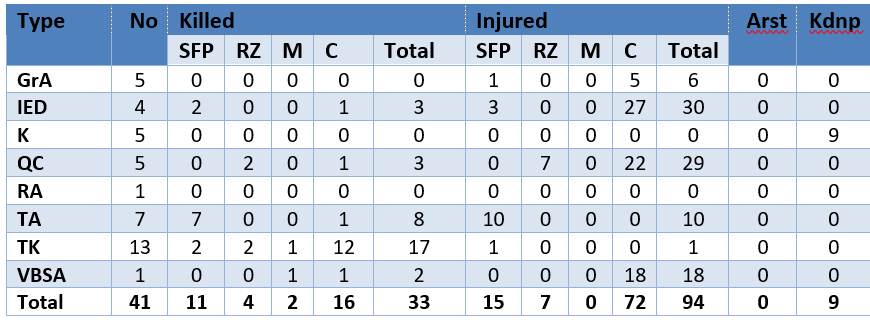
During the week 6–12 March 2026, militant violence in Pakistan increased in both frequency and intensity, with 41 attacks recorded nationwide compared to 37 in the previous week. The human toll also rose, with 33 people killed and 94 injured, up from 23 fatalities and 21 injuries earlier, indicating greater reliance on explosive devices, which typically produce higher numbers of wounded. Balochistan remained the most affected province with 17 attacks, followed by Khyber Pakhtunkhwa (14) and the former FATA region (10), the latter recording the highest number of casualties. Targeted killings remained the most common and deadliest tactic, while IED attacks and quadcopter-based strikes caused a disproportionately high number of injuries, reflecting militants’ increasing use of explosive and drone-enabled tactics. The rise in violence suggests that the earlier lull in attacks was temporary, with militant groups maintaining operational momentum amid TTP’s newly announced “Khyber” offensive, continuing Pakistan–Afghanistan tensions, and broader regional instability linked to the war in Iran, which may further encourage attempts at high-impact attacks, including in urban centres. During the same period, security forces conducted 17 counterterrorism operations, killing 28 militants, injuring eight, and arresting five, primarily in Khyber Pakhtunkhwa and Balochistan, as part of ongoing efforts to disrupt militant networks.
An anti-terrorism court (ATC) in Rawalpindi sentenced 47 proclaimed offenders, including several senior Pakistan Tehreek-i-Insaf (PTI) leaders, to 10 years in prison for their alleged role in the 9 May 2023 attack on the General Headquarters (GHQ) during nationwide protests that followed the arrest of former prime minister Imran Khan. The court found that the accused had planned and encouraged acts of vandalism, arson, and attacks on state installations, relying largely on findings from a Joint Investigation Team. PTI condemned the verdict as politically motivated and part of a broader campaign against the party. Meanwhile, the Islamabad High Court ordered the formation of a medical board to examine Imran Khan’s health, raising speculation that judicial avenues may be used to provide some relief to the jailed PTI leader.
Authorities in Gilgit-Baltistan lifted the curfew in Skardu after 11 days of unrest that followed protests triggered by the assassination of Iran’s Supreme Leader Ayatollah Ali Khamenei during US-Israeli strikes on Iran. The clashes between protesters and security forces had left more than 20 people dead, including three security personnel. With the security situation improving, communication services and flight operations have resumed, although Section 144 remains in place, banning public gatherings while security checkpoints continue to operate across the city. Officials are also engaging religious leaders to maintain calm, though regional tensions linked to developments in the Middle East may continue to influence stability in the sensitive Gilgit-Baltistan region.
The escalating US-Israel conflict with Iran has triggered an economic shock in Pakistan, exposing the country’s vulnerability to global energy disruptions. The government announced a historic Rs55 per litre increase in petrol and diesel prices, the largest in Pakistan’s history, amid surging global oil prices and concerns about supply disruptions through the Strait of Hormuz, a key route for Pakistan’s energy imports. Rising fuel prices are expected to increase inflation, particularly food prices, while negotiations with the IMF over the $7 billion Extended Fund Facility remain inconclusive, adding further uncertainty. In response, the government has introduced austerity measures, including reduced fuel usage, limited official travel, work-from-home policies, and salary cuts for officials, though these steps may also slow economic activity as Pakistan struggles to manage the economic fallout of the Middle East conflict.
Amid the growing Middle East crisis, Pakistan is attempting to maintain a delicate diplomatic balance between Iran and the Gulf states, particularly Saudi Arabia, while advocating de-escalation and dialogue. Islamabad has engaged in diplomatic outreach with multiple regional actors, including discussions between Prime Minister Shehbaz Sharif and Iranian and Saudi leaders, while military consultations have also taken place under the Pakistan–Saudi defence cooperation framework. Pakistan has simultaneously supported diplomatic initiatives at the United Nations Security Council aimed at curbing violence and restoring negotiations. The crisis has direct implications for Pakistan due to its large diaspora in Gulf countries, reliance on Gulf energy supplies, and potential disruption of trade routes, making Islamabad’s diplomatic balancing act increasingly complex as it seeks to avoid alienating either Tehran or its Gulf partners.
Relations between Pakistan and Afghanistan remain tense amid cross-border clashes, diplomatic exchanges, and competing narratives over militant activity. A delegation of Pakistani religious scholars reportedly visited Kabul for discussions with Taliban officials, possibly reflecting informal back-channel diplomacy alongside Pakistan’s ongoing military pressure on militant groups operating from Afghan territory. At the UN Security Council, Pakistan defended its cross-border strikes as legitimate counterterrorism operations while accusing India of supporting militant groups such as the TTP and BLA. Afghan officials, meanwhile, condemned Pakistan’s strikes as violations of sovereignty and reiterated that the Durand Line remains disputed, while Taliban leaders warned that further attacks could escalate tensions. Despite mediation efforts by regional actors including China and Malaysia, reports of renewed Pakistani airstrikes inside Afghanistan suggest Islamabad intends to continue its offensive strategy unless militant attacks from Afghan soil cease.
In response to growing regional security concerns and potential disruption to maritime trade routes, the Pakistan Navy launched Operation Muhafizul Bahr to safeguard national shipping and energy supply lines. The operation involves naval vessels escorting merchant ships in coordination with the Pakistan National Shipping Corporation, reflecting the importance of maritime routes through which around 90 percent of Pakistan’s trade is conducted. While initial media speculation suggested the operation might be linked to the escalating Middle East conflict and Iranian actions near the Strait of Hormuz, it is now believed that the navy’s immediate focus is securing shipping routes connected to the Red Sea and regional sea lanes, ensuring the safe movement of commercial vessels amid rising regional instability.
To get access to the complete report, please become a subscriber. For the details of subscription click here