

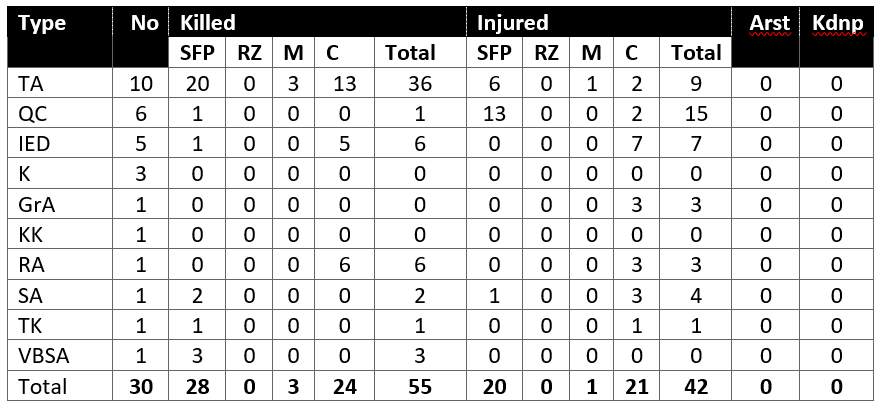
During 20–26 February 2026, militant violence escalated sharply, with 31 attacks nationwide causing 57 fatalities and 42 injuries — a notable rise from the previous week. The period saw another suicide attack and the entry of IMP as an additional militant actor. Khyber Pakhtunkhwa recorded the highest number of attacks (12), while Balochistan was the deadliest with 24 fatalities, mostly civilians; erstwhile FATA and Punjab also witnessed major incidents, including a suicide bombing at the KP–Punjab boundary. Tactical assaults were the most lethal, and increased quadcopter use in KP reflected evolving militant tactics. Security forces conducted 15 operations, killing 77 militants, but the geographic spread of violence underscores continued militant adaptability and operational reach.
Residents in Bajaur announced a social boycott of three villages in Mamond for allegedly sheltering facilitators of the Malangi check post suicide attack. Authorities identified key suspects linked to Fitna al-Khawarij and announced a Rs50 million bounty for information leading to their capture. The provincial government pledged strict action against facilitators, reflecting both intensified state pressure and growing community-level resistance to militant support networks.
Investigations into the February 6 Islamabad Imambargah bombing uncovered a sophisticated IS-K network with deep operational roots. Security forces killed a key commander in Nowshera and linked the group to multiple high-profile attacks nationwide. Authorities highlighted its mobility, cross-border links, cryptocurrency financing, encrypted communications, and the logistical role of women. Intelligence assessments now view IS-K as potentially more complex and lethal than TTP due to its structure and capacity for mass-casualty attacks.
Amid rising terror incidents, federal and provincial authorities agreed on a coordinated strategy to strengthen security, particularly in KP and Balochistan. The Centre assured provinces of resources and technical support, emphasizing unified threat assessment and response. Officials linked recent attacks to cross-border networks and reaffirmed that Pakistan would decisively counter terrorism in what they described as a highly challenging security environment.
The government signaled readiness for dialogue with the opposition under the Charter of Democracy, and the TTAP alliance responded positively. However, the opposition made talks conditional on granting Imran Khan access to his family and doctors, warning that negligence over his health could intensify political tensions. It also raised concerns over terrorism, economic decline, and regional instability, framing dialogue as dependent on transparency and political relief.
Pakistan’s poverty rate has risen to 29 percent, with nearly 70 million people below the poverty line, while inequality and unemployment have reached multi-decade highs. Real incomes have declined due to inflation and IMF-backed stabilization measures. Although the government remains confident about securing the next IMF tranche and highlights improving fiscal indicators, heavy reliance on external financing and mounting social pressures underscore the need for employment-driven growth and export expansion.
Pakistan–Afghanistan relations deteriorated sharply after Pakistan carried out airstrikes on alleged militant camps inside Afghanistan, prompting diplomatic protests, border clashes, and retaliatory military operations on both sides. Islamabad asserted that the strikes targeted cross-border terror infrastructure linked to TTP and ISKP, while Afghan authorities accused Pakistan of violating sovereignty and causing civilian casualties. Escalation intensified with exchanges of fire along multiple border sectors and Pakistan’s launch of Operation Ghazab lil-Haq, including airstrikes on Afghan military-linked targets. While both sides claimed significant casualties, the crisis highlighted the risks of conventional escalation, the persistent issue of militant safe havens, and the urgent need for structured dialogue, potentially facilitated by regional actors, to prevent further destabilization.
Pakistan voiced concern over expanding India–Israel defence ties, warning of implications for regional stability. Islamabad said it was monitoring defence cooperation closely and remained prepared to defend its sovereignty. It rejected Indian criticism of its Afghan strikes and accused New Delhi of backing proxy groups, reflecting heightened security sensitivities along both eastern and western fronts.
High-level engagements between Pakistan and Qatar aimed to deepen cooperation in trade, investment, energy, defence, and labour sectors. During Prime Minister Shehbaz Sharif’s visit to Doha, both sides agreed to strengthen economic ties through structured mechanisms and expand private-sector engagement. Regional issues, including Gaza and Afghanistan, were also discussed, reflecting efforts to convert strong political ties into tangible economic and strategic gains.
Pakistan and Bangladesh moved toward renewed engagement following Bangladesh’s political transition and the BNP’s election victory. Both sides agreed to expand cooperation across economic and diplomatic domains, building on recent agreements. The leadership change in Dhaka has opened space for recalibrating ties after years of strain, with both countries signaling intent to institutionalize forward-looking cooperation, though regional dynamics will shape the trajectory.
On 24 February 2026, Interior Minister Syed Mohsin Raza Naqvi led Pakistan’s delegation to the inaugural Quadrilateral for Migration (Q4M) dialogue in Rome with Italy, Spain, and Greece, launching a structured platform on migration cooperation. He highlighted Pakistan’s efforts against human trafficking, noting a 47% drop in irregular sea arrivals in 2025, and emphasized expanding legal migration pathways, including the Pakistan–Italy labour mobility MoU offering 10,500 job opportunities. The forum focused on linking regular employment opportunities with stronger action against illegal migration flows.